
The 2026 Declaration of Independence Quarter is the third of five one-year Semiquincentennial quarter designs created for the United States’ 250th anniversary. Its obverse features Thomas Jefferson, principal author of the Declaration of Independence and third President of the United States, while the reverse depicts the Liberty Bell ringing. Together, those two designs turn a circulating quarter into a compact story about authorship, public proclamation, independence, and the difficult birth of a new nation.
For collectors, the 2026 Declaration of Independence Quarter is more complicated than a single Philadelphia-and-Denver circulation issue. The design also appears on a 250,000-coin “July 4” privy release intentionally struck without a mint mark and randomly distributed into circulation, on a San Francisco Silver Proof, and on an entirely separate group of only 250 oversized 2.5-ounce silver quarters struck at Philadelphia on July 4, 2026. Those formats share a historical theme, but they should never be treated as the same collectible.
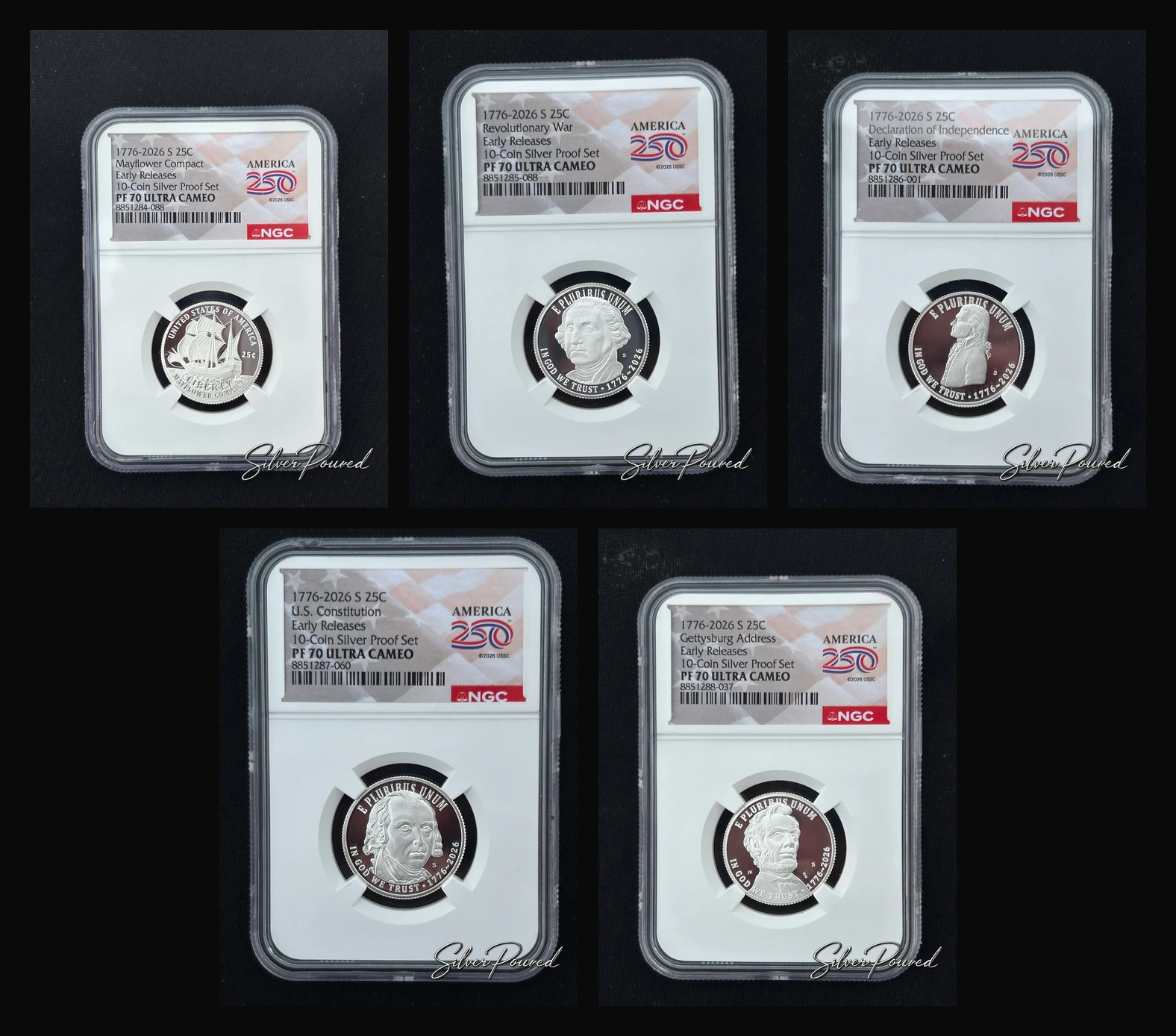
2026 Declaration of Independence Quarter Quick Facts
| Program | 2026 United States Semiquincentennial Quarters |
| Sequence | Third of five 2026 quarter designs |
| Obverse | Thomas Jefferson |
| Reverse | Liberty Bell |
| Regular circulation mints | Philadelphia and Denver |
| Regular composition | 8.33% nickel, balance copper |
| Regular weight | 5.670 grams |
| Diameter | 24.26 mm |
| Edge | Reeded |
| Federal Reserve shipping began | June 1, 2026 |
| Special circulation privy | 250,000 coins, “July 4” privy, no mint mark |
| Oversized silver issue | 250 pieces, 2.5 ounces, edge numbered 1–250 |
| Silver Proof | San Francisco, 99.9% fine silver, 0.199 troy ounce silver fine weight |
The most important rule when evaluating a 2026 Declaration of Independence Quarter is to identify the exact issue before discussing rarity, value, grading, or errors. A normal P or D circulation strike, a no-mint-mark July 4 privy coin, a Silver Proof, and one of the 250 oversized silver pieces belong to different production and collector categories.
Why the 2026 Declaration of Independence Quarter Matters
The 2026 Declaration of Independence Quarter commemorates more than the familiar date 1776. It represents the political break in which the Continental Congress moved from resistance against British policy toward a formal claim that the colonies were free and independent states. That history gives the coin unusual educational depth for a circulating denomination.
The five-quarter Semiquincentennial sequence places the 2026 Declaration of Independence Quarter between the Revolutionary War design and the U.S. Constitution design. That position is historically meaningful. Military resistance alone did not explain why a new nation claimed legitimacy, and independence alone did not create the permanent governmental framework that followed. The Declaration serves as the political bridge between revolution and constitution-making.
The broader 2026 program also makes the coin useful as a teaching object. A collector can begin with Jefferson’s portrait, move to the drafting and adoption of the Declaration, examine the Liberty Bell as a symbol of public proclamation, and then follow the story into later constitutional government. In that sense, the 2026 Declaration of Independence Quarter functions as both money and a miniature historical document.
How the Declaration of Independence Was Created
Understanding the history behind the 2026 Declaration of Independence Quarter requires separating several dates that are often compressed into a single July 4 story. On June 7, 1776, Virginia delegate Richard Henry Lee introduced a resolution calling for the colonies to be free and independent states. Congress then appointed a five-man committee to prepare a declaration explaining the case for separation.
The Committee of Five consisted of Thomas Jefferson, John Adams, Benjamin Franklin, Roger Sherman, and Robert R. Livingston. Jefferson prepared the principal draft. Adams and Franklin reviewed the text and suggested revisions before Congress considered it, debated it, and made further changes.
Congress voted for independence on July 2, 1776. The Declaration was adopted on July 4. A public reading took place in Philadelphia on July 8. Congress ordered an engrossed parchment copy on July 19, and most delegates began signing that engrossed document on August 2. Eventually 56 delegates signed. Those distinctions are essential to a historically accurate reading of the 2026 Declaration of Independence Quarter.
July 4 is the date Congress adopted the Declaration, but the independence vote occurred July 2 and most delegates signed the engrossed parchment beginning August 2. Keeping those events separate prevents one of the most common historical errors surrounding the Declaration.

Thomas Jefferson on the Obverse
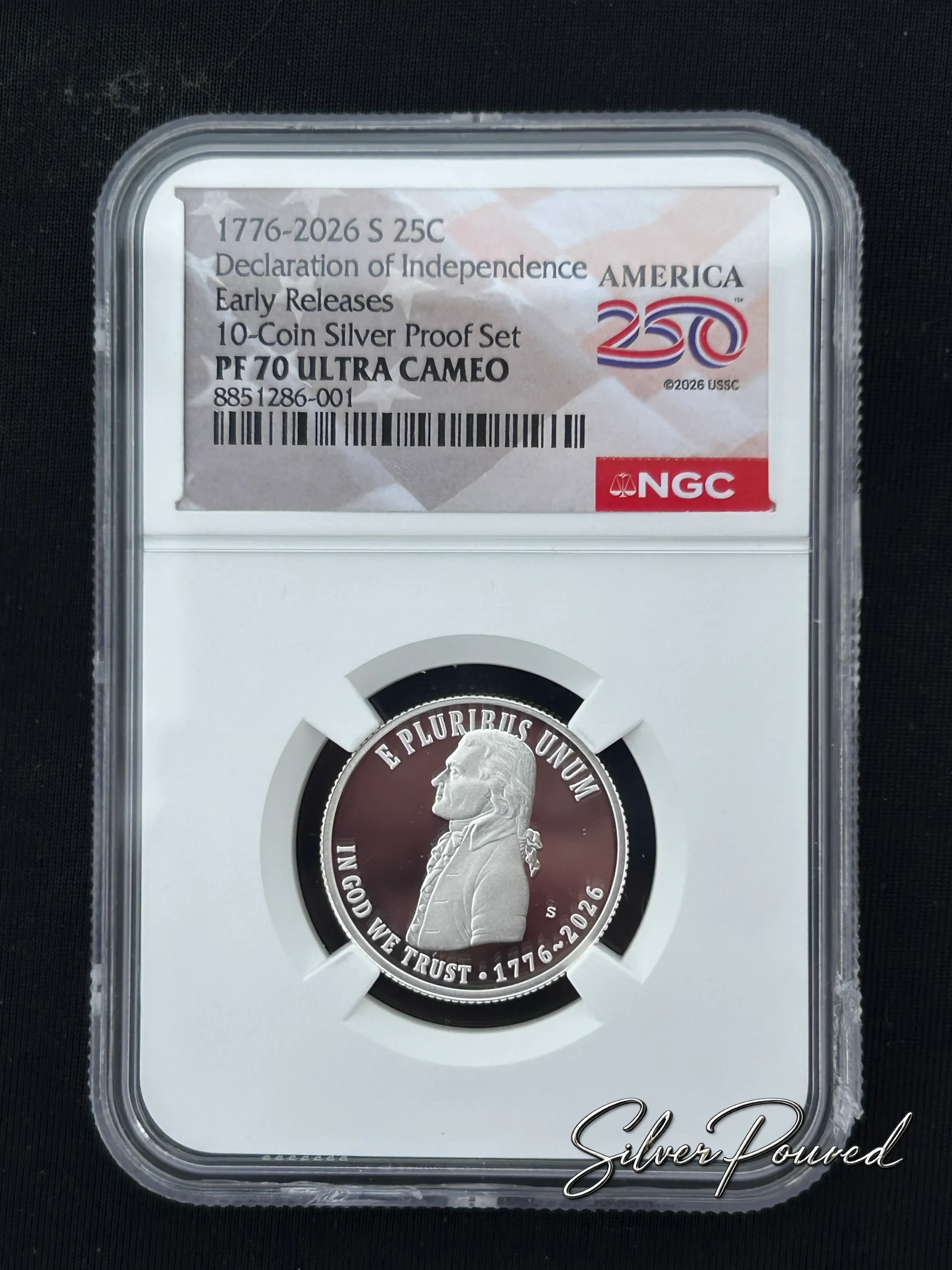
The obverse of the 2026 Declaration of Independence Quarter features Thomas Jefferson. The choice is direct rather than symbolic: Jefferson prepared the principal draft of the Declaration and later became the third President of the United States. The obverse inscriptions are E PLURIBUS UNUM, IN GOD WE TRUST, and the dual anniversary dates 1776 ~ 2026.
Jefferson’s portrait also distinguishes the 2026 Declaration of Independence Quarter from ordinary modern quarters that collectors associate with George Washington. For the Semiquincentennial program, the Mint changed the obverse portrait to match each historical subject, allowing a collector to identify the theme before turning the coin over.
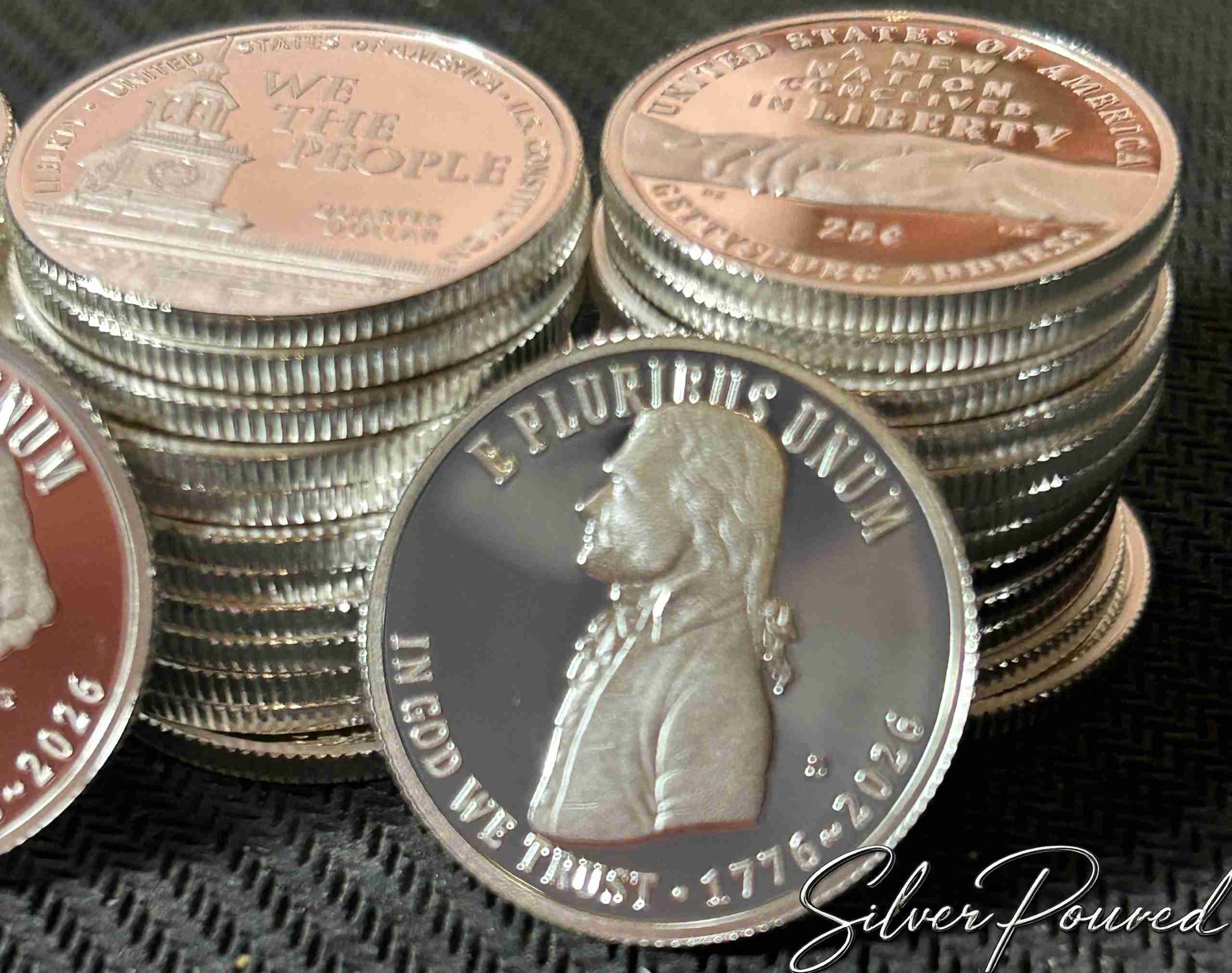
The obverse should not be given an artist attribution unless current United States Mint documentation establishes one. The available Mint Semiquincentennial material identifies the Declaration reverse designer and sculptor, while the obverse artist is not identified in the same way. For an authority page, leaving an unverified attribution unstated is more accurate than filling the gap from another coin or secondary source.
Liberty Bell Reverse Design
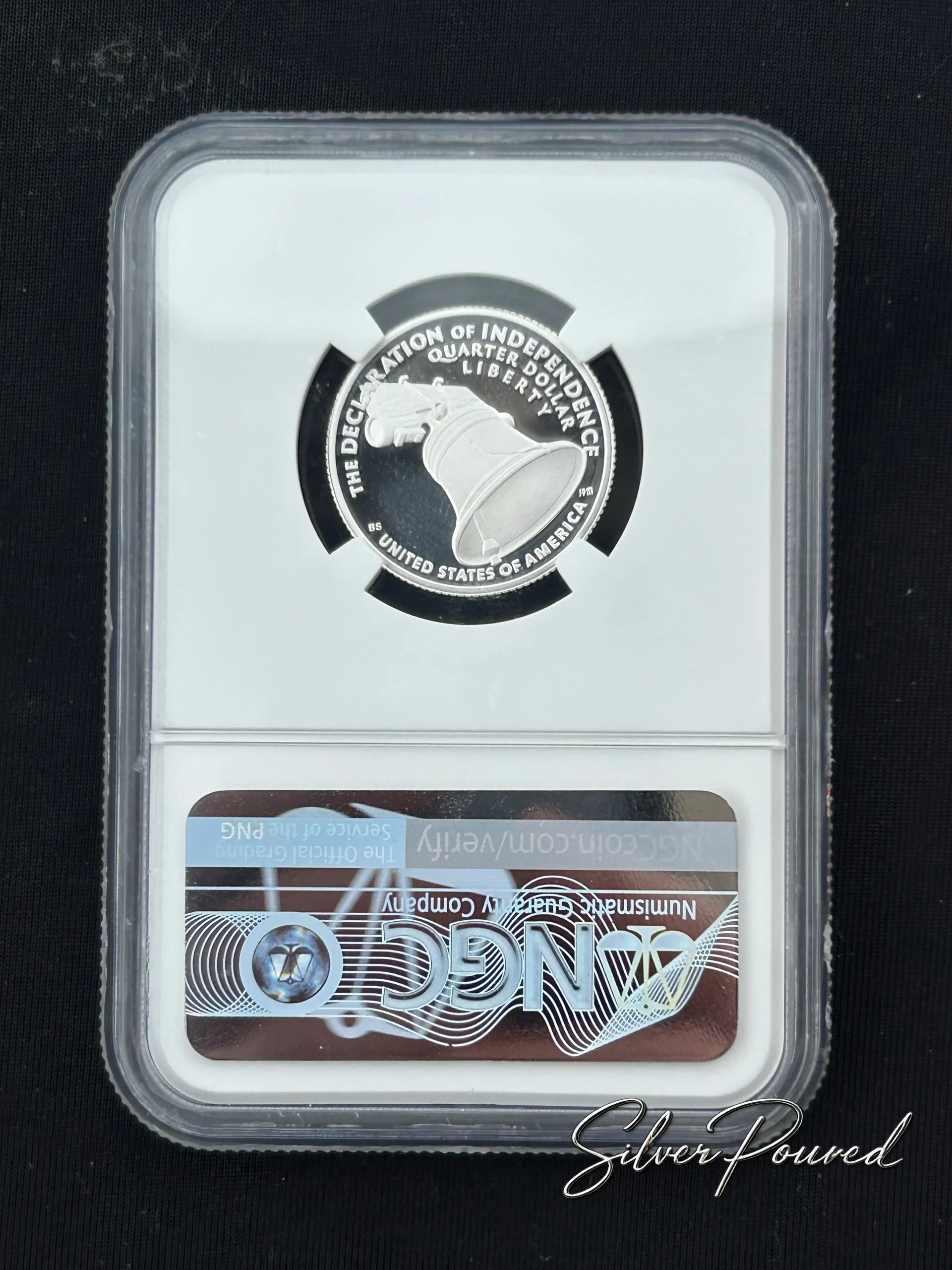
The reverse of the 2026 Declaration of Independence Quarter depicts the Liberty Bell ringing. The inscriptions are THE DECLARATION OF INDEPENDENCE, QUARTER DOLLAR, LIBERTY, and UNITED STATES OF AMERICA. The United States Mint identifies Benjamin Sowards as the reverse designer and John P. McGraw as the sculptor.
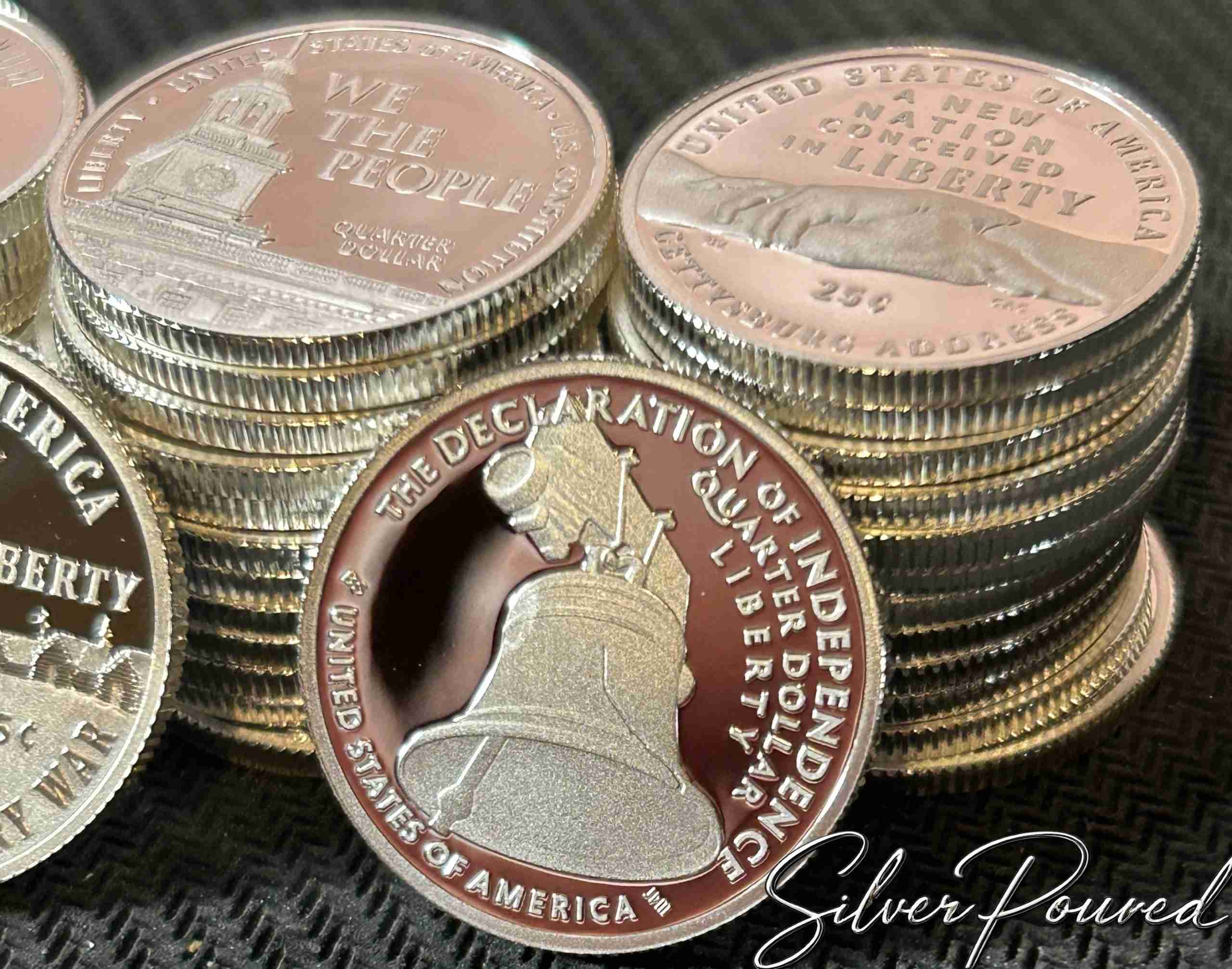
The visible crack gives the Bell another layer of meaning. In the Mint’s own explanation, the Bell’s fragility echoes the fragility of the young nation at its founding. That interpretation makes the reverse more than a generic Philadelphia landmark. It connects the uncertainty of independence with an object that later became one of the country’s best-known symbols of liberty.
Did the Liberty Bell Ring on July 4, 1776?
The 2026 Declaration of Independence Quarter shows the Liberty Bell ringing, but the design should not be used as documentary proof that the Bell definitely rang on July 4, 1776. The United States Mint itself states that it is unclear whether the Liberty Bell rang in July 1776.
Bells were used to draw people together for announcements, and the Liberty Bell therefore works naturally as a symbol of declaration and public communication. The documented public reading of the Declaration in Philadelphia occurred on July 8. The strongest historical interpretation of the reverse is symbolism: proclamation, liberty, Philadelphia, and the national memory surrounding independence.
The ringing Liberty Bell is powerful imagery, but it is not proof of a specific July 4 ringing event. The Mint explicitly notes the uncertainty. Treating the Bell as a symbol of proclamation and liberty preserves both the design’s meaning and the historical record.
Philadelphia and Denver Circulation Quarters
Regular circulating versions of the 2026 Declaration of Independence Quarter were produced at Philadelphia and Denver. These standard issues carry the appropriate P or D mint mark and should not be confused with the special July 4 privy coins that were intentionally produced without a mint mark.
The United States Mint announced that shipments of the Declaration design to the Federal Reserve would begin June 1, 2026. From there, the coins moved through commercial banks and financial institutions into general circulation. The regular clad 2026 Declaration of Independence Quarter weighs 5.670 grams, measures 24.26 mm in diameter, has a reeded edge, and uses a composition of 8.33% nickel with the balance copper.
For circulation hunters, the mint mark is the first useful diagnostic. A normal P or D quarter without a July 4 privy is not incomplete and is not an error. It is the standard circulating form of the design. Condition then becomes a separate question because contact marks, wear, scratches, discoloration, and other circulation effects can quickly separate a saved high-grade coin from an ordinary pocket-change example.
2026 Declaration Quarter Rolls and Bags
Collectors could also acquire regular circulating-quality 2026 Declaration of Independence Quarter coins through official Mint rolls and bags rather than waiting to find them individually in change. The Mint offered 100-coin Philadelphia bags, 100-coin Denver bags, and an 80-coin two-roll P/D set.
Those product quantities must not be confused with total circulation mintage. A roll or bag program is a sales and distribution format. It does not automatically establish how many regular P or D quarters were produced for circulation, and it has no relationship to the separately announced 250,000-piece July 4 privy quantity.
250,000 July 4 Privy Circulation Quarters
The special circulation version of the 2026 Declaration of Independence Quarter created one of the biggest coin-hunt stories of the Semiquincentennial year. On June 23, 2026, the United States Mint announced that it would produce exactly 250,000 Declaration quarters carrying a special “July 4” privy mark.
These coins bear no mint mark. That absence is intentional. Rather than selling the entire special issue as a conventional collector product, the Mint randomly mixed the coins into bulk circulation material and distributed them through the Federal Reserve system to banks and financial institutions nationwide. The result was a genuine nationwide search in ordinary transactions, bank rolls, and change.
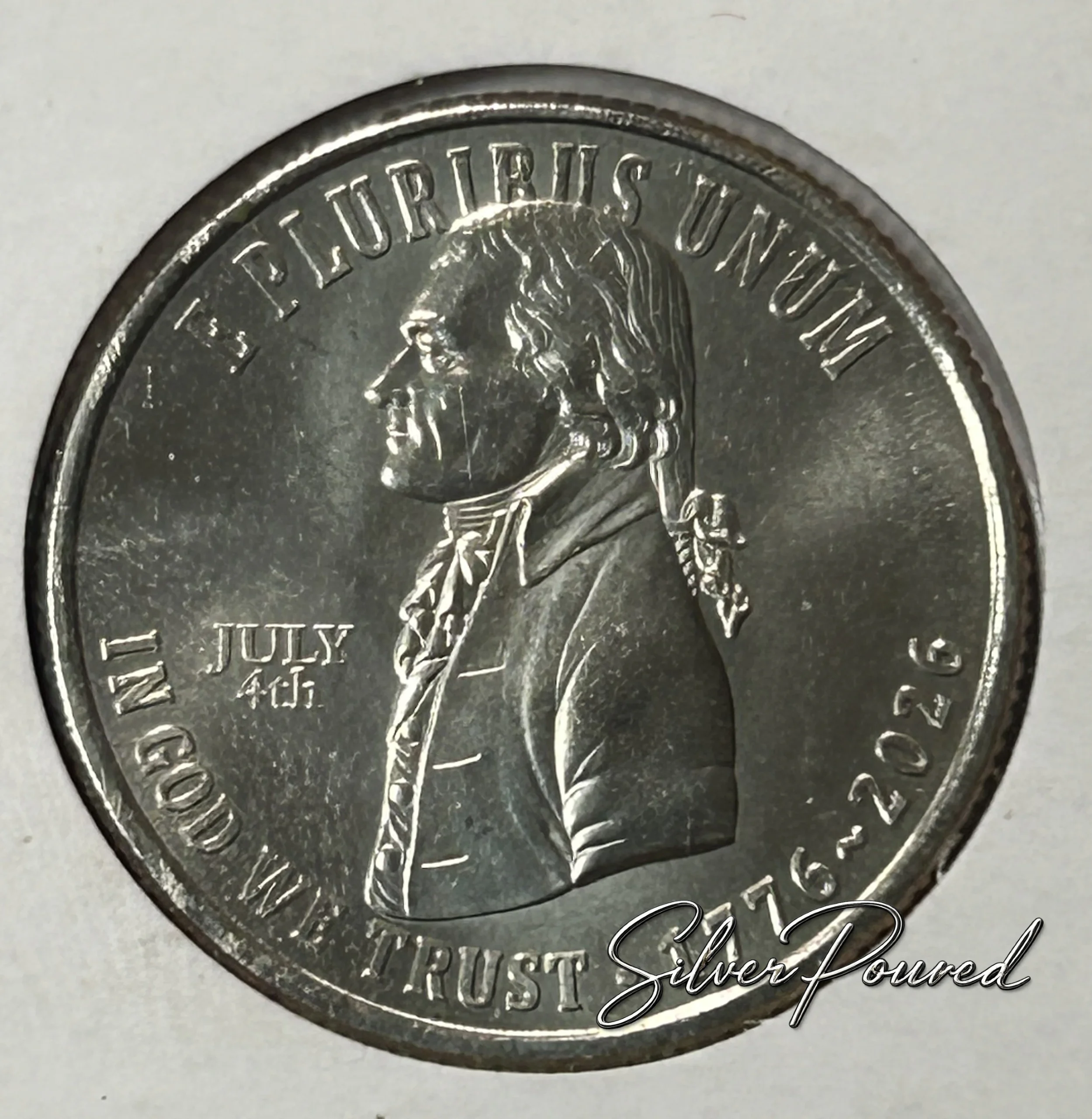
The 250,000-piece production figure gives collectors a firm starting point for discussing the special 2026 Declaration of Independence Quarter, but it does not answer every rarity question. Production quantity is not the same as surviving population, certified population, top-grade population, or the number of examples still undiscovered in circulation.
Why the Missing Mint Mark Is Not an Error
A correct July 4 privy 2026 Declaration of Independence Quarter with no mint mark is not a missing-mint-mark error. The Mint intentionally produced the special circulation coins that way. Likewise, an ordinary P or D Declaration quarter without the special privy is normal. Collectors should evaluate the complete combination of features before deciding that a coin is abnormal.
No mint mark plus the correct July 4 privy is an intentional official issue, not an error. The 250,000 special circulation quarters were made without a mint mark and released nationwide. Identify the issue first; evaluate possible errors second.
How Rare Is the July 4 Privy Quarter?
The Mint production quantity for the July 4 privy 2026 Declaration of Independence Quarter is exactly 250,000 coins. That is a limited population compared with ordinary circulation production, but collectors should resist turning the number into a guaranteed market value.
Because the special coins were deliberately circulated, condition may eventually matter as much as the headline quantity. Some examples were saved quickly. Others will accumulate wear, contact marks, scratches, discoloration, or environmental damage. Some may remain undiscovered in rolls or ordinary commerce for years. A fixed production number can therefore develop a much smaller population at exceptionally high grades without making every circulated example equally rare.
Certification adds another layer. A grading-service population report reflects coins submitted and certified, not every surviving coin. The number can increase as more examples are found and submitted. Any value discussion for a July 4 2026 Declaration of Independence Quarter should therefore separate original production, surviving condition, certification population, and actual market demand.
250-Piece 2.5-Ounce Silver July 4 Issue
The Declaration quarter also exists in an extraordinary oversized silver format that must be kept completely separate from the 250,000 circulation privies. On July 4, 2026, the United States Mint at Philadelphia struck only 250 2.5-ounce silver Declaration quarters.
These 250 pieces carry the special July 4 privy, bear no mint mark, and were struck sequentially with edge numbers 1 through 250. The defining numbers are therefore easy to remember but easy to confuse: 250,000 circulation privy quarters versus 250 oversized 2.5-ounce silver quarters.
The two issues share the same Declaration theme and July 4 association, but they differ radically in physical format, production quantity, distribution, and collector intent. A description that merely says “rare July 4 2026 Declaration of Independence Quarter” is not precise enough when the distinction can mean the difference between a circulation find and one of only 250 numbered oversized silver pieces.
Two July 4 issues exist: 250,000 special circulation quarters and 250 oversized 2.5-ounce silver quarters. The oversized pieces were struck at Philadelphia on July 4 and edge-numbered 1 through 250. Similar privy imagery does not make the two issues interchangeable.
The public Mint announcement verifies the 2.5-ounce silver weight, 250-piece production, Philadelphia striking, no-mint-mark format, July 4 privy, and sequential numbering. Specifications not established by current primary Mint documentation should not be borrowed from the standard Silver Proof or inferred from the circulating quarter.
2026 Declaration of Independence Quarter Silver Proof
The Silver Proof 2026 Declaration of Independence Quarter provides the same Jefferson-and-Liberty-Bell design in a premium collector format. It was produced at San Francisco with an S mint mark as part of the 2026 Semiquincentennial Silver Proof Set.
The quarter is struck in 99.9% fine silver and contains 0.199 troy ounce of silver. It measures 24.26 mm in diameter and has a reeded edge. The 2026 Silver Proof Set contains ten Proof coins, and the dime, five quarters, and half dollar are struck in 99.9% fine silver.
The United States Mint lists both the mintage limit and product limit at 271,520. Because each 2026 Semiquincentennial Silver Proof Set contains one Declaration Silver Proof quarter, that figure provides an important production ceiling for this form of the 2026 Declaration of Independence Quarter. It should not be mislabeled as a certified population or surviving PF70 population.
Silver Melt Value
Because the Silver Proof 2026 Declaration of Independence Quarter contains 0.199 troy ounce of silver, its approximate intrinsic metal value can be calculated with a simple formula:
silver spot price × 0.199 = approximate silver melt value
If silver were hypothetically $50 per troy ounce, 0.199 troy ounce would contain about $9.95 in silver value. That example is illustrative only and is not a current silver quote. Actual melt value changes with the market price of silver.
Melt value and collector value are not the same. A Silver Proof 2026 Declaration of Independence Quarter may sell above intrinsic value because of Proof quality, certification, PF70 grade, label type, set demand, eye appeal, or broader interest in the Semiquincentennial program. The silver calculation also does not apply to ordinary clad P and D circulation strikes.
PF70 and Ultra Cameo Examples
A PF70 Declaration Silver Proof is a Proof coin graded at the highest numerical level on the standard 70-point grading scale. PF70 is a condition designation. It does not, by itself, prove that the coin is rare.
Ultra Cameo describes strong contrast between frosted design elements and mirrored fields. On the Declaration Silver Proof, that contrast can make Jefferson’s portrait and the Liberty Bell stand sharply against the reflective background. Collectors often value that appearance, especially when assembling matched certified sets of all five 2026 Semiquincentennial quarters.
Market premiums for a certified 2026 Declaration of Independence Quarter can depend on certified population, submission volume, grade distribution, label type, holder generation, eye appeal, and demand. Population reports can also change as additional coins are submitted. PF70 should therefore be read as a precise statement about grade, not as a permanent statement about scarcity.
What Is the 2026 Declaration of Independence Quarter Worth?
There is no single value for every 2026 Declaration of Independence Quarter. The correct value framework begins with issue identification. A regular circulated P or D quarter, an uncirculated circulation strike, a July 4 privy coin, a raw Silver Proof, a PF70 Silver Proof, and one of the 250 oversized silver pieces belong to different markets.
Regular P and D examples begin as circulating legal tender. Exceptional condition may add collector interest, but an ordinary circulation strike should not automatically receive a speculative premium simply because it carries the one-year 2026 design.
The July 4 privy 2026 Declaration of Independence Quarter has a stronger scarcity narrative because the Mint fixed production at 250,000 and intentionally distributed the coins into commerce. Even there, condition matters. A heavily circulated example and a pristine certified example can occupy very different price levels despite sharing the same original production quantity.
The Silver Proof has both intrinsic metal value and numismatic value. PF70 certification can add another market layer. The 250-piece oversized silver issue belongs in an entirely separate category because of its tiny announced production, unusual weight, July 4 striking, and sequential edge numbering. Current completed sales and reputable dealer activity are more useful for estimating market value than unsupported asking prices.
Identifying an Authentic Declaration Quarter
Authentication begins with ordinary diagnostics rather than a dramatic feature. Check the coin’s diameter, weight, edge, mint mark or intentional lack of one, privy mark, surface characteristics, and overall design details. Compare the piece with verified United States Mint images before relying on marketplace descriptions or social-media claims.
For the July 4 circulation privy, the correct combination is especially important: the special privy is present and the mint mark is absent. For regular circulation issues, a P or D mint mark is expected. For the San Francisco Silver Proof, the S mint mark, Proof surfaces, and known silver specifications provide a different identification path. The oversized 2.5-ounce pieces require still another standard because their format and sequential edge numbering immediately separate them from ordinary quarters.
Weight can be useful, but it should never be the only test. A damaged or altered coin may weigh differently, while a counterfeit can sometimes be engineered to approximate a target weight. Diameter, edge, design sharpness, metal appearance, and known issue characteristics should be considered together. High-value or questionable pieces may justify professional authentication rather than destructive testing.
Collectors should also preserve potential discoveries carefully. Avoid cleaning, polishing, scraping, or testing a suspicious coin with chemicals. Cleaning can permanently alter original surfaces and reduce numismatic value even when the underlying coin is genuine. Photograph both sides and the edge, record weight and dimensions when practical, and preserve the coin in an inert holder while seeking additional attribution.
Errors and Varieties
New coin programs often generate immediate error claims, and the 2026 Declaration of Independence Quarter requires especially careful attribution because intentional design differences can look unusual to someone unfamiliar with the program.
Potential genuine Mint error categories can include off-center strikes, clipped planchets, struck-through errors, multiple strikes, wrong-planchet strikes, and other abnormalities created during the minting process. Suspected doubling, die cracks, unusual surfaces, or distorted details require closer examination before attribution.
Post-Mint damage is not a Mint error. Scratches, flattening, tool marks, discoloration, environmental exposure, and ordinary circulation damage occur after production and should not be promoted as manufacturing varieties.
The most important diagnostic remains the July 4 issue. A no-mint-mark 2026 Declaration of Independence Quarter carrying the correct July 4 privy is an intentional official coin. The missing mint mark is not an error. Conversely, an ordinary P or D Declaration quarter without the privy is also normal.
As of August 2026, collectors should avoid treating every newly reported anomaly as an established major variety. A marketplace description, social-media post, or unusual photograph does not equal recognized attribution. Identify the exact issue first, document the abnormality, compare it with normal examples, and look for credible grading or attribution evidence.
How to Collect the 2026 Declaration of Independence Quarter
A basic Declaration quarter collection can begin with one Philadelphia and one Denver circulation strike. Collectors who enjoy roll hunting can then add the no-mint-mark July 4 privy as the challenge coin of the group.
Proof collectors can expand into the San Francisco issues, including the 99.9% Silver Proof. Grade-focused collectors may prefer PF70 examples, while broader Semiquincentennial collectors can build complete five-quarter sets using the same format and grading standard across all designs.
The 2026 Declaration of Independence Quarter is also well suited to historical collecting. A set can be organized around Jefferson, the Liberty Bell, the 1776 ~ 2026 dual date, the special July 4 privy, or the entire five-quarter narrative. That flexibility allows both casual circulation hunters and advanced certified-coin collectors to participate in the same program at very different price points.
Why Jefferson and the Liberty Bell Work Together
The strongest visual idea behind the Declaration quarter is the relationship between its two sides. Jefferson represents drafting, argument, and political authorship. The Liberty Bell represents proclamation, Philadelphia, public memory, and the idea of announcing independence to a wider public.
Together, the designs move from creating the words to announcing the idea. That makes the quarter more coherent than an anniversary design built only around dates or decorative symbols. Even the uncertainty surrounding the Bell’s exact July 1776 use becomes educational because it invites collectors to distinguish documented history from national legend.
The Five 2026 Semiquincentennial Quarter Designs
The 2026 Declaration of Independence Quarter is the middle design in a five-quarter historical sequence: Mayflower Compact, Revolutionary War, Declaration of Independence, U.S. Constitution, and Gettysburg Address. The program moves across major episodes in the development of American self-government and national identity.
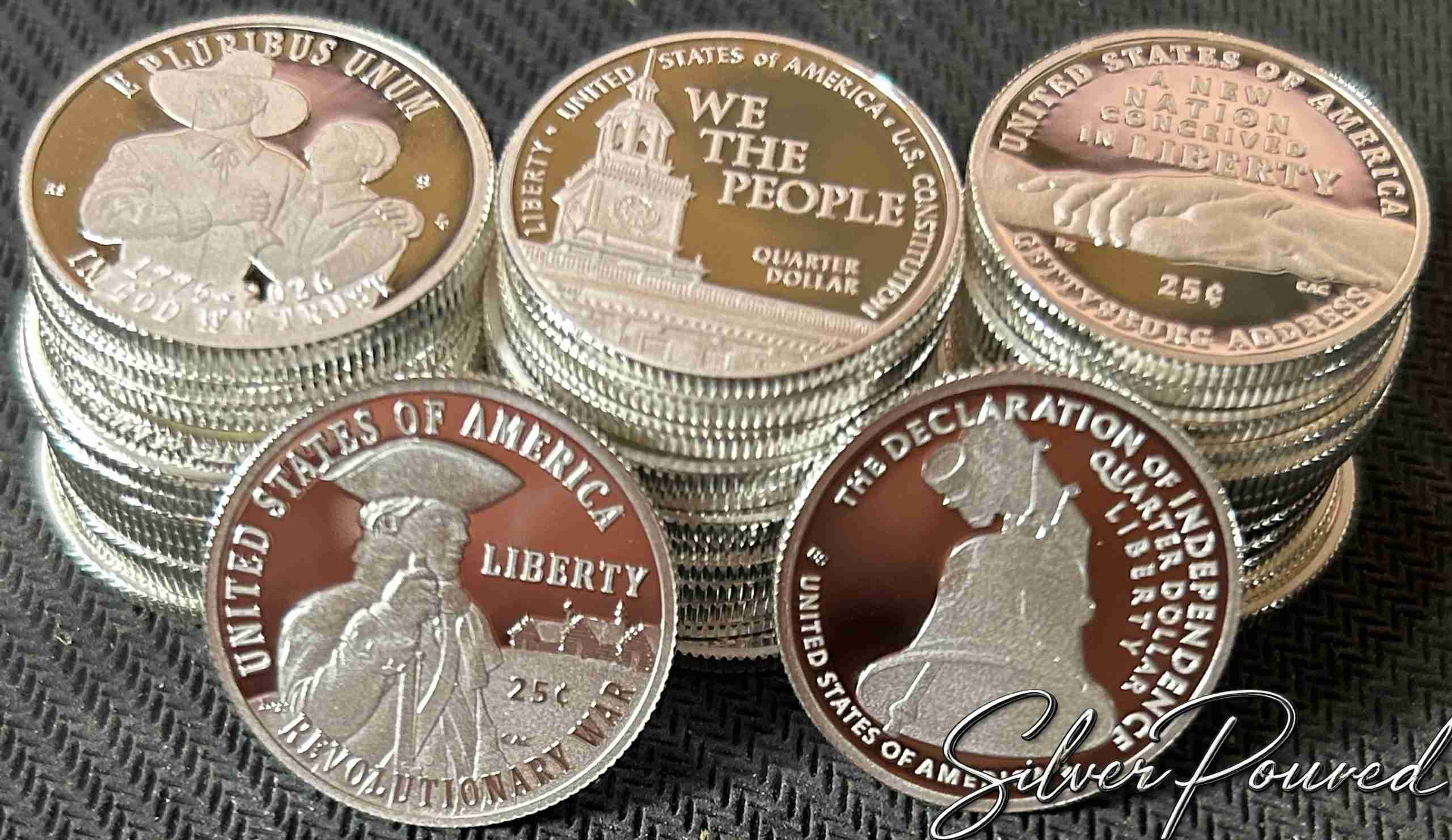
The sequence begins with an early agreement for self-government, moves through revolution and declared independence, then reaches the Constitution and the later Gettysburg Address. The 2026 Declaration of Independence Quarter occupies the center because independence is the hinge between resistance to British rule and the later task of building and preserving an American political system.
Frequently Asked Questions
Who is on the 2026 Declaration of Independence Quarter?
Thomas Jefferson appears on the obverse. Jefferson prepared the principal draft of the Declaration of Independence and later served as the third President of the United States.
What is on the reverse?
The reverse depicts the Liberty Bell ringing. The design connects the Declaration with Philadelphia, public proclamation, liberty, and the fragility of the young nation.
How many July 4 privy quarters were made?
The Mint produced 250,000 special circulation examples of the 2026 Declaration of Independence Quarter with the July 4 privy and no mint mark.
Is the no-mint-mark July 4 quarter an error?
No. The special 250,000-piece circulation issue was intentionally produced without a mint mark. A genuine July 4 privy coin with no mint mark is an official issue, not a missing-mint-mark error.
Are the 250,000 privy quarters the same as the 250 silver quarters?
No. The 250,000 coins are circulation-format privy quarters distributed nationwide. The separate 250-piece issue consists of oversized 2.5-ounce silver quarters struck at Philadelphia on July 4 and edge-numbered 1 through 250.
Is there a Silver Proof 2026 Declaration of Independence Quarter?
Yes. The San Francisco Silver Proof is struck in 99.9% fine silver and contains 0.199 troy ounce of silver. It is included in the 2026 Semiquincentennial Silver Proof Set.
What does PF70 mean?
PF70 is the highest numerical grade on the standard 70-point grading scale for Proof coins. It describes the certified condition of a coin and does not automatically prove rarity.
Did the Liberty Bell definitely ring on July 4, 1776?
No definitive claim should be made. The United States Mint states that it is unclear whether the Liberty Bell rang in July 1776. On the quarter, the ringing Bell is best understood as historical symbolism rather than proof of a specific July 4 event.
When did the Declaration quarter enter circulation?
The United States Mint began shipping the 2026 Declaration of Independence Quarter to the Federal Reserve for distribution beginning June 1, 2026.
Official Sources
Primary research for the 2026 Declaration of Independence Quarter should begin with current United States Mint material covering the circulation release, July 4 privy issue, 2.5-ounce silver issue, Semiquincentennial Silver Proof Set, and official design descriptions. Historical chronology should be checked against primary archival sources rather than repeated folklore.
- United States Mint — Declaration of Independence Quarters Released into Circulation
- United States Mint — 250,000 July 4 Privy Quarters
- United States Mint — 250 2.5-Ounce Silver July 4 Quarters
- United States Mint — 2026 Semiquincentennial Silver Proof Set
- National Archives — Declaration of Independence
Related SilverPoured Resources
The 2026 Declaration of Independence Quarter connects United States Mint history, modern quarter collecting, Silver Proof coinage, precious-metal value, and collector premiums. These SilverPoured resources provide additional background for identifying Mint issues, evaluating silver content, and understanding how collector value differs from bullion value.
2026 Semiquincentennial Coin Guides
2026 Coins: Complete Guide to America’s 250th Anniversary Coin Program
2026 Mayflower Compact Quarter: Complete Collector Guide
2026 Revolutionary War Quarter: Complete Collector Guide
2026 U.S. Constitution Quarter: Complete Collector Guide
2026 Gettysburg Address Quarter
More 2026 Collector Guides
2026 Privy Quarter: July 4 Privy Mark, Value, Mintage & Rarity
2026 Emerging Liberty Dime
2026 Enduring Liberty Half Dollar
2026 Lincoln Cent
Silver Coin Values
Quarter Values & Collector Research
Washington Quarter Value
Standing Liberty Quarter Silver Value
Coin Mint Marks
Silver Proof Set Mintages
Philadelphia Mint
Purchase Precious Metals from a Trusted Dealer
Whether you are collecting a 2026 Declaration of Independence Quarter, building a certified coin set, or adding physical silver to a long-term holdings strategy, purchasing from an established precious-metals dealer helps separate collectible coin premiums from ordinary bullion pricing.
SilverPoured recommends Golden State Mint for a wide selection of silver, gold, copper, and precious-metals products. Compare weight, purity, premium over spot, shipping, and product type before buying. Numismatic coins and modern bullion can both contain precious metal while serving very different collector and investment purposes.
Collector Insight
The strongest way to evaluate this quarter family is to identify the exact issue before discussing price. Regular P and D circulation strikes, 250,000-piece July 4 privies, 99.9% Silver Proofs, PF70 certified examples, and the 250 oversized silver pieces can share the same design while occupying completely different collector markets.
Keep SilverPoured Free
SilverPoured is built to help collectors and precious-metals investors make smarter decisions through free calculators, original photography, coin research, value references, collector education, and independent market resources. Every page is created to make valuable precious-metals information available without requiring a paid subscription.
If this 2026 Declaration of Independence Quarter guide helped you distinguish regular circulation strikes, July 4 privy coins, Silver Proofs, PF70 examples, or the 250-piece oversized silver issue, consider supporting the continued growth of SilverPoured. Every contribution helps fund original research, new calculators, expanded educational resources, additional photography, and future tools for the precious-metals community.
Your support allows SilverPoured to remain independent while building one of the web’s most comprehensive free libraries for coin collectors, bullion buyers, precious-metals researchers, and long-term investors.