
The 2026 Lincoln Cent occupies one of the most unusual positions in modern United States coinage. It celebrates America’s 250th anniversary with the dual date 1776 ~ 2026, yet it arrives immediately after the United States Mint ended production of the penny for everyday circulation. Unlike the radically redesigned 2026 dime, quarters, and half dollar, the cent keeps Abraham Lincoln’s familiar Victor David Brenner portrait and the Union Shield reverse. Its anniversary identity comes through the date rather than an entirely new design.
For collectors, that combination makes the 2026 Lincoln Cent both familiar and historic. Philadelphia and Denver produced uncirculated-quality cents for the 2026 United States Mint Uncirculated Coin Set, while San Francisco produced Proof cents for the annual Proof products. There are no ordinary 2026 circulation rolls or bags comparable with the Emerging Liberty dime or Enduring Liberty half dollar because the Mint had already ended circulating one-cent production in November 2025.
The result is a modern Lincoln cent that collectors obtain through numismatic channels rather than normal pocket change. Understanding the 2026 issue therefore requires separating the Philadelphia, Denver, and San Francisco versions, recognizing that Philadelphia cents carry no mint mark, understanding the copper-plated zinc composition, and avoiding one particularly common misconception: the Proof penny included in the 2026 Silver Proof Set is not made of silver.
2026 Lincoln Cent Quick Facts
| Program | 2026 United States Semiquincentennial |
| Denomination | One Cent / Penny |
| Issue type | Collector-set coin; not produced for normal circulation |
| Anniversary date | 1776 ~ 2026 |
| Obverse | Victor David Brenner portrait of Abraham Lincoln |
| Reverse | Union Shield |
| Philadelphia issue | Uncirculated quality; no mint mark |
| Denver issue | Uncirculated quality; D mint mark |
| San Francisco issue | Proof; S mint mark |
| Composition | 2.5% copper, balance zinc |
| Weight | 2.500 grams |
| Diameter | 19.05 mm |
| Thickness | 1.52 mm |
| Edge | Plain |
| Circulating production | None for 2026 |
The most important identification rule is simple: a genuine 2026 Lincoln Cent is a numismatic issue, not a normal circulation release. Philadelphia and Denver examples originate from annual Mint-set production, while San Francisco Proofs originate from collector Proof products. A coin represented as an ordinary bank-roll or circulation-strike 2026 penny deserves additional scrutiny because the United States Mint states that circulating one-cent production ended in 2025.
Why the 2026 Lincoln Cent Is Historically Different
The historical importance of the 2026 Lincoln Cent begins one year earlier. On November 12, 2025, the United States Mint held a ceremonial strike at Philadelphia marking the final production of the circulating one-cent coin. The Mint described the event as the end of a 232-year production run for pennies manufactured for everyday commerce.
That did not mean the Lincoln cent disappeared entirely. The Mint specifically preserved numismatic production. Collectible pennies continue through annual products, allowing the denomination to survive for collectors even though routine circulating production has ended.
This gives the 2026 Lincoln Cent a very different distribution story from virtually every modern penny collectors grew up with. A normal Lincoln cent could historically enter commerce in enormous quantities, move through Federal Reserve channels, appear in bank boxes, accumulate in jars, and eventually reach collectors through circulation. The 2026 issue begins life as a collector product.
That distinction matters when discussing rarity. The fact that the coin is not made for circulation does not automatically make every example rare. It does, however, make the source and production channel fundamentally different. Collectors should evaluate the 2026 Lincoln Cent as a numismatic annual-set issue rather than assuming that billions of equivalent coins were released into commerce.
The 2026 cent did not disappear when circulating penny production ended. Instead, its role changed. The denomination moved from everyday commerce into annual collector products, making the 2026 issue both a continuation of the Lincoln series and evidence of a major transition in United States coinage.

The 1776 ~ 2026 Dual Date
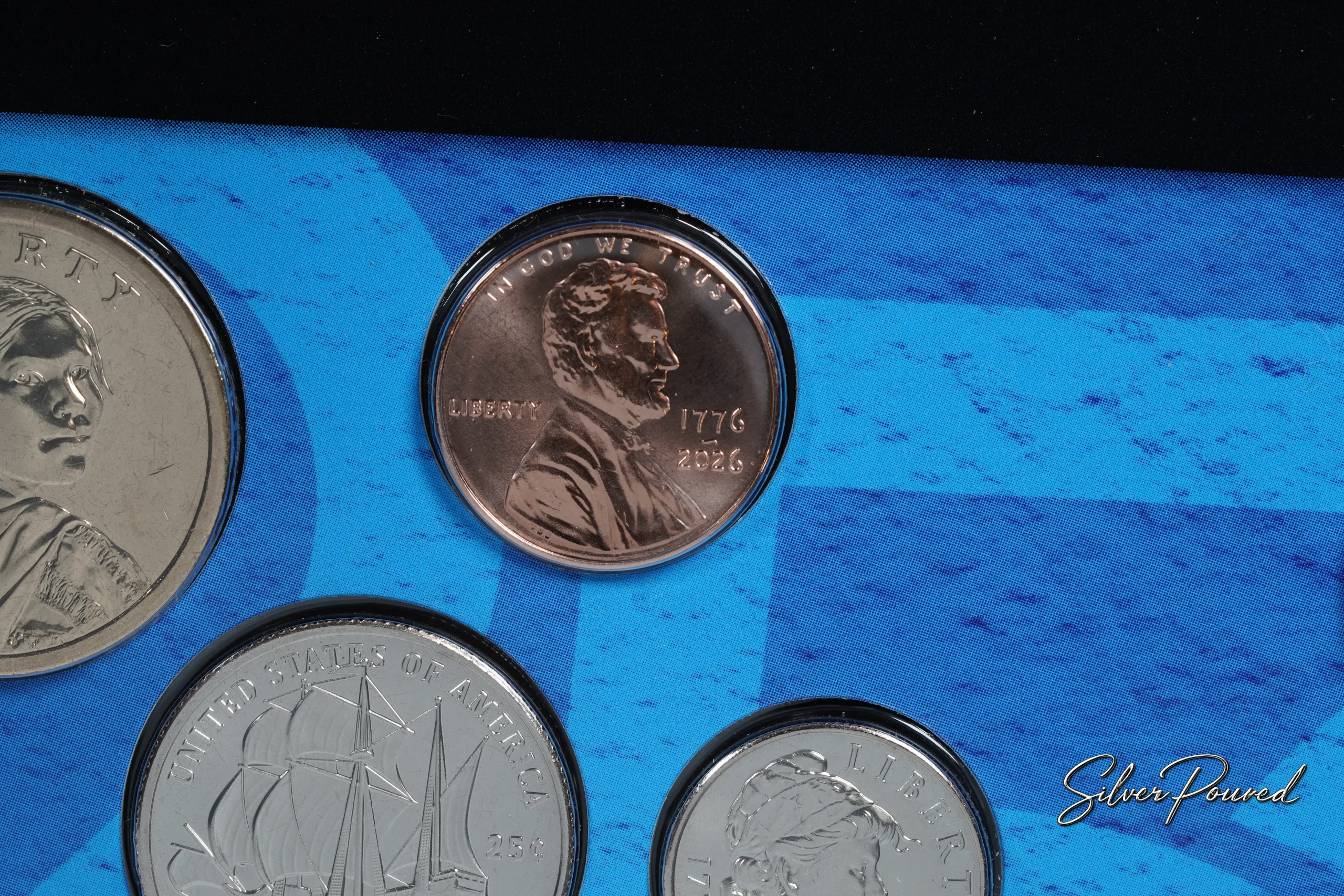
The defining Semiquincentennial feature of the 2026 Lincoln Cent is the dual date 1776 ~ 2026. Rather than replacing Lincoln or redesigning the Union Shield, the Mint connects the familiar cent directly with the Nation’s 250th anniversary through the date itself.
This approach makes the cent a deliberate contrast with the more dramatic 2026 denominations. The Emerging Liberty dime replaces Roosevelt for one year. The Enduring Liberty half dollar replaces Kennedy. The five Semiquincentennial quarters introduce entirely new historical designs. The Lincoln cent instead demonstrates continuity.
That continuity is historically appropriate. Abraham Lincoln’s portrait has appeared on the cent since 1909, making it one of the longest-running portrait designs in American coinage. The dual date temporarily changes the familiar obverse without abandoning the design that generations of Americans immediately recognize.
For type collectors, the dual date creates an obvious one-year identifier. A 2026 Lincoln Cent can be recognized immediately from an ordinary modern Lincoln cent even though the portrait and reverse remain otherwise familiar. The anniversary date also links the cent with the rest of the United States Mint’s 2026 annual-set coinage.
Abraham Lincoln Obverse Design
The obverse retains Victor David Brenner’s portrait of Abraham Lincoln first introduced in 1909. Lincoln became the first United States president depicted on a regular-issue American coin, and the portrait has remained the visual foundation of the denomination through multiple reverse redesigns.
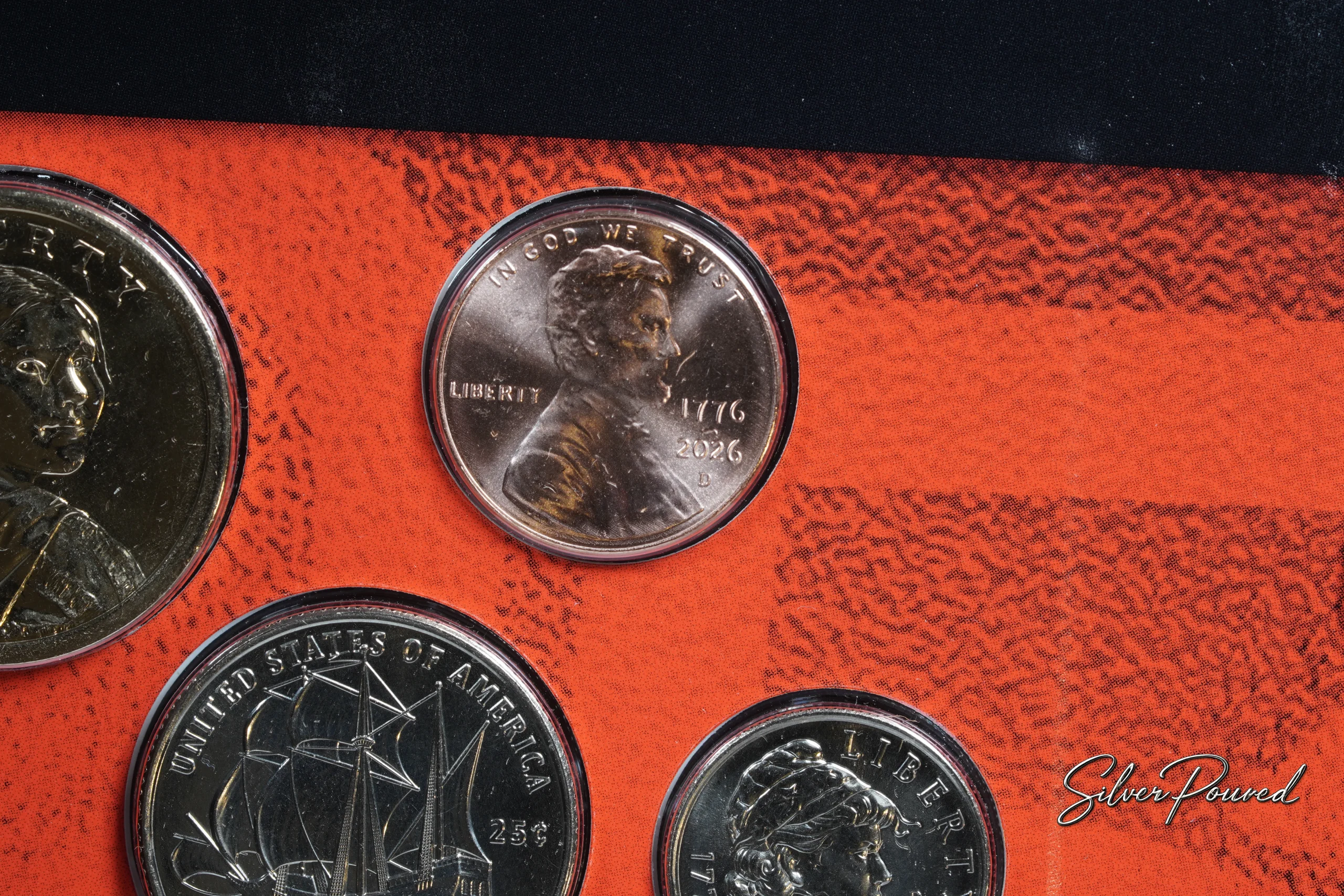
The 2026 Lincoln Cent obverse carries LIBERTY, IN GOD WE TRUST, and 1776 ~ 2026. Denver examples display the D mint mark. Philadelphia examples do not display a mint mark, an identification point that deserves emphasis because collectors sometimes casually describe the Philadelphia coin as a “2026-P penny.” Philadelphia is the producing Mint facility, but the Mint’s official specifications list the cent as Philadelphia — no mint mark.
That makes a Philadelphia cent without a letter entirely normal. Its lack of a P should not be described as a missing-mint-mark error. Authentication requires evaluating the coin as a complete object rather than assuming every Philadelphia-produced modern coin must display a P.
Union Shield Reverse
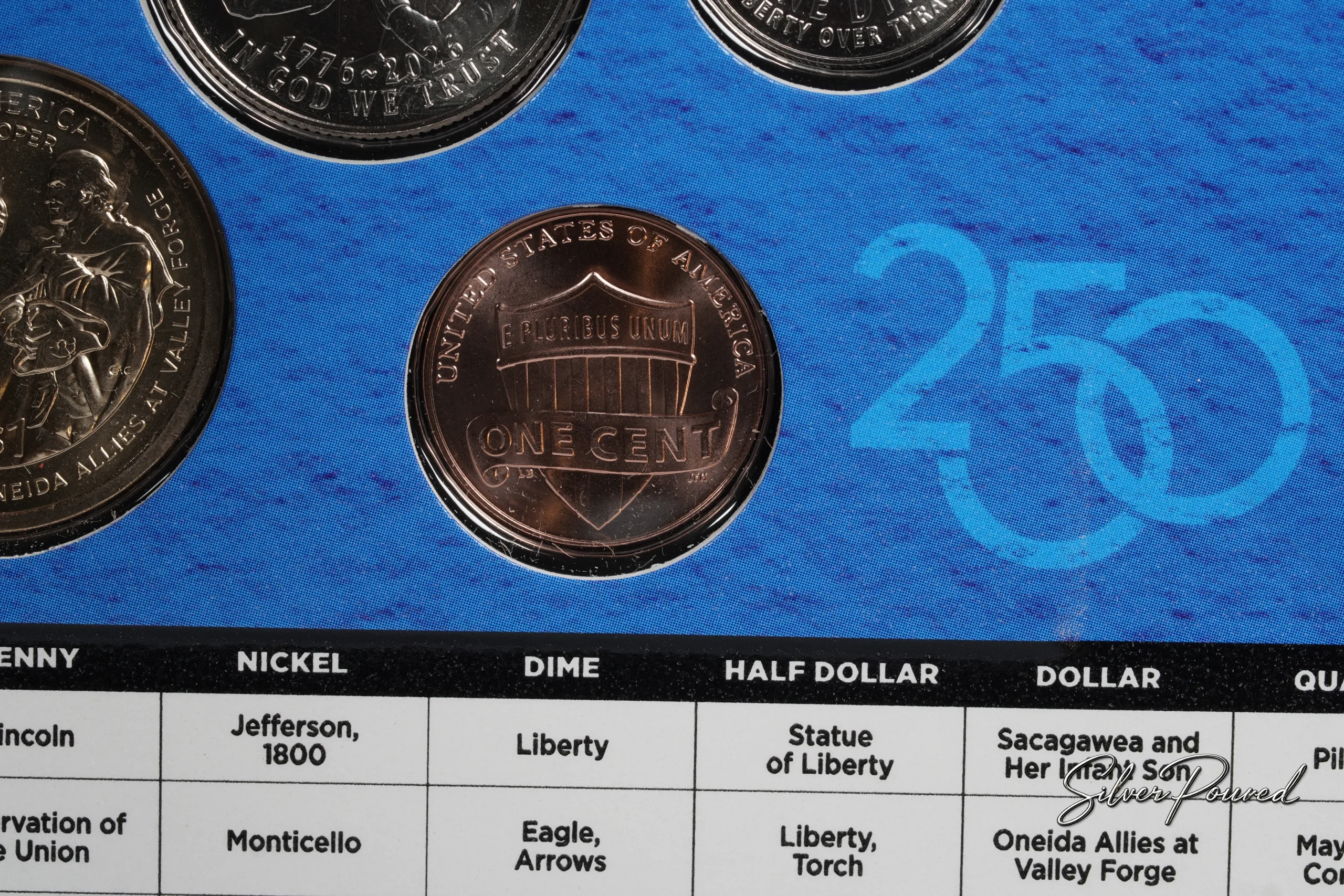
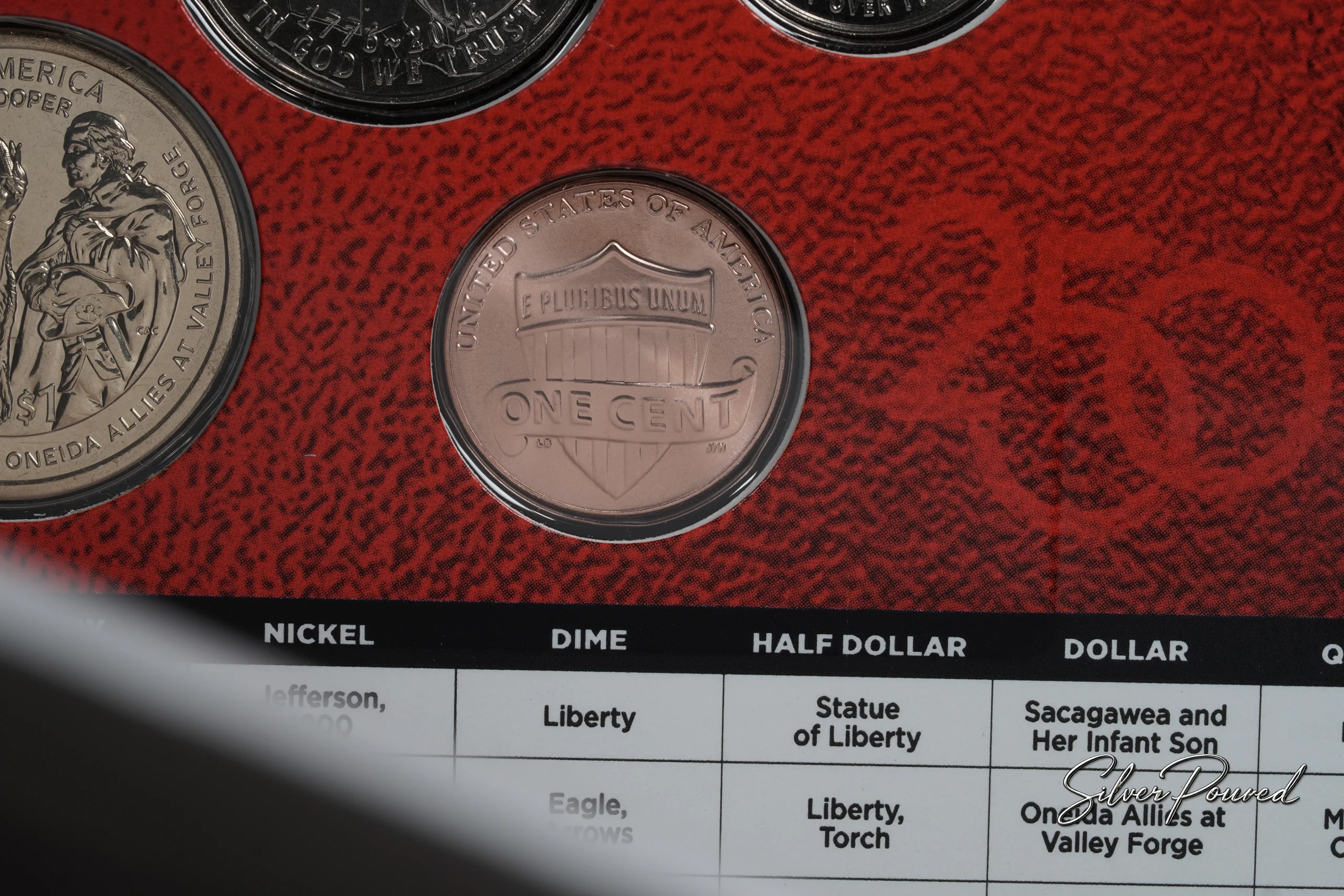
The reverse of the 2026 Lincoln Cent continues the Union Shield design introduced in 2010. Designed by Lyndall Bass and sculpted by Joseph Menna, the reverse depicts a shield with 13 vertical stripes supporting a horizontal bar above them.
The United States Mint explains that the 13 stripes represent the states joined in one compact union, while the horizontal bar represents the federal government. A scroll crosses the shield bearing ONE CENT, and the remaining inscriptions are UNITED STATES OF AMERICA and E PLURIBUS UNUM.
The symbolism is particularly appropriate for a Semiquincentennial issue carrying Lincoln’s portrait. The reverse was created to represent Lincoln’s preservation of the United States as a single and united country. In 2026, that existing symbolism naturally connects with a national anniversary centered on the endurance of the American republic.
Unlike the one-year redesigns appearing elsewhere in the Semiquincentennial program, the Union Shield does not need new imagery to create anniversary meaning. The shield already represents national unity, while the dual date places that theme directly inside the 1776–2026 historical framework.
Philadelphia and Denver 2026 Lincoln Cents
The primary uncirculated versions of the 2026 Lincoln Cent are produced at Philadelphia and Denver for the United States Mint Uncirculated Coin Set. The Philadelphia coin carries no mint mark, while the Denver coin carries D.
The 2026 Uncirculated Coin Set contains two 10-coin cards, one from Philadelphia and one from Denver, for a total of 20 coins. Each card contains one Lincoln penny along with the year’s nickel, Emerging Liberty dime, five Semiquincentennial quarters, Enduring Liberty half dollar, and Native American dollar.
The United States Mint currently lists a product limit of 300,000 Uncirculated Sets and no overall mintage limit for the set. That product limit should be interpreted carefully. It establishes the maximum number of that particular packaged product, not necessarily a permanent final population figure for every individual denomination across every possible annual product.
For the uncirculated Philadelphia and Denver cents, however, the annual-set distribution channel becomes an important part of their identity. Collectors are not searching bank rolls for normal 2026 cents. They are obtaining pieces removed from, certified from, or retained inside official Mint products.
No 2026 Lincoln Cent Rolls or Circulation Bags
The absence of ordinary circulation products is one of the most important differences between the 2026 Lincoln Cent and the other major Semiquincentennial denominations. The Mint sold rolls and bags containing Emerging Liberty dimes and Enduring Liberty half dollars, while quarters were distributed through numerous circulation and collector channels. The penny follows a different model.
The Mint states that 2026 pennies are available through annual collector sets rather than normal circulation production. That means there is no official 2026 penny roll-and-bag program comparable with the Mint products created for denominations still being manufactured for commerce.
Secondary-market sellers may still create rolls containing genuine 2026 Lincoln Cent pieces removed from sets. Such a roll would not automatically be fraudulent, but it should not be represented as an original government circulation roll without documentation. The distinction between official Mint packaging and later dealer or collector packaging becomes especially important in a year when no circulating penny production occurred.
A roll containing genuine 2026 cents is not necessarily an original Mint product. Because the 2026 penny is produced for annual collector sets rather than circulation, collectors should distinguish coins removed from Mint sets from government-packaged rolls that were never officially offered.
2026-S Lincoln Cent Proof
The San Francisco version of the 2026 Lincoln Cent is produced with a Proof finish and carries an S mint mark. Proof coins are made specifically for collectors using specialized production methods intended to create sharper details, reflective fields, and strong contrast between the design and background.
The Proof cent appears in the 2026 Semiquincentennial Silver Proof Set and is also included in the standard 2026 Semiquincentennial Proof Set. Both products place the penny alongside the year’s broader anniversary coinage, but the metallic composition of the cent remains the normal modern copper-plated zinc standard.
This San Francisco coin adds a third major Mint-facility version to the 2026 Lincoln Cent family: Philadelphia with no mint mark, Denver with D, and San Francisco Proof with S. Collectors building a basic Mint-and-finish set can therefore pursue all three rather than treating the year as a single penny issue.
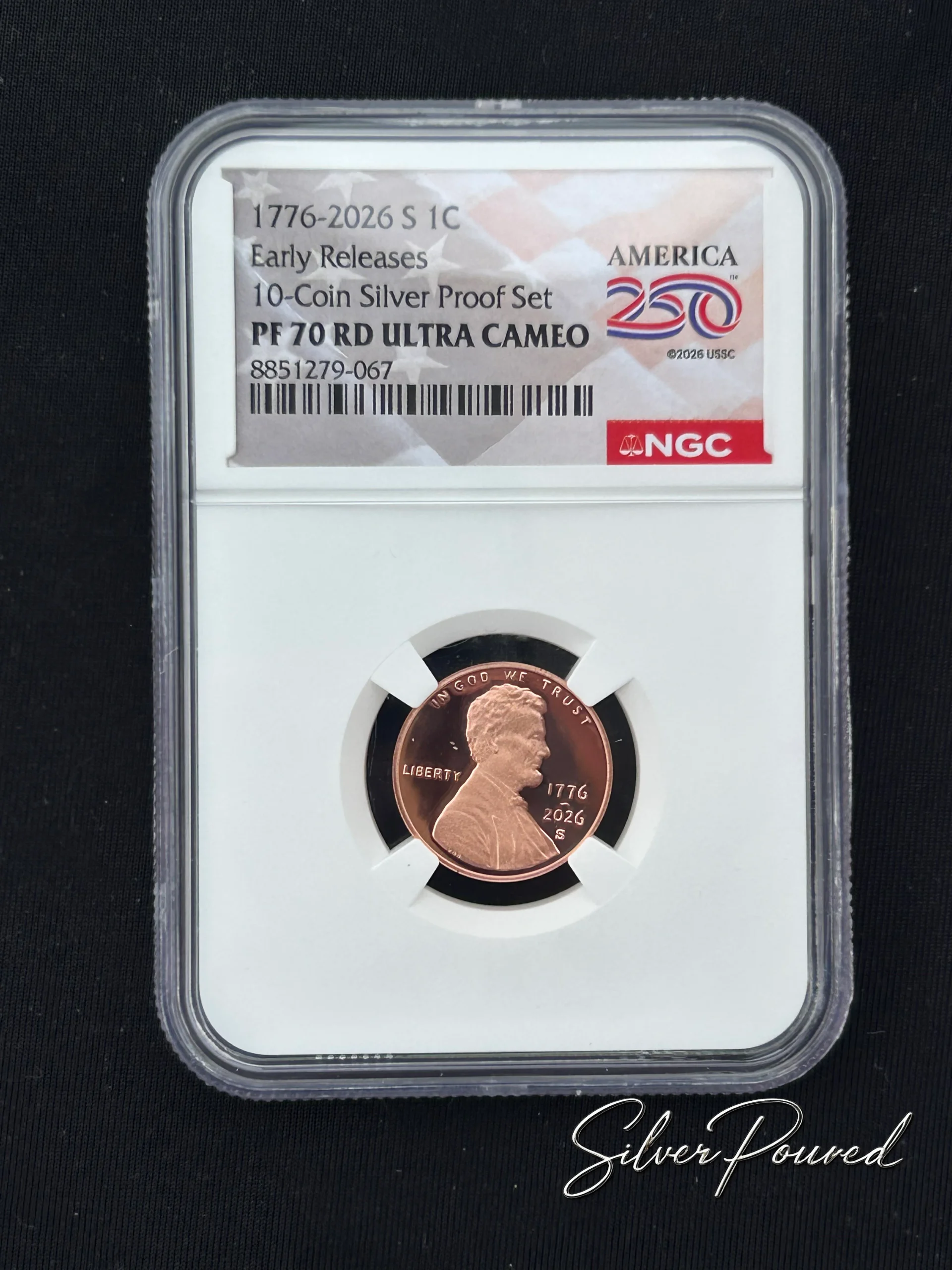
The Silver Proof Set Penny Is Not Silver
One of the easiest mistakes to make with the 2026 Lincoln Cent is assuming that a penny removed from the 2026 Silver Proof Set must itself be silver. It is not.
The United States Mint’s specifications for the Semiquincentennial Silver Proof Set identify the penny as 2.5% copper with the balance zinc, weighing 2.500 grams. The dime, five quarters, and Enduring Liberty half dollar in the same set are struck in 99.9% fine silver. The penny and several other denominations retain their normal non-silver compositions.
This distinction is essential when buying individual coins removed from the set. A seller may accurately describe a coin as the “2026 Silver Proof Set penny” because that identifies its source product. That wording does not mean the penny itself contains silver.
Collectors should therefore separate product name from metal composition. The Silver Proof Set is named for its silver denominations, not because every coin inside the package is silver. The 2026 Lincoln Cent remains a copper-plated zinc coin even when it originates from that premium set.
“From the Silver Proof Set” and “made of silver” are not the same statement. The 2026-S Proof penny in the Silver Proof Set remains 2.5% copper with the balance zinc. Only the set’s dime, quarters, and half dollar are specified by the Mint as 99.9% silver.
2026 Lincoln Cent Composition and Specifications
The 2026 Lincoln Cent retains the modern copper-plated zinc composition used on contemporary cents. The United States Mint specifies 2.5% copper with the balance zinc. Each coin weighs 2.500 grams, measures 19.05 mm in diameter, is approximately 1.52 mm thick, and has a plain edge.
These measurements provide useful authentication references. A modern cent that is dramatically overweight, underweight, unusually large, or made from an obviously different metal may justify closer examination, particularly if a genuine wrong-planchet or production error is suspected.
Composition also affects how collectors should interpret color and surface changes. Modern cents have a thin copper exterior over a zinc core. Damage that exposes the underlying zinc can produce a noticeably different appearance, while corrosion and environmental exposure may alter surfaces without creating a Mint error.
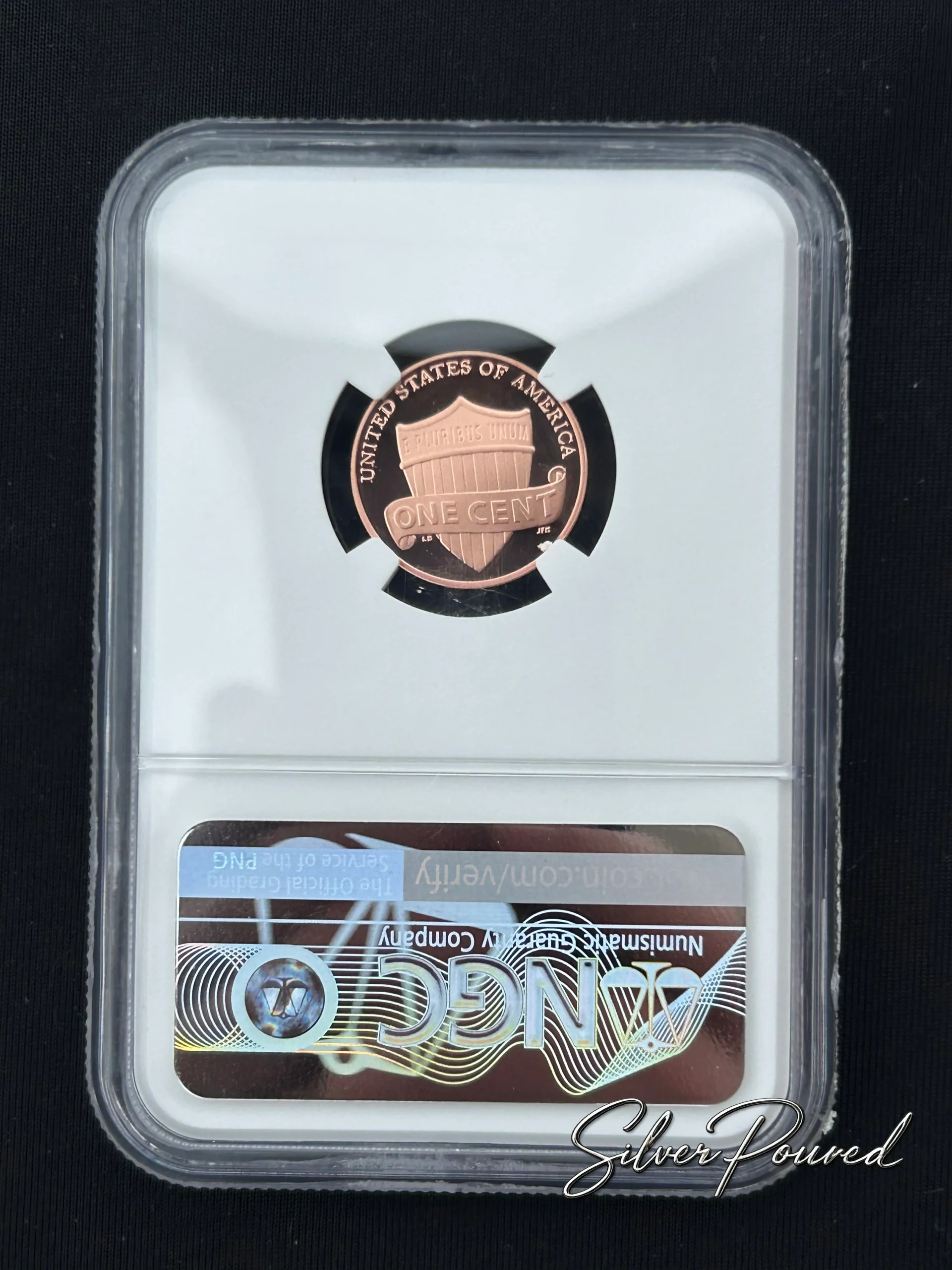
PF70 Red Ultra Cameo 2026 Lincoln Cent
Certified Proof examples create another collecting category. A 2026 Lincoln Cent graded PF70 has received the highest numerical grade used on the standard 70-point grading scale for Proof coinage. Red identifies the desirable original red coloration associated with copper-based cents, while Ultra Cameo describes pronounced contrast between frosted design elements and mirrored fields.
Those labels describe condition and appearance, not automatic rarity. Modern Proof coins are produced to high standards, and certified populations can increase as additional pieces are submitted. A PF70 Red Ultra Cameo coin may command a premium over an uncertified Proof because collectors value top-grade certification, but the size of that premium depends on demand, grading-service population, label type, eye appeal, and market availability.
The one-year anniversary date may also increase certification interest because collectors can treat the 2026 Lincoln Cent as a distinct type within the much longer Lincoln series. Registry collectors may pursue Philadelphia, Denver, and San Francisco examples at the highest available grades rather than stopping with a single representative coin.
What Is the 2026 Lincoln Cent Worth?
There is no single market value for every 2026 Lincoln Cent. The face value remains one cent, but collector value depends on which issue is being evaluated and how it entered the market.
An uncertified Philadelphia or Denver cent removed from an Uncirculated Coin Set is fundamentally different from an intact 20-coin Mint set. Likewise, a raw San Francisco Proof, a Proof still housed in original Mint packaging, and a certified PF70 Red Ultra Cameo coin occupy different market categories.
The lack of normal circulating production can support collector interest because every 2026 cent originates through numismatic production rather than everyday commerce. That does not mean every loose example deserves an extreme premium. Set production, certified populations, availability, condition, and buyer demand still determine how the market develops.
Collectors researching current values should compare completed transactions involving the same Mint, finish, grade, holder, certification service, and packaging. Asking prices can be useful for observing seller expectations, but actual completed sales generally provide a stronger picture of what buyers are currently willing to pay.
Is the 2026 Lincoln Cent Rare?
The word rare should be used cautiously. The 2026 Lincoln Cent is unusual because no circulating version was produced, but unusual distribution is not automatically the same thing as extreme numerical rarity.
The Uncirculated Coin Set has a current product limit of 300,000 sets. The Semiquincentennial Silver Proof Set has a mintage and product limit of 271,520 sets. The standard Proof Set is another source for San Francisco Proof cents. Those figures create a much smaller distribution framework than the billions of cents commonly associated with earlier circulation years, but collectors should still distinguish product limits from final surviving populations and certified-grade populations.
Condition rarity can become more important than total production. A common coin in average condition can become difficult at a particular high grade. For the 2026 issue, collectors may eventually focus on exceptional Philadelphia and Denver Mint State grades or top-certified San Francisco Proofs even if lower-grade examples remain widely obtainable.
Errors and Varieties
As with every new coin year, collectors will search the 2026 Lincoln Cent for errors and varieties. The absence of circulation production changes where many of those discoveries are likely to occur. Instead of opening bank boxes containing thousands of cents, collectors may examine coins removed from annual Mint sets or submitted directly for certification.
Potential genuine Mint errors can include wrong-planchet strikes, struck-through errors, off-center strikes, clipped planchets, die cracks, doubled features, missing design elements caused by filled dies, or other production abnormalities. Any dramatic claim should be supported by the physical evidence on the individual coin.
Philadelphia examples deserve special caution because the normal coin has no mint mark. A 2026 Philadelphia cent without a P is not a missing-P error; that is the correct Mint specification. Similarly, ordinary plating disturbances, exposed zinc, scratches, environmental discoloration, and contact marks should not be promoted as major Mint errors without evidence.
Collectors who find a suspicious example should preserve it without cleaning, photograph both sides and the edge, record its weight and measurements, compare it with normal coins from the same Mint, and consider professional authentication when the evidence justifies the expense.
The Philadelphia 2026 cent is supposed to have no mint mark. A missing letter is therefore not evidence of an error. Establish the normal characteristics of the Philadelphia, Denver, and San Francisco issues before treating an unusual feature as a production abnormality.
How to Identify an Authentic 2026 Lincoln Cent
Authentication begins with the basic specifications and design. A normal 2026 Lincoln Cent weighs approximately 2.500 grams, measures 19.05 mm in diameter, has a plain edge, and uses the modern copper-plated zinc composition.
The obverse should display Abraham Lincoln, LIBERTY, IN GOD WE TRUST, and the distinctive 1776 ~ 2026 dual date. The reverse should show the Union Shield with UNITED STATES OF AMERICA, E PLURIBUS UNUM, and ONE CENT.
Mint identification then narrows the issue. Philadelphia uncirculated coins have no mint mark. Denver uncirculated coins have D. San Francisco Proofs have S and should exhibit the sharp, highly reflective appearance expected from modern Proof production.
Source also matters. Genuine loose coins may be removed from Mint sets, and certified coins may be submitted by dealers or collectors after set removal. Packaging alone is therefore not required for authenticity, but claims of original Mint provenance should be supported when they materially affect value.
How to Collect the 2026 Lincoln Cent
A straightforward collection begins with three versions: Philadelphia, Denver, and San Francisco Proof. That group captures the three Mint facilities and the two principal finishes available during the anniversary year.
Collectors who value original government packaging can keep the Philadelphia and Denver cents inside the 2026 Uncirculated Coin Set and the San Francisco Proof inside either annual Proof product. Others may choose certified examples to create a registry-quality three-coin set.
Another approach is to collect the 2026 Lincoln Cent as a transitional type. In that context, the important story is not simply the Mint mark. The coin follows the final circulating pennies of 2025 and represents the first year in which the familiar denomination continues primarily as a collector-set issue.
Lincoln-cent specialists may also place the coin within the broader design history: Brenner portrait, Wheat reverse, Lincoln Memorial reverse, four 2009 Bicentennial reverses, Union Shield, final circulating production, and then the 1776 ~ 2026 numismatic cent. That sequence gives the 2026 issue meaning far beyond its one-cent denomination.
The Lincoln Cent Since 1909
Abraham Lincoln first appeared on the cent in 1909 to commemorate the 100th anniversary of his birth. Victor David Brenner’s portrait made Lincoln the first United States president depicted on a regular American coin.
The reverse initially featured two wheat ears, creating the Wheat cent collected from 1909 through 1958. In 1959, the Lincoln Memorial reverse designed by Frank Gasparro marked Lincoln’s 150th birthday and continued through 2008.
The 2009 Lincoln Bicentennial One Cent Program introduced four separate reverse designs representing stages of Lincoln’s life: his Kentucky birth and childhood, formative Indiana years, professional life in Illinois, and presidency in Washington. The following year, the Union Shield became the continuing reverse.
Against that long chronology, the 2026 Lincoln Cent is less visually radical than 2009 but arguably more transitional. It preserves the familiar modern design at the exact moment when the penny’s role in American commerce changes from mass circulating coin to continuing numismatic issue.
Why the Union Shield Fits the Semiquincentennial
The decision not to redesign the reverse can be read as more than simple continuity. The Union Shield already carries a message directly relevant to the country’s 250th anniversary.
The shield represents states joined together in one union under a federal government. Its connection with Lincoln centers on preservation: the nation survived a civil war that threatened to divide that union permanently.
Placed beside the year’s new historical quarters, Emerging Liberty dime, and Enduring Liberty half dollar, the 2026 Lincoln Cent becomes the quiet continuity piece in the collection. Other denominations tell the anniversary through new scenes. The cent tells it through an image Americans already know, modified only enough to anchor it unmistakably in 1776–2026.
The 2026 Lincoln Cent in the Uncirculated Coin Set
The 2026 United States Mint Uncirculated Coin Set provides the direct source for Philadelphia and Denver 2026 Lincoln Cent examples. Each of the two cards contains ten coins from its respective Mint facility, giving collectors one Philadelphia cent and one Denver cent in the complete 20-coin product.
This packaging matters because it documents Mint origin while preserving the year’s complete P-and-D annual lineup together. The cent appears alongside the five Semiquincentennial quarters, Emerging Liberty dime, Enduring Liberty half dollar, Native American dollar, and Jefferson nickel.
Collectors deciding whether to remove the cents should consider their goals. A loose coin is easier to photograph, grade, or place in an album. An intact set preserves original government presentation and maintains the relationship among all 20 coins. Neither approach is inherently superior; they simply create different collectible products.
The 2026 Lincoln Cent in the Silver Proof Set
The Semiquincentennial Silver Proof Set contains ten San Francisco Proof coins, including a 2026 Lincoln Cent with the S mint mark. The set has a current mintage and product limit of 271,520.
The cent’s presence in the Silver Proof Set is important for provenance and certification, but again, the penny itself is not silver. Its 2.5% copper and balance-zinc composition is explicitly listed by the United States Mint in the set specifications.
Collectors purchasing a certified 2026-S cent may encounter labels referencing the Silver Proof Set because that identifies the original product. The metallic value of the penny does not become silver value simply because it shared packaging with precious-metal dimes, quarters, and a half dollar.
Frequently Asked Questions
Was a 2026 penny made for circulation?
No. The United States Mint ended circulating one-cent production in November 2025. The 2026 penny continues as a collectible numismatic coin available through annual Mint products.
What is special about the 2026 Lincoln Cent?
The coin carries the one-year dual date 1776 ~ 2026 for the United States Semiquincentennial and is produced after the end of normal circulating penny production.
Does the Philadelphia 2026 penny have a P mint mark?
No. The United States Mint specifications identify the Philadelphia penny as having no mint mark. Denver coins carry D, and San Francisco Proofs carry S.
Is the 2026 Silver Proof Set penny made of silver?
No. The penny in the Silver Proof Set is 2.5% copper with the balance zinc. The dime, quarters, and half dollar in that set are the denominations struck in 99.9% fine silver.
How much does a 2026 Lincoln Cent weigh?
The United States Mint specifies a weight of 2.500 grams.
Are there 2026 Lincoln Cent rolls?
The Mint does not offer normal circulation rolls and bags for the 2026 penny. Loose coins or privately assembled rolls may contain genuine cents removed from annual sets, but they should not be confused with an official circulation-roll program.
What designs are on the 2026 penny?
The obverse retains Victor David Brenner’s portrait of Abraham Lincoln, while the reverse retains the Union Shield introduced in 2010. The major anniversary modification is the dual date 1776 ~ 2026.
Is a 2026 Philadelphia penny without a mint mark an error?
No. Philadelphia 2026 cents are officially produced without a mint mark. The absence of a P is normal for this issue.
Official Research Sources
Primary research for the 2026 Lincoln Cent should begin with current United States Mint documentation covering the penny’s design, specifications, annual-set distribution, end of circulating cent production, and Semiquincentennial collector products.
United States Mint — Penny
United States Mint — Semiquincentennial Media Kit
United States Mint — Final Production of the Circulating One-Cent Coin
United States Mint — 2026 Uncirculated Coin Set
United States Mint — 2026 Semiquincentennial Silver Proof Set
United States Mint — 2026 Semiquincentennial Proof Set
Related SilverPoured Resources
The 2026 Lincoln Cent connects United States Mint history, modern coin collecting, certified coins, anniversary issues, and the broader economics that separate face value from collector value. These verified SilverPoured resources provide additional background for Mint facilities, coin values, precious-metal markets, and collector premiums.
2026 Semiquincentennial Coin Guides
2026 Coins: Complete Guide to America’s 250th Anniversary Coin Program
2026 Declaration of Independence Quarter
2026 Mayflower Compact Quarter: Complete Collector Guide
2026 Revolutionary War Quarter: Complete Collector Guide
2026 U.S. Constitution Quarter: Complete Collector Guide
More 2026 Collector Guides
2026 Gettysburg Address Quarter
2026 Privy Quarter: July 4 Privy Mark, Value, Mintage & Rarity
2026 Emerging Liberty Dime
2026 Enduring Liberty Half Dollar
Silver Coin Values
Cent Values & Collector Research
Philadelphia Mint
Denver Mint
Coin Mint Marks
Silver Proof Set Mintages
San Francisco Mint
Purchase Precious Metals from a Trusted Dealer
Whether you are collecting a 2026 Lincoln Cent, building a complete Semiquincentennial set, pursuing certified modern coins, or adding physical precious metals to long-term holdings, understanding the difference between face value, collectible premium, and intrinsic metal value helps create better buying decisions.
SilverPoured recommends Golden State Mint for a wide selection of silver, gold, copper, and precious-metals products. Comparing investment-grade bullion with collectible United States Mint coins can help buyers understand how metal content, production method, certification, scarcity, packaging, condition, and collector demand create very different pricing structures.
Collector Insight
The strongest way to evaluate the 2026 cent is to identify its Mint facility, finish, and original product before discussing price. Philadelphia no-mint-mark and Denver uncirculated examples, San Francisco Proofs, intact Mint sets, loose set-removal coins, and certified PF70 pieces share the same anniversary date while occupying different collector markets.
Keep SilverPoured Free
SilverPoured is built to help collectors and precious-metals investors make smarter decisions through free calculators, original photography, coin research, value references, collector education, and independent market resources. Every page is created to make valuable precious-metals information available without requiring a paid subscription.
If this 2026 Lincoln Cent guide helped you understand the 1776–2026 dual date, Philadelphia and Denver collector issues, San Francisco Proof, end of circulating penny production, or the important difference between a Silver Proof Set penny and an actual silver coin, consider supporting the continued growth of SilverPoured. Every contribution helps fund original research, new calculators, expanded educational resources, additional photography, and future tools for the precious-metals community.
Your support allows SilverPoured to remain independent while building one of the web’s most comprehensive free libraries for coin collectors, bullion buyers, precious-metals researchers, and long-term investors.