
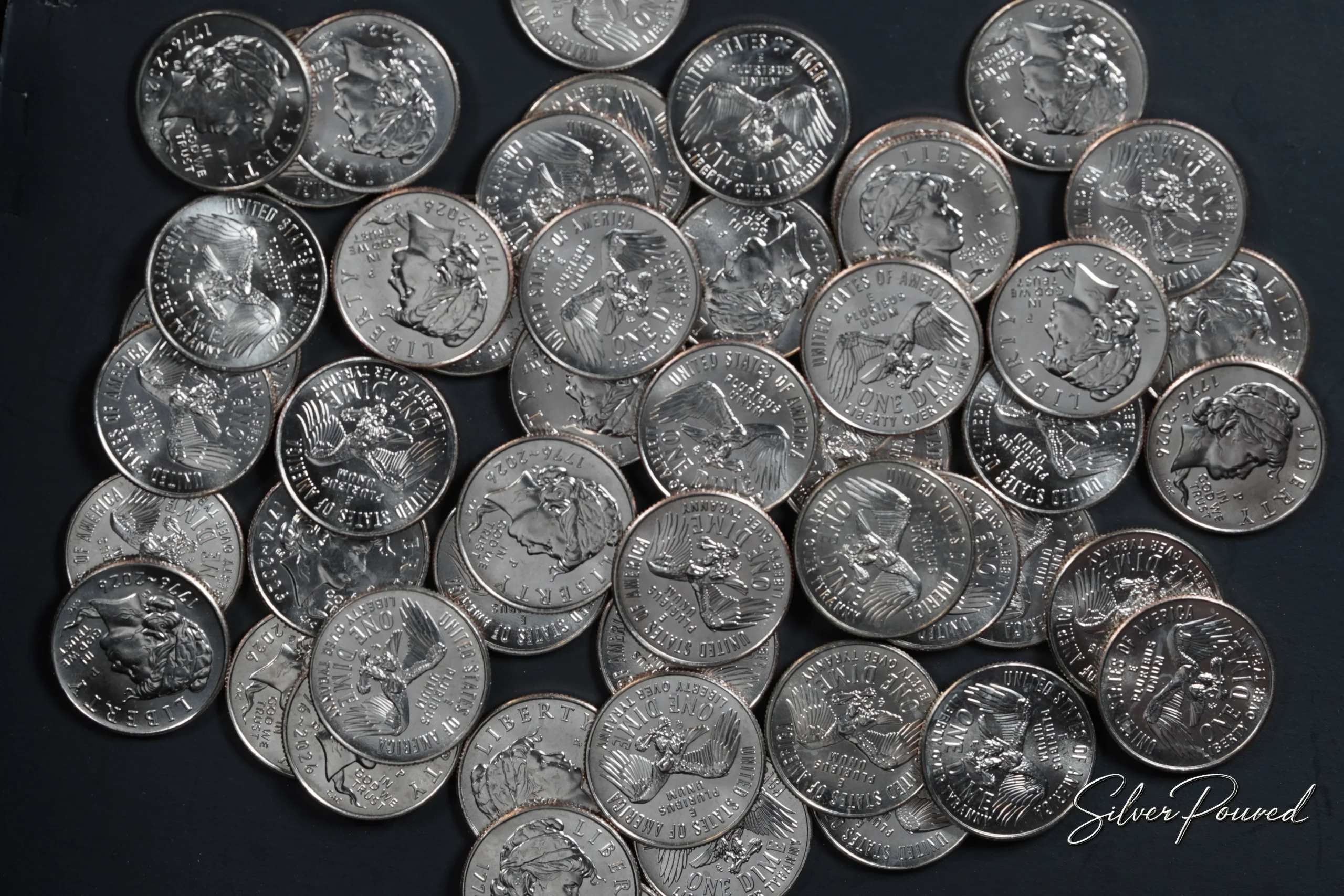
The 2026 Emerging Liberty Dime is one of the defining circulating coins of the United States Semiquincentennial. For one year, the familiar Roosevelt dime gives way to a completely new design centered on Liberty, revolution, and the struggle for American independence. The obverse depicts a determined Liberty wearing a patriotic Liberty cap as the winds of revolution move through her hair, while the reverse shows an eagle in flight carrying arrows beneath the forceful inscription LIBERTY OVER TYRANNY.
For collectors, the 2026 Emerging Liberty Dime is much more than a temporary design change. Philadelphia and Denver circulation-quality strikes appear in rolls, bags, annual Mint products, bank distribution, and ordinary commerce. San Francisco produced Proof and 99.9% fine silver Proof versions for collectors. Certified examples introduce another layer of condition rarity, while newly reported production anomalies such as possible die clashes are already attracting attention from error specialists.
The result is a compact but surprisingly complex one-year coin family. Understanding the 2026 Emerging Liberty Dime requires collectors to separate mint mark, finish, metal composition, certification, packaging, condition, and genuine production abnormalities before assigning value or rarity.
2026 Emerging Liberty Dime Quick Facts
| Program | 2026 United States Semiquincentennial |
| Denomination | Dime / 10 cents |
| Design name | Emerging Liberty |
| Issue period | One-year design for 2026 |
| Obverse | Liberty wearing a patriotic Liberty cap |
| Reverse | Eagle carrying arrows with LIBERTY OVER TYRANNY |
| Circulation mints | Philadelphia (P) and Denver (D) |
| Circulation composition | 8.33% nickel, balance copper |
| Circulation weight | 2.268 grams |
| Diameter | 17.91 mm |
| Edge | Reeded |
| Circulation privy mark | None |
| Silver Proof mint | San Francisco (S) |
| Silver Proof composition | 99.9% fine silver |
| Silver fine weight | 0.079 troy ounce |
The most important first step in evaluating a 2026 Emerging Liberty Dime is identifying exactly which version is being examined. A Philadelphia circulation strike, Denver circulation strike, original Mint roll coin, San Francisco Proof, 99.9% Silver Proof, certified Mint State example, PF70 Ultra Cameo coin, and genuine Mint error can all share the same basic Emerging Liberty design while occupying completely different collector markets.
Why the 2026 Emerging Liberty Dime Matters
The historical significance of the 2026 Emerging Liberty Dime begins with what it temporarily replaces. Franklin D. Roosevelt has appeared on the dime since 1946. For the Nation’s 250th anniversary, the United States Mint interrupted that familiar design for a single year and returned personified Liberty to the obverse.
The Mint describes 2026 as the first time since 1945 that Liberty appears on the obverse of the dime. That statement connects the new issue directly with the long Liberty tradition that preceded Roosevelt. Before the modern presidential portrait era, Liberty appeared in many forms across American dime designs, including the Draped Bust, Capped Bust, Seated Liberty, Barber, and Winged Liberty Head dime commonly called the Mercury dime.
The 2026 Emerging Liberty Dime therefore does not merely commemorate an anniversary. It deliberately reaches backward into early American coinage language while interpreting Liberty through the struggle for independence. That gives the issue relevance to collectors of modern circulating coins, historic dime series, Liberty-themed coinage, Semiquincentennial coins, high-grade certified material, Silver Proofs, and Mint errors.
The 2026 design is temporary, but its historical position is permanent. Roosevelt dominates modern dime history beginning in 1946, while Emerging Liberty occupies one anniversary year between decades of Roosevelt coinage. That one-year interruption gives collectors a clearly defined modern type rather than simply another date in an uninterrupted series.

Emerging Liberty Obverse Design
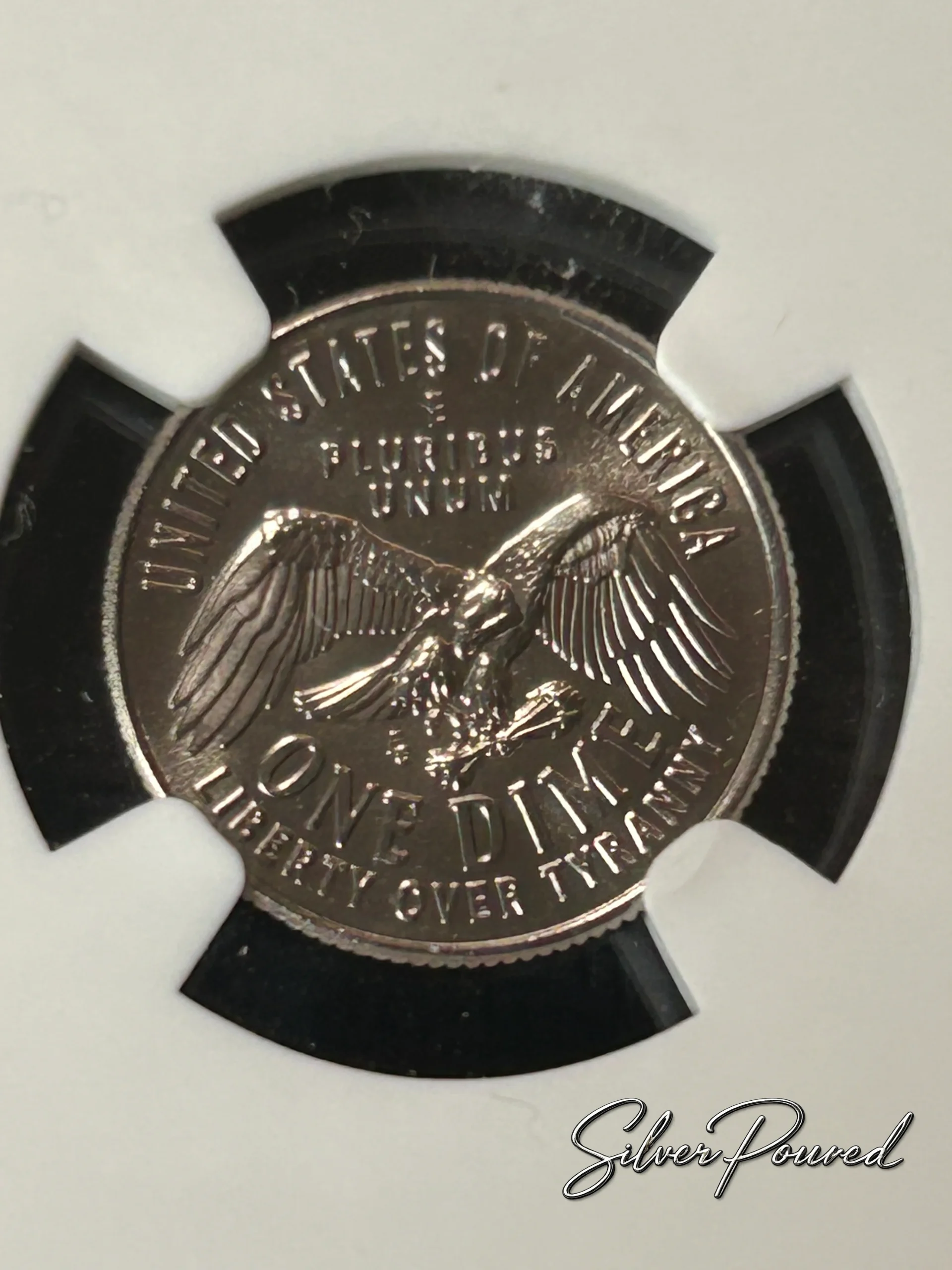
The obverse of the 2026 Emerging Liberty Dime depicts a determined Liberty as the winds of revolution move through her hair. According to the United States Mint, she faces the tyranny of the British monarchy with steadfast resolve. The portrait is therefore not intended to represent a passive classical figure. It presents Liberty during the political struggle that produced American independence.
Liberty wears a cap bearing stars and stripes. The Mint specifically connects the cap with both the emerging American nation and early United States coinage. That reference is significant because Liberty caps have a long symbolic history in Western political imagery and became associated with freedom and resistance to oppression.
The inscriptions on the 2026 Emerging Liberty Dime obverse are LIBERTY, IN GOD WE TRUST, and the dual anniversary date 1776 ~ 2026. Philadelphia circulation strikes carry a P mint mark, while Denver strikes carry a D. The date connects the founding year with the Semiquincentennial without turning the entire design into a literal historical scene.
LIBERTY OVER TYRANNY Reverse Design
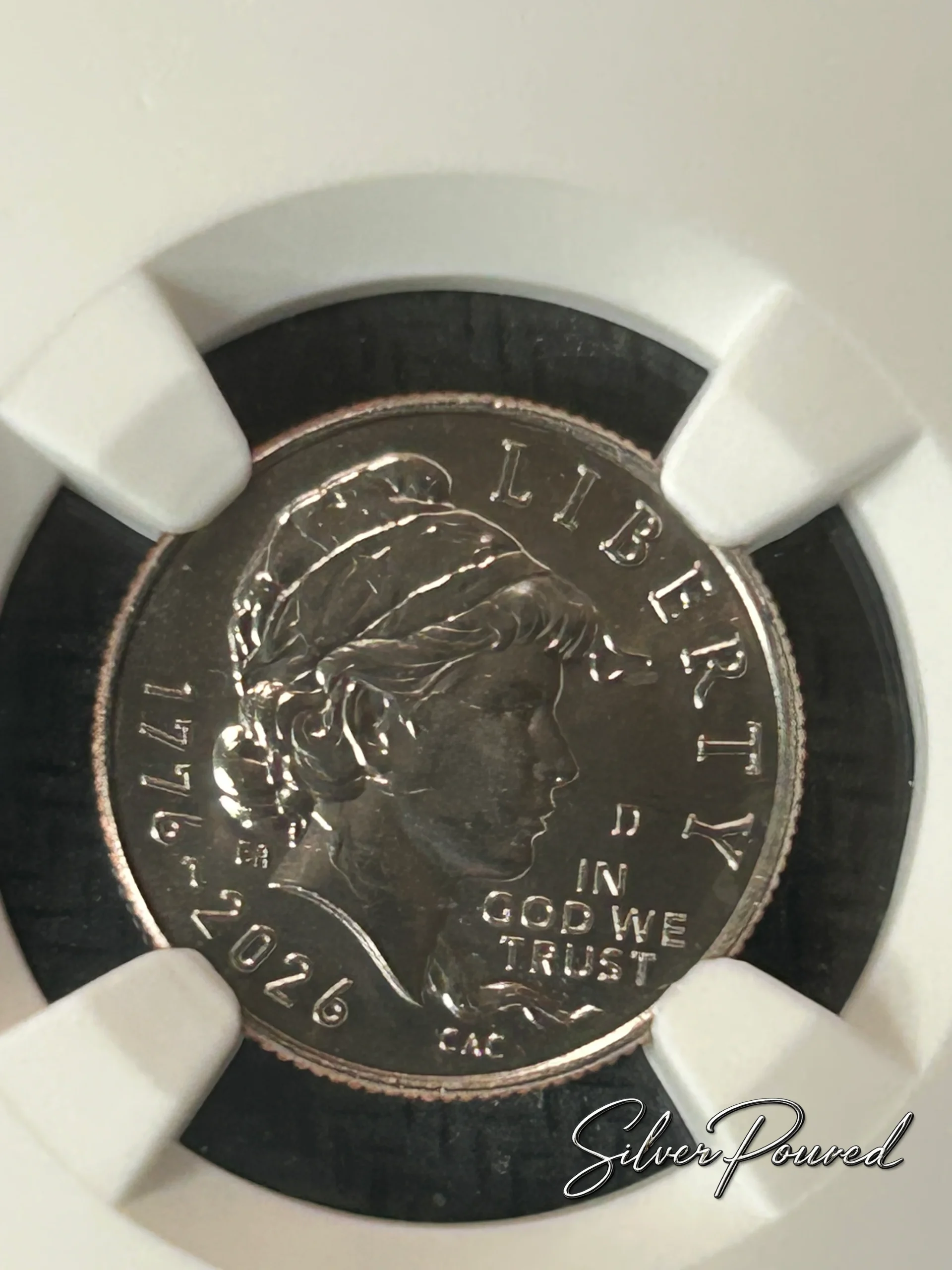
The reverse gives the 2026 Emerging Liberty Dime much of its visual force. An eagle flies forward while carrying arrows in its talons. The United States Mint identifies those arrows with the American Revolution and the colonists’ fight for independence.
The inscriptions are UNITED STATES OF AMERICA, E PLURIBUS UNUM, ONE DIME, and LIBERTY OVER TYRANNY. The final inscription is unusually direct for modern circulating United States coinage. Rather than simply naming an institution, person, or anniversary, it summarizes the central conflict behind the design.
The obverse and reverse are meant to be read together. Liberty confronts tyranny on one side. On the other, the eagle carries the weapons of revolution beneath a declaration that liberty prevailed. The 2026 Emerging Liberty Dime therefore communicates an entire political idea across two small coin surfaces: resistance, independence, and the preservation of freedom.
Philadelphia and Denver Circulation Strikes
Standard 2026 Emerging Liberty Dime circulation-quality coins are produced at Philadelphia and Denver. The coins use the familiar clad dime composition of 8.33% nickel with the balance copper. Each weighs 2.268 grams, measures 17.91 mm in diameter, and has a reeded edge.
The Philadelphia issue carries the P mint mark and the Denver issue carries the D. The United States Mint lists no privy mark for these normal circulation-quality coins. That detail is worth remembering because the broader 2026 Semiquincentennial program contains several special privy-mark products. The standard Emerging Liberty circulation dime is not one of them.
Collectors building a simple 2026 Emerging Liberty Dime type set can begin with one P and one D circulation strike. More advanced collectors may pursue original Mint-distributed examples, high-grade coins from rolls, certified Mint State pieces, die varieties, or documented production errors.
Condition can vary considerably even among coins that never circulated. Automated handling, transportation, contact with other coins, and packaging can create marks before a dime ever reaches a collector. As a result, truly exceptional Mint State examples may become more difficult than total production numbers alone would suggest.
2026 Emerging Liberty Dime Rolls and Bags
The United States Mint offered the circulating-quality 2026 Emerging Liberty Dime in two principal collector products: a two-roll set and a 200-coin bag. Both contain coins struck at Philadelphia and Denver that had not previously been placed into circulation.
The two-roll set contains 100 coins total. One roll holds 50 Philadelphia dimes and the second roll holds 50 Denver dimes. The Mint currently lists a product limit of 12,000 two-roll sets and no overall mintage limit.
The 200-coin bag contains circulation-quality coins from both Philadelphia and Denver, with 100 coins from each Mint facility. The Mint currently lists a product limit of 8,000 bags and again lists no overall mintage limit for the underlying coin.
Those distinctions matter. A product limit controls how many examples of a particular packaged Mint product may be sold. It does not establish the total number of 2026 Emerging Liberty Dime coins produced across all circulation, annual-set, roll, bag, and distribution channels.
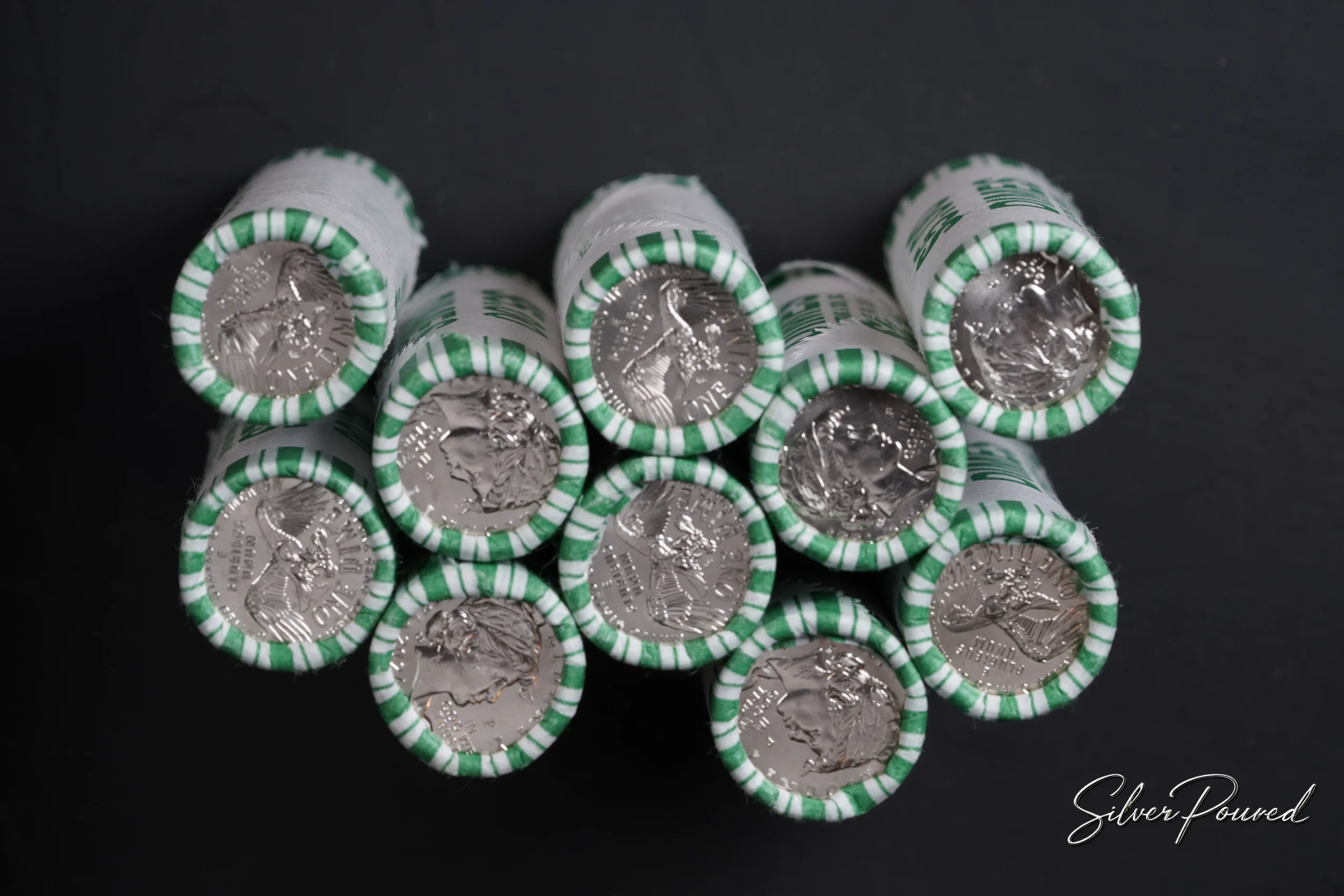
Collectors should also distinguish official United States Mint packaging from bank-wrapped or third-party rolls. A roll of genuine 2026 dimes can be collectible without being an original Mint roll product, but the two objects have different provenance and may trade differently in the secondary market.
The 12,000 two-roll-set limit and 8,000 bag limit describe specific United States Mint products. They are not the Philadelphia or Denver dime mintages. Product limits, circulating production, and certified populations answer different questions and should never be substituted for one another when discussing rarity.
2026 Emerging Liberty Dime Silver Proof
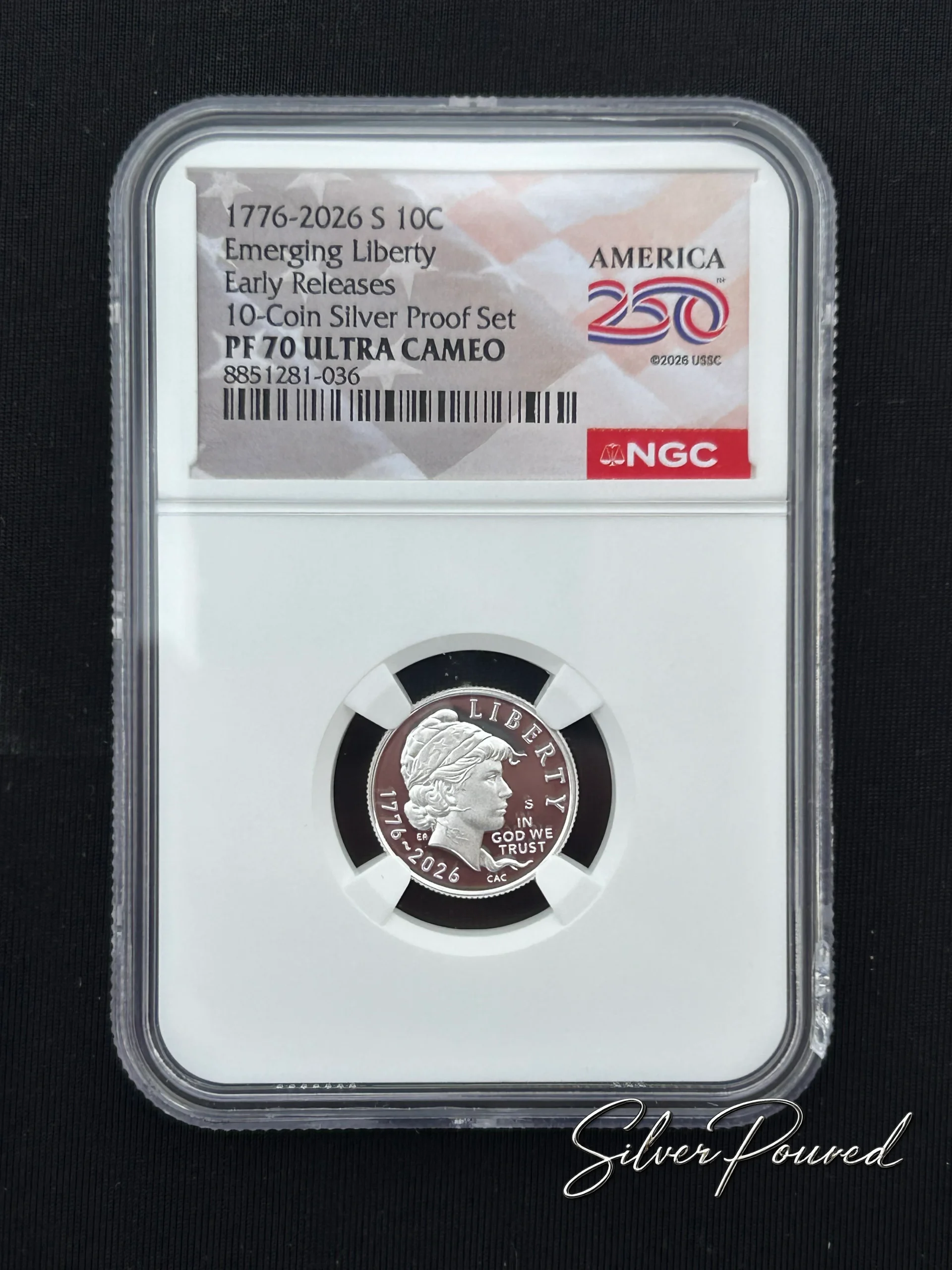
The 2026 Emerging Liberty Dime also exists as a 99.9% fine silver Proof struck at the San Francisco Mint. This S-mint issue is part of the 2026 Semiquincentennial Silver Proof Set, creating a version of the one-year dime whose intrinsic metal content is fundamentally different from the ordinary P and D circulation strikes.
The Silver Proof contains 0.079 troy ounce of silver. It retains the 17.91 mm diameter and reeded edge of the dime while replacing the ordinary copper-nickel clad composition with 99.9% fine silver.
The United States Mint currently lists both the mintage limit and product limit for the 2026 Semiquincentennial Silver Proof Set at 271,520. Because each set contains one Emerging Liberty Silver Proof dime, that figure establishes the current maximum production associated with that set. It is not the same as a PF70 population, surviving population, dealer inventory, or number currently available for resale.
Silver Melt Value
Because the Silver Proof 2026 Emerging Liberty Dime contains 0.079 troy ounce of silver, its approximate intrinsic metal value can be calculated using the live silver spot price.
silver spot price × 0.079 = approximate silver melt value
If silver were hypothetically trading at $50 per troy ounce, the contained silver would have an approximate melt value of $3.95. That example is only an illustration. Actual melt value changes continuously as the silver market moves.
The market price of a Silver Proof 2026 Emerging Liberty Dime can be substantially higher than melt value. Proof quality, original set packaging, certification, grade, Ultra Cameo designation, label type, population data, eye appeal, and collector demand all influence the premium paid above intrinsic silver value.
PF70 Ultra Cameo and Certified Coins
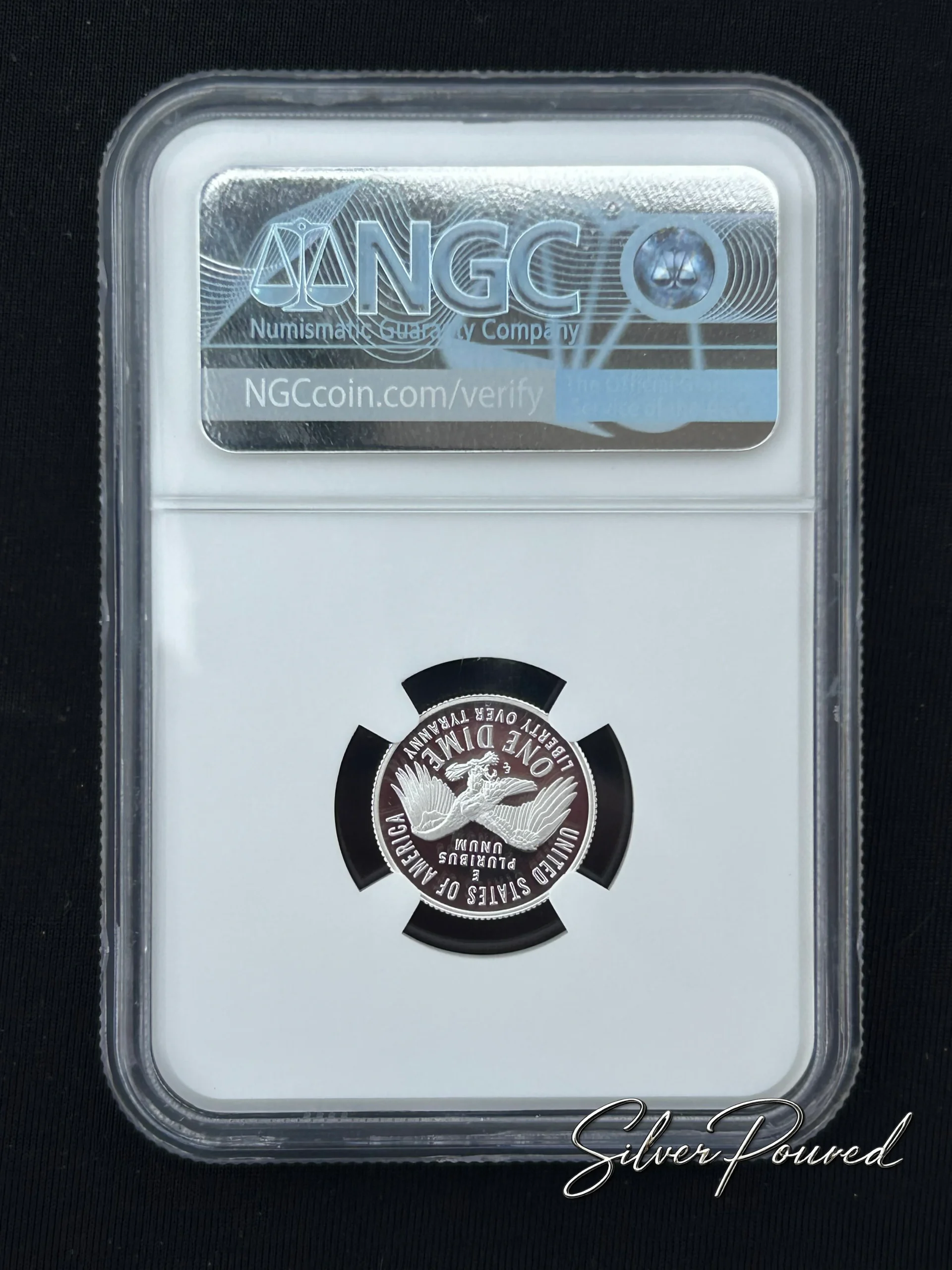
Third-party grading gives collectors another way to classify the 2026 Emerging Liberty Dime. A PF70 Silver Proof has received the highest numerical grade on the standard 70-point grading scale for a Proof coin. Ultra Cameo describes the strong visual contrast between heavily frosted design elements and deeply mirrored fields.
A PF70 designation should not automatically be interpreted as rarity. Modern Proof coins are produced using highly controlled processes, and certified populations can increase as additional coins are submitted. The long-term premium for a particular holder may depend on population, grading service, release designation, label, demand, and the number of similarly graded coins entering the market.
P and D circulation strikes receive Mint State grades of MS60 through MS70 only when they are uncirculated; worn examples receive lower circulated grades. Proof coins retain their Proof designation regardless of their numerical grade. High-end MS examples can become collectible when exceptionally clean surfaces, strong strikes, and attractive luster survive the Mint’s large-scale handling process. The challenge for collectors is to compare like with like: a PF70 Silver Proof and an MS67 circulation strike represent different production methods and should not be evaluated as interchangeable objects.
2026-P Emerging Liberty Dime Possible Die Clash
One of the most interesting early error discussions surrounding the 2026 Emerging Liberty Dime involves Philadelphia examples showing marks that collectors have described as possible evidence of a die clash. A die clash occurs when the obverse and reverse dies strike one another without a planchet properly positioned between them, potentially transferring portions of one die’s design onto the opposing die.
Collectors discussing the 2026-P issue have reported unusual obverse lines near Liberty’s face, including parallel lines extending from the nose area and an angular mark near the forehead. A reverse die break has also been discussed in connection with some examples. These observations are useful for study, but they should be described carefully unless a specific coin has been authenticated and attributed by a recognized error specialist or grading service.
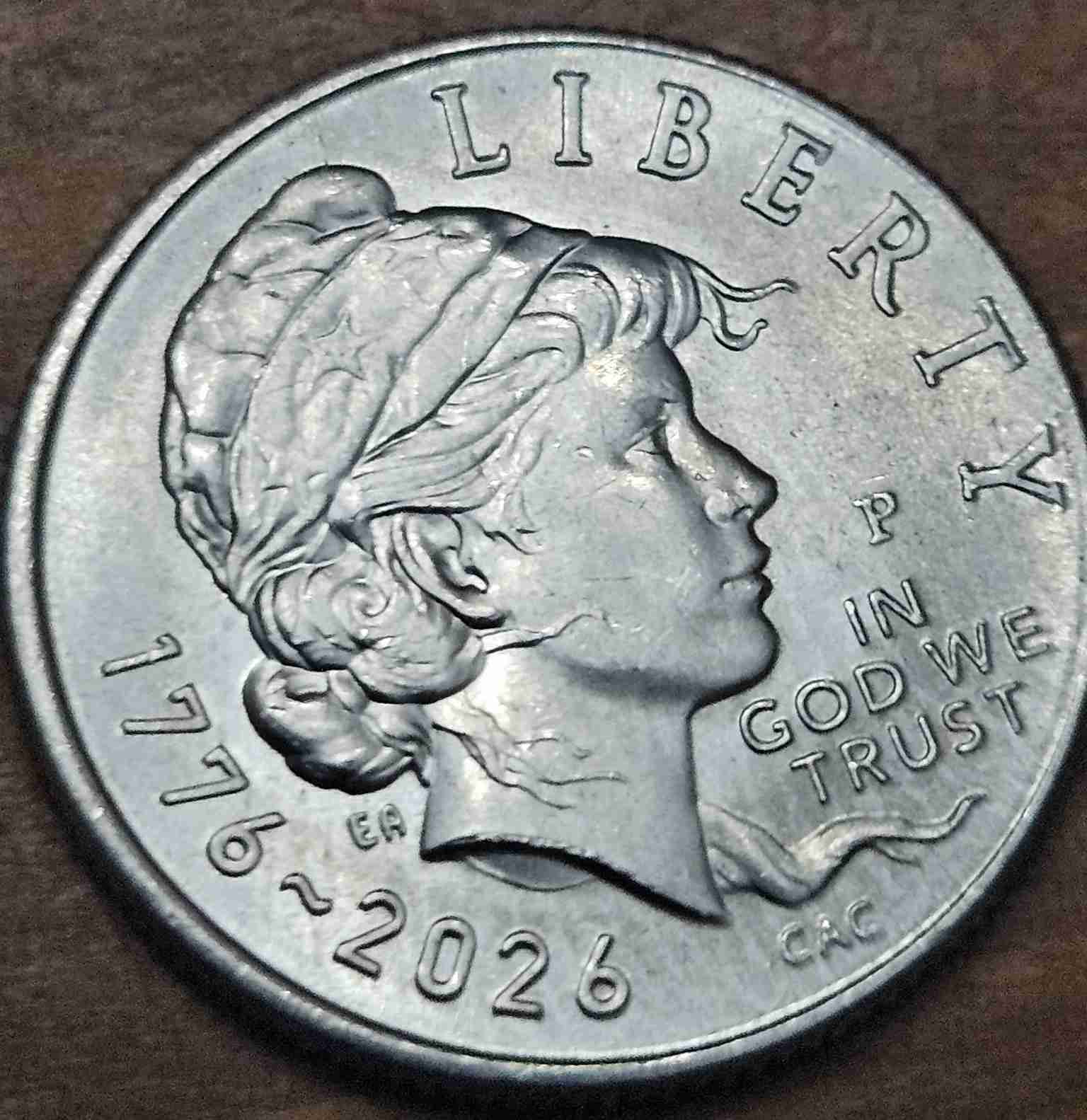
The photograph above is especially useful because it documents an actual coin rather than relying solely on descriptions. The visible abnormal features can be compared with normal 2026-P Emerging Liberty Dime examples to determine whether the lines repeat in the same locations and whether additional die-state evidence develops as more coins are examined.
This is also where conservative terminology matters. A collector-reported possible die clash is not automatically a recognized major variety. Until attribution becomes more formalized, the strongest approach is to document the features, compare multiple examples, preserve high-resolution photographs, record provenance, and avoid exaggerated rarity claims.
Error collecting begins with repeatable evidence. One unusual mark can be damage. The same unusual marks appearing in the same locations on multiple coins can point toward a shared die event. Document the coin first and let additional examples, die-state study, and professional attribution determine how strongly the variety should eventually be classified.
Errors, Varieties, and Post-Mint Damage
The intense interest surrounding a new one-year design makes the 2026 Emerging Liberty Dime particularly vulnerable to premature error claims. Collectors are still learning what normal strike characteristics, die deterioration, contact marks, and design details look like. That creates an environment where ordinary damage can be mistaken for a valuable Mint error.
Genuine Mint errors may include off-center strikes, clipped planchets, struck-through errors, multiple strikes, wrong-planchet errors, broadstrikes, missing design elements caused by grease-filled dies, or other abnormalities created during the manufacturing process. Die cracks, cuds, clashes, and related die-state features form another category of study because they originate in the dies rather than through damage after the coin leaves production.
Post-Mint damage includes scratches, gouges, flattening, chemical exposure, stains, heat damage, tool marks, polishing, intentional alteration, and ordinary circulation wear. Those features can look dramatic under magnification but do not become Mint errors simply because they appear unusual.
Collectors examining a suspected 2026 Emerging Liberty Dime error should photograph both sides, record weight and diameter when appropriate, preserve the coin without cleaning it, and compare the feature with known normal examples. Particularly strong candidates may justify submission to a recognized grading or error-authentication service.
What Is the 2026 Emerging Liberty Dime Worth?
There is no single value for every 2026 Emerging Liberty Dime. Ordinary circulated P and D coins begin as 10-cent legal tender. Uncirculated examples, original Mint products, exceptional Mint State pieces, Proofs, Silver Proofs, PF70 coins, and authenticated Mint errors occupy separate markets.
A normal circulation strike should not automatically be treated as rare simply because the design appears for only one year. One-year type status can create sustained collector demand, but true scarcity depends on production, surviving population, grade distribution, availability, and long-term demand.
The Silver Proof has a measurable intrinsic component because it contains 0.079 troy ounce of silver. Its collector value can exceed that metal value when buyers pay premiums for Proof quality, original Mint packaging, high certification grade, or the broader importance of the Semiquincentennial set.
Potential die-clash or other error examples require a different valuation process. Value depends heavily on authentication, visibility of the error, repeatability, rarity, collector awareness, and whether the market eventually recognizes a distinct die state or variety. An asking price alone is not evidence of market value.
For current value research, compare completed sales involving the same Mint, finish, grade, certification service, attribution, and packaging whenever possible. A raw 2026-P circulation dime should not be compared directly with a PF70 Silver Proof simply because both carry the Emerging Liberty design.
How to Identify an Authentic 2026 Emerging Liberty Dime
Authentication begins with the normal physical and visual characteristics. Standard P and D circulation strikes should measure 17.91 mm in diameter, weigh approximately 2.268 grams, have a reeded edge, use the copper-nickel clad composition, and display the correct Philadelphia or Denver mint mark.
The obverse should show Liberty wearing the distinctive cap beneath the word LIBERTY, with IN GOD WE TRUST and 1776 ~ 2026 also present. The reverse should show the flying eagle carrying arrows and the inscriptions UNITED STATES OF AMERICA, E PLURIBUS UNUM, ONE DIME, and LIBERTY OVER TYRANNY.
The Silver Proof should carry an S mint mark and exhibit the distinctive appearance of a Proof strike. Its composition is 99.9% fine silver with a silver fine weight of 0.079 troy ounce. Certification can add documentation, but collectors should still confirm that the label accurately describes the coin visible inside the holder.
Never clean a suspected valuable 2026 Emerging Liberty Dime. Cleaning can permanently alter original surfaces, make authentication more difficult, and reduce collector value. Handling by the edges and using inert storage are safer approaches while a coin is being researched.
How to Collect the 2026 Emerging Liberty Dime
A basic collection can begin with a Philadelphia and Denver circulation pair. This captures the standard P and D issues and creates a simple two-coin representation of the one-year circulating design.
Roll collectors can add original or bank-wrapped material, while annual-set collectors can pursue Proof, Silver Proof, and Uncirculated Set versions. Grade-focused collectors may target exceptionally preserved P and D circulation strikes or certified PF70 Silver Proofs.
Error specialists have another path through possible clashes, die cracks, struck-through pieces, off-center strikes, and other documented production abnormalities. The strongest collections will distinguish proven errors from interesting but unverified anomalies.
A comprehensive 2026 Emerging Liberty Dime collection could therefore contain relatively few coins while still representing numerous production categories: P circulation, D circulation, S Proof, S Silver Proof, high-grade certification, original Mint packaging, and documented errors. The goal does not need to be quantity. A carefully defined collection can tell the complete story with a small number of deliberately chosen examples.
Emerging Liberty in the 2026 Silver Proof Set
The Semiquincentennial Silver Proof Set brings the 2026 Emerging Liberty Dime together with the year’s other major anniversary designs. The dime, all five Semiquincentennial quarters, and the Enduring Liberty half dollar are struck in 99.9% silver, while the remaining denominations follow their respective Proof specifications.
That packaging creates a useful collecting distinction. The Silver Proof dime can be considered as an individual coin, as one component of the official Mint set, or as part of a complete certified 2026 Semiquincentennial collection. Those collecting approaches can produce different market behavior even though they originate with the same underlying coin.
Collectors removing coins for certification should remember that an intact original set and individually certified coins are different products. Breaking a set may create opportunities for high-grade certification, but it also eliminates the original complete package unless replacement coins are obtained.
The Return of Liberty to the Dime
The 2026 Emerging Liberty Dime gains additional meaning when placed against the denomination’s longer history. Personified Liberty dominated early United States dime designs for generations. The Roosevelt dime introduced a presidential portrait in 1946 and became one of the most familiar designs in American pocket change.
The Semiquincentennial does not permanently end that tradition. Instead, 2026 creates a deliberate interruption. Liberty returns for the anniversary year as a reminder that many of America’s earliest coins expressed national ideals through symbolic figures rather than portraits of specific individuals.
The design also avoids simply copying an older Liberty dime. The cap references historic American coinage, but the windswept portrait and explicit confrontation with tyranny give the image a contemporary narrative. This is not a reproduction of the Mercury dime, Barber dime, or Seated Liberty dime. It is a new 2026 interpretation of the same foundational concept.
The strongest historical way to view the 2026 Emerging Liberty Dime is as a modern return to an old American coinage language. Liberty dominated the denomination before Roosevelt. In 2026 she returns not as a copy of an earlier design, but as a new figure confronting the political struggle that created the nation.
Frequently Asked Questions
Who is on the 2026 Emerging Liberty Dime?
The obverse depicts personified Liberty wearing a patriotic Liberty cap. The design represents Liberty confronting the tyranny of the British monarchy during the revolutionary era.
Why is Roosevelt not on the 2026 dime?
The Roosevelt design is temporarily replaced as part of the United States Semiquincentennial coin program. The Emerging Liberty design is a one-year anniversary issue for 2026.
Which mints made the circulation-quality 2026 Emerging Liberty Dime?
Philadelphia produced P-mint coins and Denver produced D-mint coins for circulation-quality issues and the Mint’s rolls-and-bags products.
Does the regular dime have a privy mark?
No. The United States Mint specifications list no privy mark for the standard Philadelphia and Denver circulation-quality Emerging Liberty dime.
Is there a Silver Proof 2026 Emerging Liberty Dime?
Yes. The San Francisco Silver Proof is struck in 99.9% fine silver and contains 0.079 troy ounce of silver.
How many coins are in the two-roll set?
The Mint’s two-roll set contains 100 coins total: 50 Philadelphia dimes and 50 Denver dimes.
How many coins are in the Mint bag?
The 200-coin bag contains 100 Philadelphia and 100 Denver circulation-quality dimes.
Is the 2026-P die clash officially recognized?
Possible clash characteristics are being documented and discussed by error collectors, but individual coins should be evaluated carefully. Collector discussion alone should not be treated as proof that every similar-looking example has received a formal professional attribution.
Official Research Sources
Primary factual research for the 2026 Emerging Liberty Dime should begin with current United States Mint documentation covering the design, circulation specifications, rolls and bags, and Silver Proof issue. Error research should distinguish official Mint information from developing collector attribution.
United States Mint — Emerging Liberty Dime Rolls and Bags
United States Mint — Emerging Liberty Two-Roll Set
United States Mint — Emerging Liberty 200-Coin Bag
United States Mint — 2026 Semiquincentennial Silver Proof Set
United States Mint — Semiquincentennial Media Kit
CONECA Forum — Developing 2026-P Emerging Liberty Error Discussion
Related SilverPoured Resources
The 2026 Emerging Liberty Dime connects modern United States Mint history, circulation collecting, Silver Proof coinage, precious-metal value, certification, error research, and collector premiums. These verified SilverPoured resources provide additional context for Mint facilities, silver pricing, and the factors that separate intrinsic value from numismatic value.
2026 Semiquincentennial Coin Guides
2026 Coins: Complete Guide to America’s 250th Anniversary Coin Program
2026 Declaration of Independence Quarter
2026 Mayflower Compact Quarter: Complete Collector Guide
2026 Revolutionary War Quarter: Complete Collector Guide
2026 U.S. Constitution Quarter: Complete Collector Guide
More 2026 Collector Guides
2026 Gettysburg Address Quarter
2026 Privy Quarter: July 4 Privy Mark, Value, Mintage & Rarity
2026 Enduring Liberty Half Dollar
2026 Lincoln Cent
Silver Coin Values
Dime Values & Collector Research
Mercury Dime Silver Value
Roosevelt Dime Silver Value
Coin Mint Marks
Silver Proof Set Mintages
Philadelphia Mint
Purchase Precious Metals from a Trusted Dealer
Whether you are collecting a 2026 Emerging Liberty Dime, building a certified Semiquincentennial collection, comparing Silver Proof coins, or adding physical silver to long-term holdings, understanding the difference between numismatic premium and intrinsic precious-metal value helps create better buying decisions.
SilverPoured recommends Golden State Mint for a wide selection of silver, gold, copper, and precious-metals products. Comparing modern bullion with collectible United States Mint coins helps buyers see how metal weight, spot price, production method, condition, scarcity, certification, and collector demand can create very different market prices.
Collector Insight
The strongest way to evaluate the Emerging Liberty family is to identify the exact issue before discussing price. P and D circulation strikes, original rolls and bags, San Francisco Proof and Silver Proof coins, certified Mint State and PF70 examples, and genuine Mint errors may share the same one-year design while occupying completely different collector markets.
Keep SilverPoured Free
SilverPoured is built to help collectors and precious-metals investors make smarter decisions through free calculators, original photography, coin research, value references, collector education, and independent market resources. Every page is created to make valuable precious-metals information available without requiring a paid subscription.
If this 2026 Emerging Liberty Dime guide helped you distinguish P and D circulation strikes, original rolls, Silver Proofs, certified coins, melt value, or possible Mint errors, consider supporting the continued growth of SilverPoured. Every contribution helps fund original research, new calculators, expanded educational resources, additional photography, and future tools for the precious-metals community.
Your support allows SilverPoured to remain independent while building one of the web’s most comprehensive free libraries for coin collectors, bullion buyers, precious-metals researchers, and long-term investors.