
Proof Set mintages tell one of the most revealing stories in modern United States coin collecting. From the tiny production levels of the first modern Proof issues in 1936 to multimillion-set peaks during the 1960s, 1970s, and 1980s, annual Proof Set demand has changed dramatically as coin designs, precious-metal content, Mint packaging, collector demographics, and special programs evolved.
This SilverPoured historical archive brings Proof Set mintages, Silver Proof Set history, production changes, important collector issues, and modern United States Mint sales data into one reference. The goal is not simply to publish a long list of numbers. Understanding what those numbers actually measure is essential because a coin mintage, packaged-set production figure, cumulative sales total, product limit, and mintage limit are not automatically the same thing.
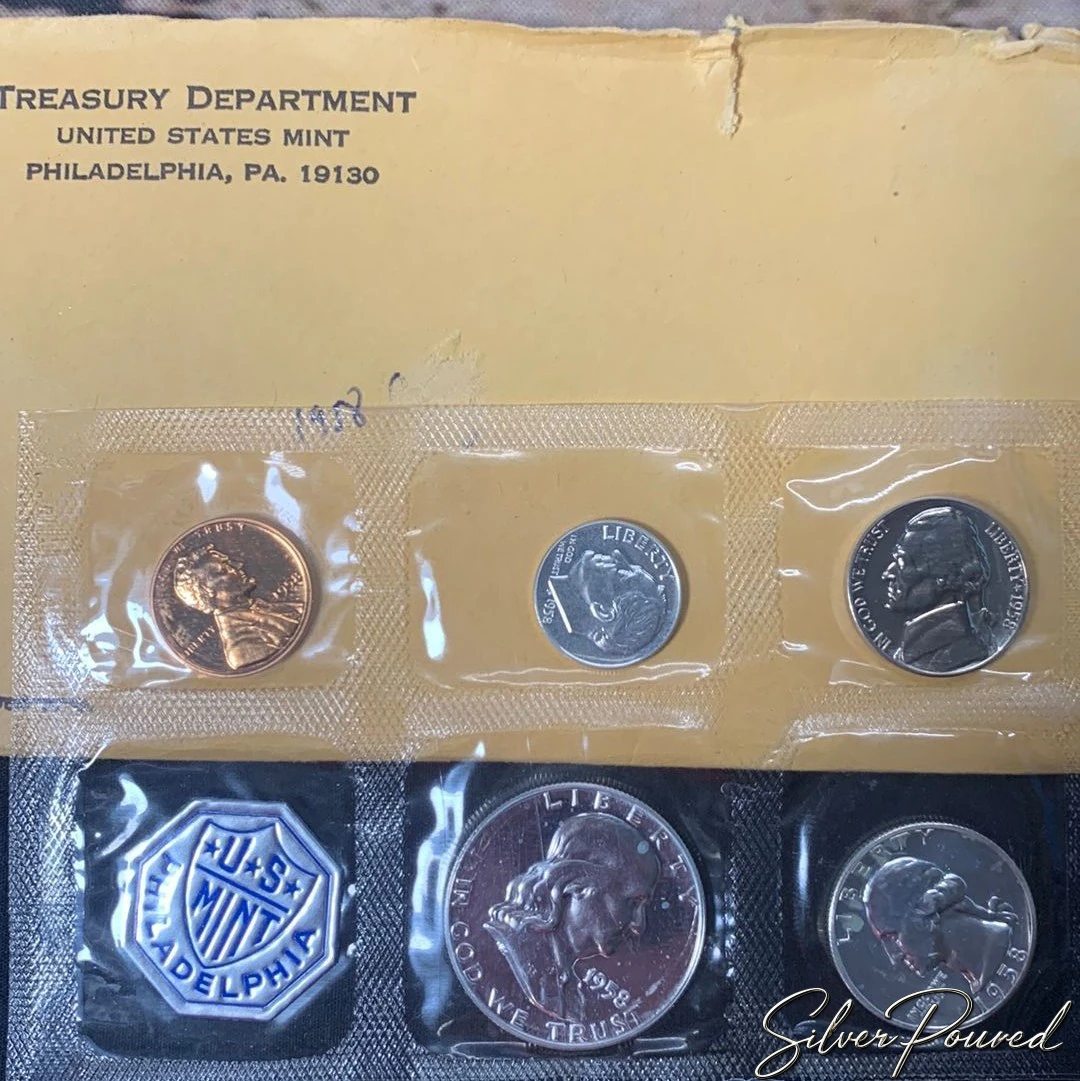
What Is a United States Mint Proof Set?
A United States Mint Proof Set is a collector product containing specially manufactured Proof versions of the year’s coinage. Modern Proof coins are produced with carefully prepared dies and planchets to create sharply defined details, reflective fields, and contrasting devices. They are collector coins rather than ordinary circulation strikes.
The composition of an annual Proof Set changes with the circulating coinage of its era. A five-coin set once meant a cent, nickel, dime, quarter, and half dollar. Later sets grew as dollar coins and multiple annual quarter designs entered the program. Special collector products such as Silver Proof Sets, Prestige Sets, Limited Edition Silver Proof Sets, Bicentennial sets, and commemorative combinations expanded the meaning of Proof collecting even further.
| Reference Term | What It Means |
|---|---|
| Proof coin | A specially manufactured collector coin produced with a Proof finish. |
| Proof Set | A packaged United States Mint product containing Proof coins representing the year’s designated coinage. |
| Proof Set mintage | A historical production reference associated with a Proof Set issue; methodology can vary by era and source. |
| Set sales | The number of packaged sets reported sold, often subject to later returns, cancellations, and reconciliation. |
| Mintage limit | The maximum authorized quantity the Mint may produce under a stated product specification. |
| Product limit | The maximum quantity the Mint plans to offer in a particular packaged product. |
This terminology is especially important on a Proof Set mintages database. Historical reference books and Mint reports do not always use identical measurements. SilverPoured therefore separates unlike metrics rather than placing a sales figure beside a production limit and implying they measure the same thing.
Why Proof Set Mintages Need Historical Context
The modern Proof era began in 1936 after a long interruption in regular Proof coin production for collectors. Understanding Proof Set mintages from this earliest modern period requires more than comparing annual totals, because the Mint’s selling and packaging practices were different from those used for later annual sets. Those early Proof Set mintages therefore need to be read within the production system of their own era.
This distinction illustrates a larger principle that applies throughout Proof Set history: the number printed beside a year must be understood in the context of how the Mint sold, packaged, and reported that year’s coins. Proof Set mintages are most useful when treated as historical evidence rather than as isolated scarcity scores.
A Proof Set total and an individual Proof coin mintage are not automatically interchangeable. In 1936, the five Proof denominations could be ordered separately, and the Washington quarter had the lowest Proof mintage of the group. That makes 3,837 the theoretical maximum number of complete five-coin 1936 sets, even though more examples of several other denominations were struck.

Proof Set Mintages: 1936–1942
The first modern Proof Set era was short but historically important. Production returned in 1936 and continued through 1942 before wartime priorities again interrupted the program. These prewar Proof Sets sit at the opposite end of the production spectrum from the multimillion-set issues that would follow decades later.
| Year | Historical Proof Set Mintage Reference | Historical Note |
|---|---|---|
| 1936 | 3,837 | Maximum theoretical complete sets based on the lowest-mintage Proof denomination. |
| 1937 | 5,542 | Early modern Proof era. |
| 1938 | 8,045 | Demand continued to expand. |
| 1939 | 8,795 | Prewar collector issue. |
| 1940 | 11,246 | Production moved above 10,000. |
| 1941 | 15,287 | Demand continued rising. |
| 1942 | 21,120 | Final Proof year before the wartime interruption; one- and two-nickel configurations affect historical reporting. |
The dramatic importance of these early Proof Set mintages becomes obvious when compared with later decades. A complete 1936 issue represents an entirely different production environment from an annual Proof Set struck by the millions. Survival, original packaging, surface quality, and whether individual coins were separated from their original groups also matter when collectors evaluate prewar sets today.
The Philadelphia Proof Set Era: 1950–1964
Regular Proof production returned in 1950. Through 1964, the Mint manufactured and packaged its Proof Sets at Philadelphia. Proof Set mintages expanded dramatically during this period as collecting became increasingly popular with the American public. The Philadelphia-era Proof Set mintages document the transformation from a relatively specialized collector product into a major annual Mint program.
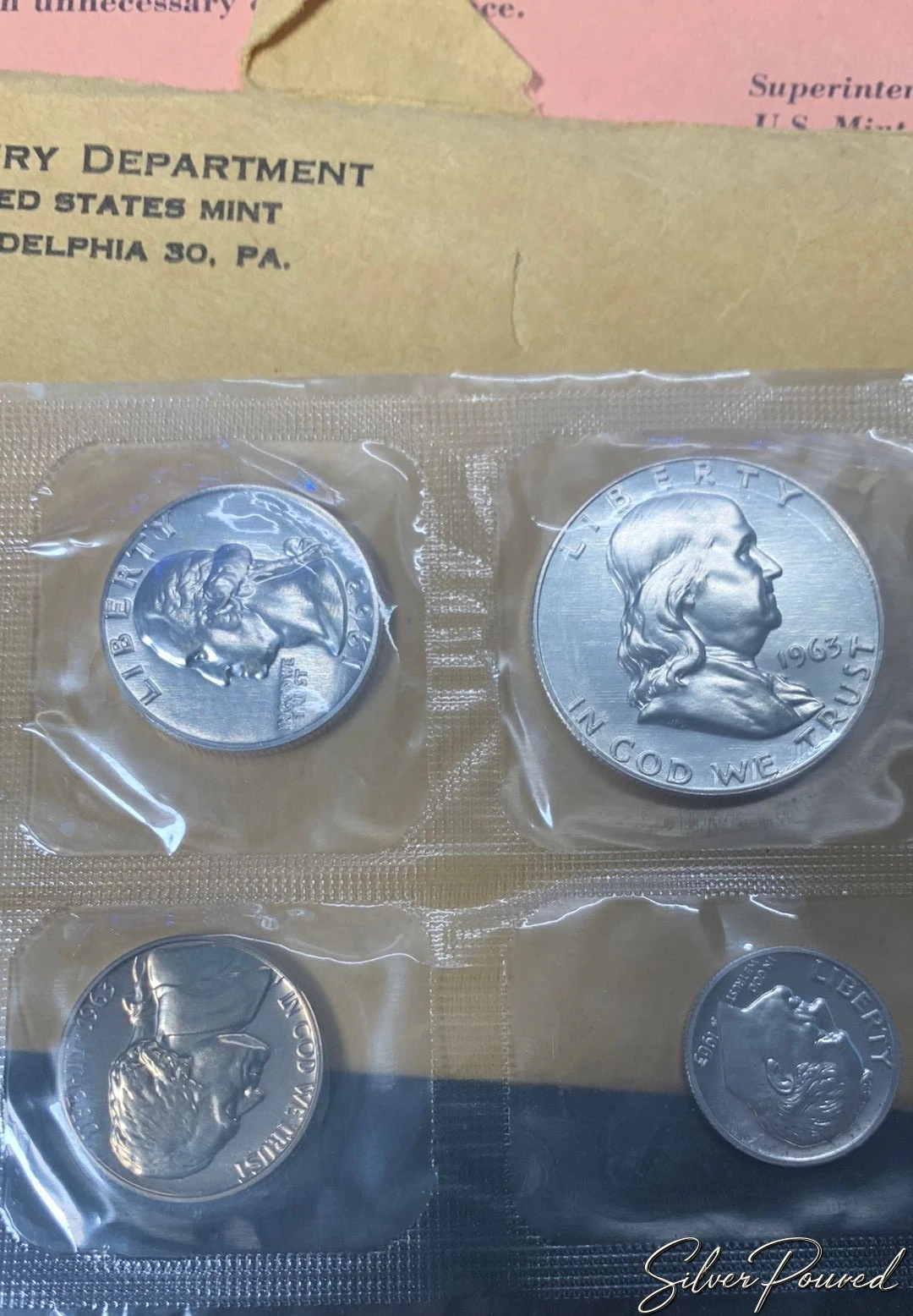
The change can be seen directly in the numbers. The 1950 issue began at only 51,386 sets. By 1957 production had exceeded one million. The 1961 issue passed three million, and 1964 reached nearly four million. Proof Set mintages had transformed from a specialized collector niche into a major United States Mint numismatic program.
| Year | Historical Proof Set Mintage Reference |
|---|---|
| 1950 | 51,386 |
| 1951 | 57,500 |
| 1952 | 81,980 |
| 1953 | 128,800 |
| 1954 | 233,300 |
| 1955 | 378,200 |
| 1956 | 669,384 |
| 1957 | 1,247,952 |
| 1958 | 875,652 |
| 1959 | 1,149,291 |
| 1960 | 1,691,602 |
| 1961 | 3,028,244 |
| 1962 | 3,218,019 |
| 1963 | 3,075,645 |
| 1964 | 3,950,762 |
The packaging also became part of the collecting story. Early 1950s sets can be encountered in box-style packaging, while later Philadelphia issues used the familiar flat-pack format with individual coin pockets and Mint material. Original government packaging can add documentary value because it helps preserve the set as the Mint originally distributed it.
Why There Are No Regular Proof Sets for 1965, 1966, or 1967
Collectors studying Proof Set mintages quickly encounter a conspicuous three-year gap. Regular Proof Sets were not produced for 1965, 1966, or 1967. The United States was dealing with a severe circulating coin shortage and a major transition away from traditional silver circulating coinage. Mint resources were redirected toward producing coins for commerce.
Instead of standard Proof Sets, the Mint offered Special Mint Sets during this period. These coins were produced to a quality above ordinary circulation strikes but were explicitly not the same as traditional Proof coins. Treating a 1965 Special Mint Set as a 1965 Proof Set erases an important historical distinction.
There are no regular United States Mint Proof Sets dated 1965, 1966, or 1967. The Mint suspended normal Proof production during the coin-shortage period and offered Special Mint Sets instead. Those sets may look more carefully made than ordinary circulation coins, but the United States Mint itself distinguished them from Proof quality.
San Francisco Takes Over Proof Production in 1968
Proof coin production returned in 1968, but the program had changed geographically. San Francisco assumed modern Proof production from Philadelphia, beginning a new chapter in Proof Set mintages that continues to define the annual program. Comparing Proof Set mintages before and after this transition also reveals how firmly the product had become established with American collectors.
This shift established the San Francisco Proof tradition that continues to define annual United States Mint Proof Sets. When collectors see an S mint mark on modern Proof coinage, it connects directly to the program’s 1968 restart.
Proof Set Mintages: 1968–1991
| Year | Historical Proof Set Mintage Reference |
|---|---|
| 1968 | 3,041,506 |
| 1969 | 2,934,631 |
| 1970 | 2,632,810 |
| 1971 | 3,220,733 |
| 1972 | 3,260,996 |
| 1973 | 2,760,339 |
| 1974 | 2,612,568 |
| 1975 | 2,845,450 |
| 1976 | 4,149,730 |
| 1977 | 3,251,152 |
| 1978 | 3,127,781 |
| 1979 | 3,677,175 |
| 1980 | 3,554,806 |
| 1981 | 4,063,083 |
| 1982 | 3,857,479 |
| 1983 | 3,138,765 |
| 1984 | 2,748,430 |
| 1985 | 3,362,821 |
| 1986 | 2,411,180 |
| 1987 | 3,972,233 |
| 1988 | 3,031,287 |
| 1989 | 3,009,107 |
| 1990 | 2,793,433 |
| 1991 | 2,610,833 |
The 1976 issue stands out immediately. Bicentennial designs on the quarter, half dollar, and Eisenhower dollar created extraordinary public interest and helped push the standard Proof Set above four million. The era also produced several varieties that collectors continue to search for, including No-S Proof errors and different mint-mark styles.
The 1976 Bicentennial Silver Proof Set Is a Different Product
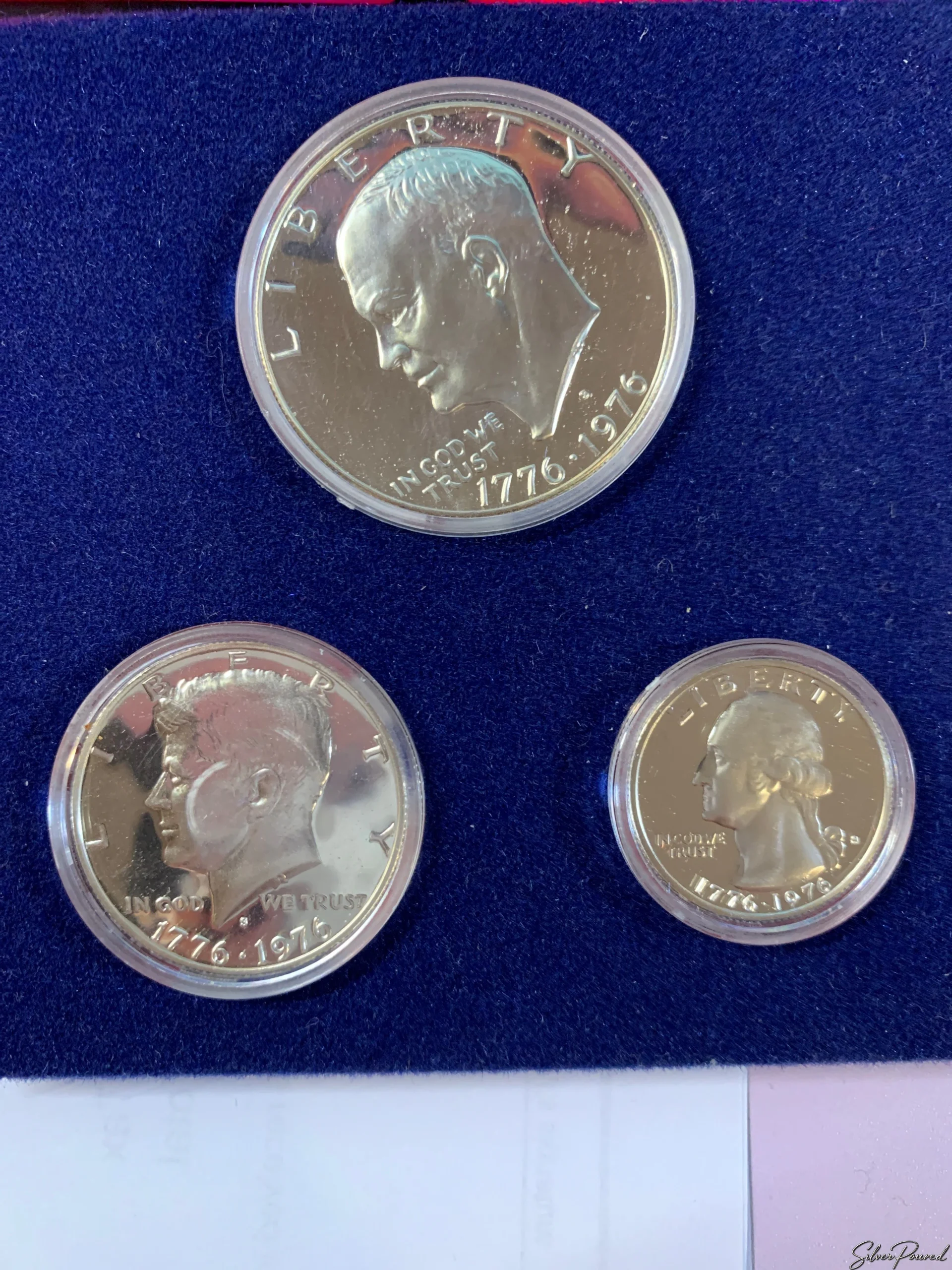
The three-coin 1976 Bicentennial silver Proof product should not be confused with the standard annual 1976 Proof Set. It contains the special Bicentennial Eisenhower dollar, Kennedy half dollar, and Washington quarter in the 40% silver collector composition. Historical references place production of this special silver Proof product at 3,998,621 sets.
That distinction matters because a search for Proof Set mintages can easily produce two very large 1976 numbers that describe different products. The standard annual Proof Set and the three-coin silver Bicentennial set served different collector markets even though both belong to the broader 1976 Proof story.
Prestige Proof Sets Added Commemoratives to the Annual Formula
The United States Mint introduced the Prestige Proof Set in 1983. Prestige Sets combined the regular Proof versions of circulating denominations with one or two commemorative coins, creating a more elaborate premium product. They belong in Proof Set history, but their production figures should remain separate from the ordinary annual Proof Set mintages.
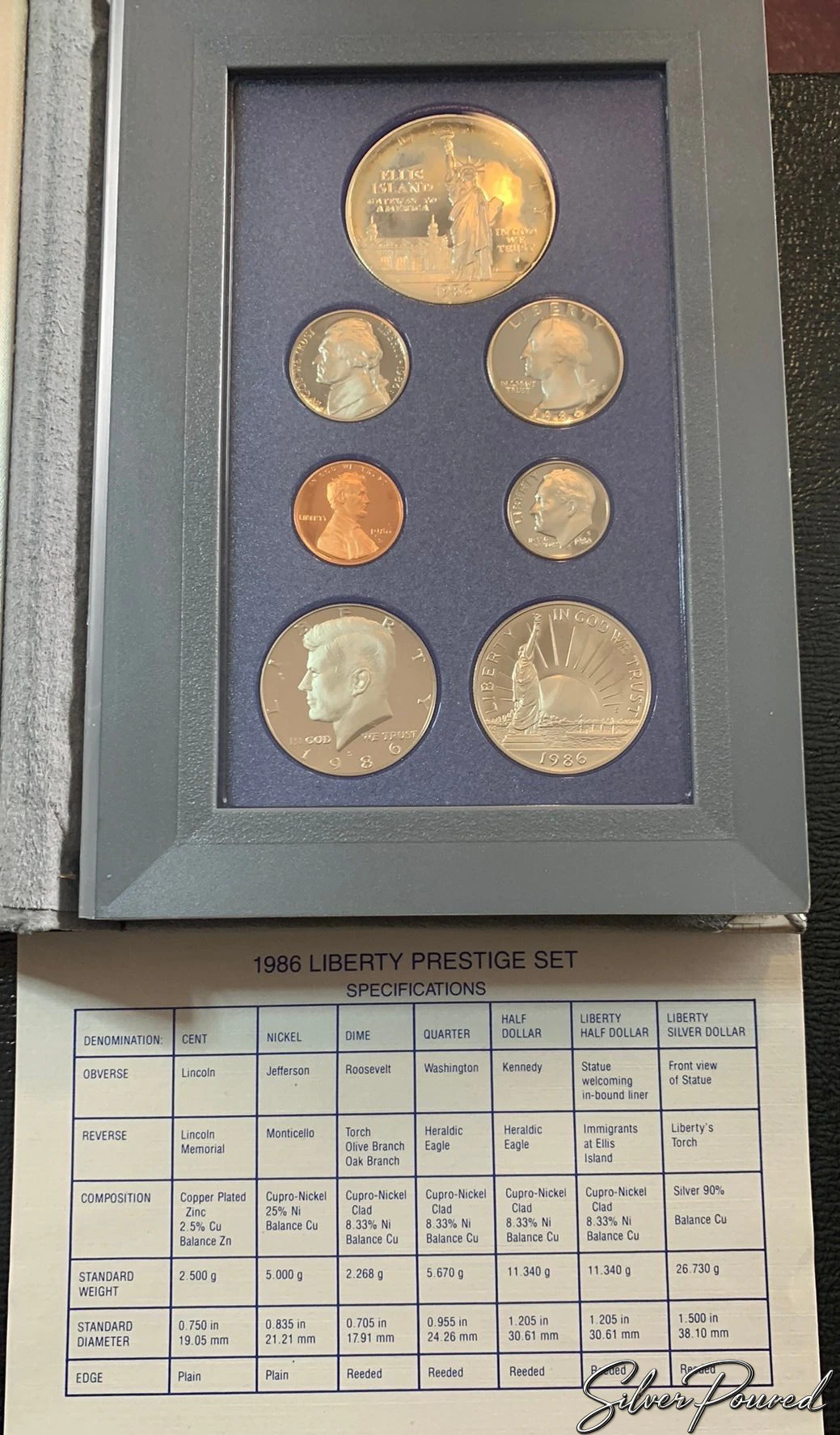
The 1986 Liberty Prestige Set is particularly important. It contains the five regular Proof denominations along with the Statue of Liberty commemorative clad half dollar and 90% silver dollar. United States Mint records identify 1986 as the Prestige program’s highest-sales year at 599,317 sets. The photograph above also preserves the Mint’s original specification panel, making it an unusually useful documentary example of how a Prestige Set was presented to collectors.
The Prestige Proof Set was not simply a more expensive package for the same five coins. Beginning in 1983, the format added commemoratives to the regular Proof denominations. The program reached its sales peak in 1986, when 599,317 sets included both Statue of Liberty commemorative coins alongside the annual Proof coinage.
Proof Set Mintages: 1992–2022
The 1990s introduced an important split in the annual collector market. Traditional Proof Sets continued, while annual Silver Proof Sets gave collectors a separate product containing silver versions of designated denominations. Standard Proof Set mintages remained much higher at first, but the long-term trend moved lower as collector choices multiplied and annual demand changed.
| Year | Historical Proof Set Mintage Reference |
|---|---|
| 1992 | 2,675,618 |
| 1993 | 2,409,394 |
| 1994 | 2,308,701 |
| 1995 | 2,010,384 |
| 1996 | 1,695,244 |
| 1997 | 1,975,000 |
| 1998 | 2,086,507 |
| 1999 | 2,543,401 |
| 2000 | 3,082,572 |
| 2001 | 2,294,909 |
| 2002 | 2,319,766 |
| 2003 | 2,172,684 |
| 2004 | 1,798,488 |
| 2005 | 2,275,000 |
| 2006 | 2,000,428 |
| 2007 | 1,702,116 |
| 2008 | 1,382,017 |
| 2009 | 1,482,502 |
| 2010 | 1,103,815 |
| 2011 | 1,098,835 |
| 2012 | 794,002 |
| 2013 | 802,460 |
| 2014 | 714,661 |
| 2015 | 662,854 |
| 2016 | 575,183 |
| 2017 | 568,678 |
| 2018 | 517,053 |
| 2019 | 600,423 |
| 2020 | 465,080 |
| 2021 | 512,603 |
| 2022 | 399,950 |
The overall trend in Proof Set mintages is unmistakable. Annual production that routinely exceeded two or three million during earlier decades eventually fell below one million and then below half a million. These declining Proof Set mintages document a major change in the scale of the modern collector market, but they do not automatically make every lower-production set scarce or valuable.
Silver Proof Set Mintages and the Annual Silver Program
The modern annual Silver Proof Set program began in 1992, creating a second major series of Proof Set mintages for collectors to follow. Silver Proof Set mintages are especially useful for comparing changes in collector demand because the series combines annual Proof coinage with designated precious-metal denominations. These figures should still be interpreted alongside composition, set contents, survival, and the exact metric being reported.
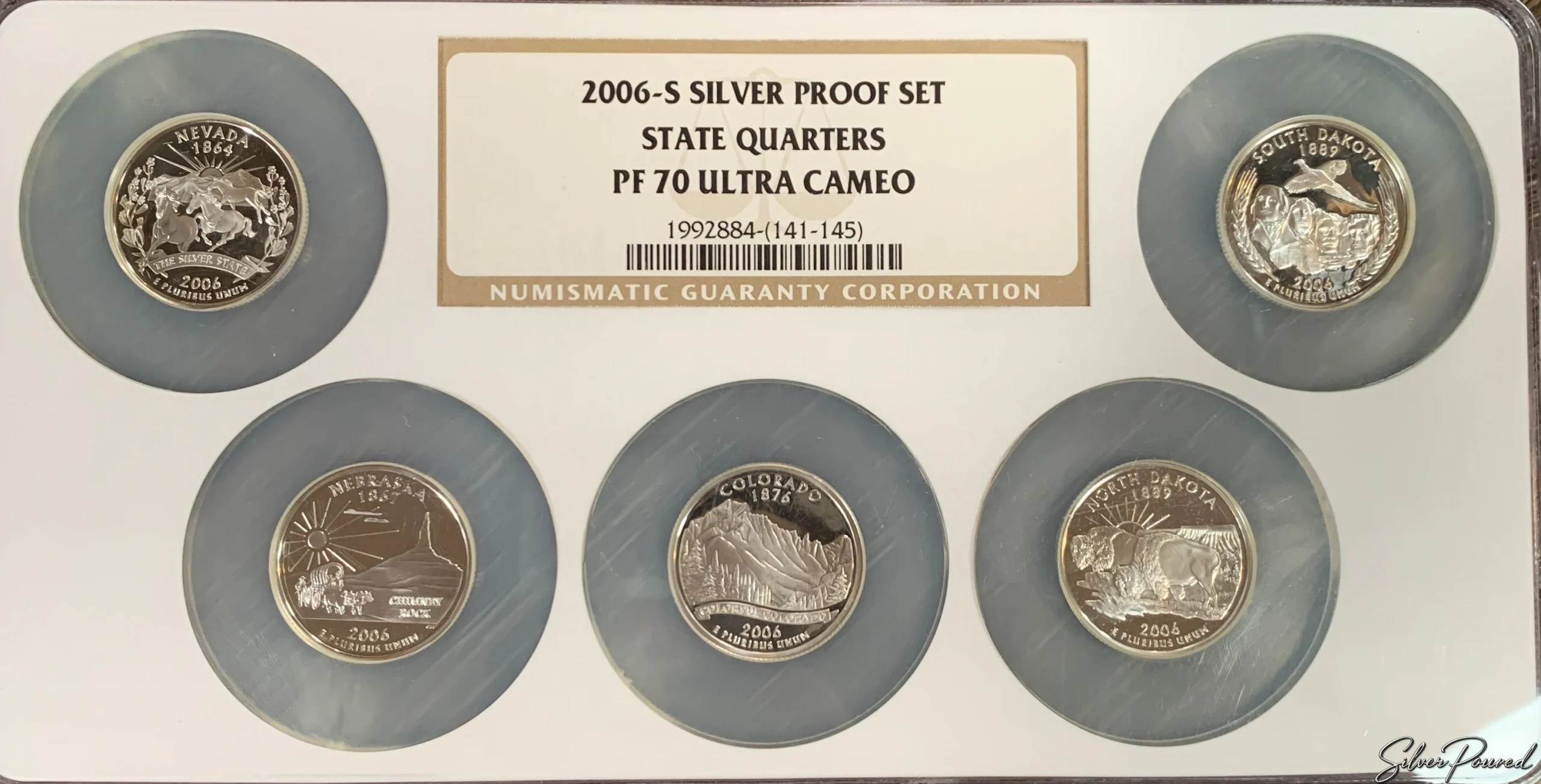
The certified 2006-S State Quarters shown above illustrate another path these sets can take after leaving original government packaging. Coins removed from Silver Proof Sets are frequently submitted to grading services, where high-grade designations create a secondary collecting market distinct from intact original sets.
How to Read Historical Silver Proof Set Production
The annual Silver Proof Set series began in 1992, but historical production and sales figures should be compared only when the underlying measurement is known. Depending on the year and source, published figures may represent production, final mintage, cumulative sales, last-reported net sales, product limits, or other Mint accounting measures. SilverPoured does not combine unlike measurements into a single continuous series and label them all as mintage.
For recent issues, the separate net-sales table below provides a clearly identified comparison using the same type of reported measurement. Older annual Silver Proof Set data can be incorporated into this historical archive as source-level production records are verified and the measurement represented by each figure can be documented consistently.
2019 Changed the Silver Proof Set Standard to .999 Silver
The 2019 annual Silver Proof Set marked an important composition change. The United States Mint identified it as the first annual Silver Proof Set in which the Roosevelt dime, America the Beautiful quarters, and Kennedy half dollar were struck in 99.9% silver. Earlier annual Silver Proof Sets used the traditional 90% silver composition for those silver denominations.
This transition matters when comparing Silver Proof Set mintages because two sets from different eras may contain similar denominations but different amounts and fineness of silver. Collectors evaluating melt value, intrinsic metal content, or long-term precious-metal exposure should therefore confirm the exact composition of the year they own.
The 2019 Silver Proof Set was a composition milestone. The dime, five quarters, and half dollar moved from the traditional 90% silver alloy to 99.9% silver. That means collectors comparing Silver Proof Set mintages across decades should also compare composition, because similar-looking annual sets can represent different quantities and fineness of precious metal.
Special Proof Products Should Not Be Mixed With Annual Proof Set Mintages
The United States Mint has repeatedly experimented with collector products that use Proof coins without being the standard annual Proof Set. These products are an important part of Proof history, but combining their production totals with ordinary Proof Set mintages would distort the historical record.
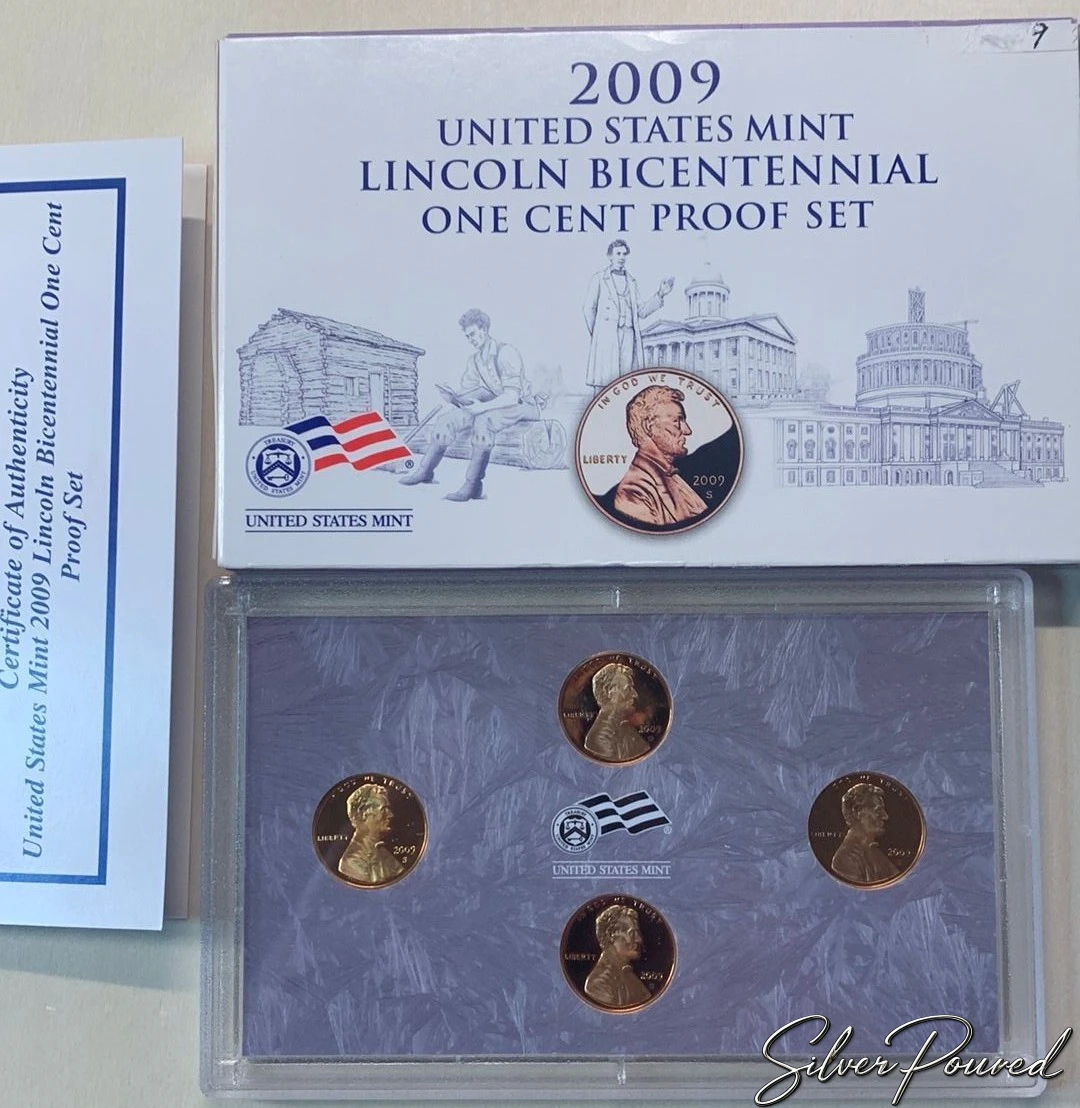
The 2009 Lincoln Bicentennial One Cent Proof Set is a good example. It is a focused collector product containing the four special 2009 Lincoln cent reverse designs rather than the year’s complete annual denomination lineup. Its role is documentary and commemorative, not a replacement for the standard 2009 Proof Set mintage entry.
Limited Edition Silver Proof Sets Created Another Premium Category
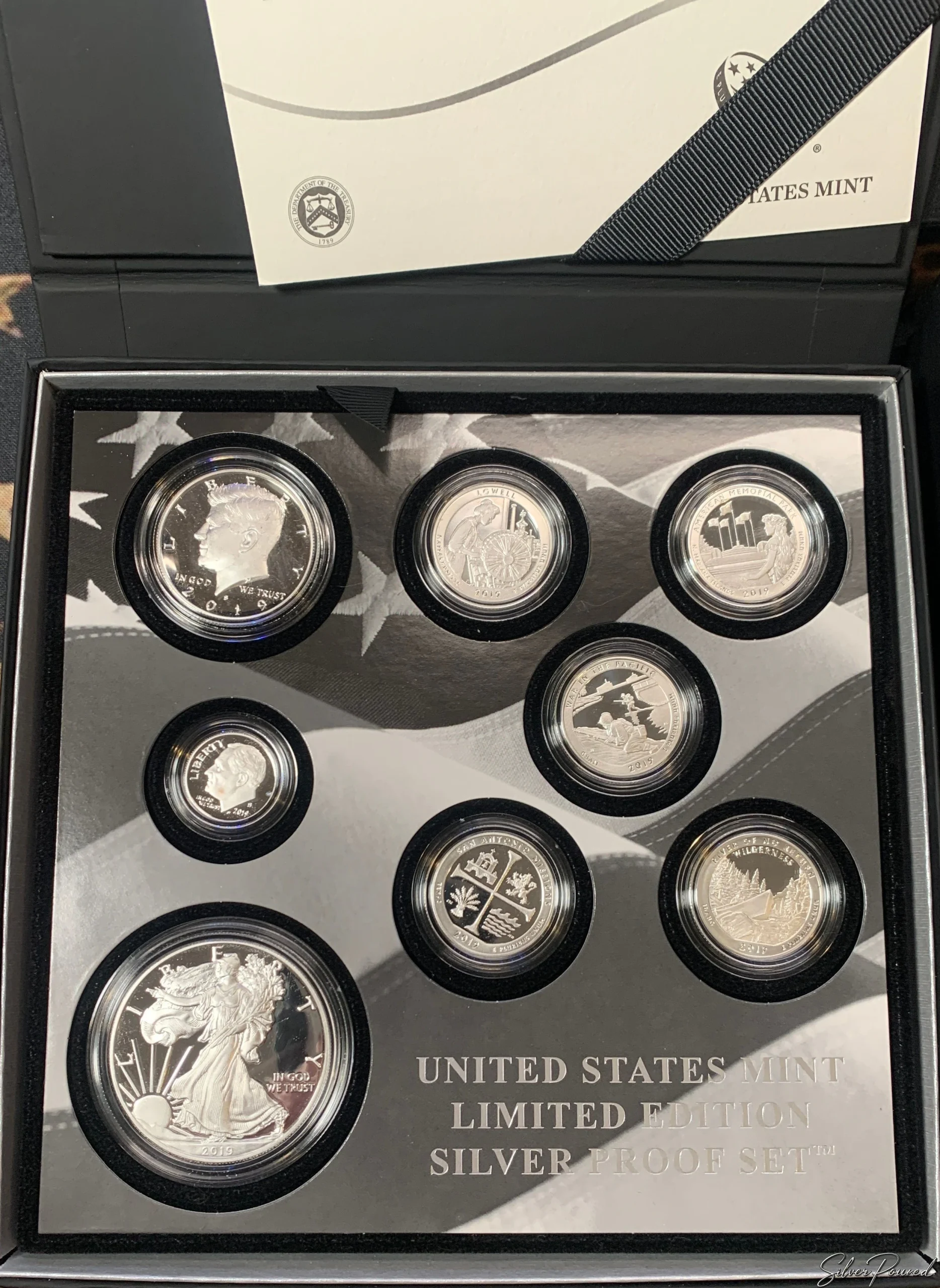
The Limited Edition Silver Proof Set added another distinct branch to the Mint’s product family. The 2019 edition contained eight .999 silver Proof coins: an American Silver Eagle, five America the Beautiful quarters, a Kennedy half dollar, and a Roosevelt dime. The Mint limited that specific product to 50,000 sets.
Those figures belong in a Limited Edition Silver Proof Set production history rather than being added to the annual Silver Proof Set mintages table as though both products were identical. The same underlying coin design can appear in multiple Mint products, which is another reason why set sales and individual coin mintages must be treated carefully.
Recent Silver Proof Set Net Sales Tell a Different Story
Recent United States Mint cumulative sales reporting provides another way to evaluate the annual Silver Proof Set program. These figures represent last-reported net sales for the packaged set rather than the historical mintage reference used in the preceding table. They may change through returns, cancellations, reconciliation, or final auditing.
| Year | Last Reported Net Sales | Metric |
|---|---|---|
| 2012 | 395,443 | Last reported net sales |
| 2013 | 419,720 | Last reported net sales |
| 2014 | 429,493 | Last reported net sales |
| 2015 | 387,310 | Last reported net sales |
| 2016 | 369,849 | Last reported net sales |
| 2017 | Approximately 358,085 | Last reported net sales |
| 2018 | 332,273 | Last reported net sales |
| 2019 | 415,382 | Last reported net sales |
| 2020 | 313,183 | Last reported net sales |
| 2021 | 308,531 | Last reported net sales |
| 2022 | 249,374 | Last reported net sales |
| 2023 | 201,518 | Last reported net sales |
| 2024 | 170,440 | Last reported net sales |
| 2025 | 124,178 | Last reported net sales |
The decline is striking. Annual Silver Proof Set net sales dropped from levels near or above 400,000 in several earlier years to roughly 124,000 for the 2025 set. That trend provides important context for future Proof Set mintages, but low sales alone do not guarantee future rarity or appreciation. Modern sets often have high survival rates because collectors preserve them carefully from the day of issue.
Why Mintage and Net Sales Can Disagree
Historical Proof Set figures can differ even when two sources appear to describe the same year. The underlying measurements may not be identical: one source may report production or final mintage while another reports cumulative or last-reported net sales. Returns, cancellations, product combinations, reconciliation, and later Mint accounting can all affect the final record. That is why SilverPoured identifies the metric being used instead of treating every published quantity as interchangeable.
For that reason, SilverPoured does not silently average conflicting numbers or choose whichever number looks more dramatic. The database identifies the measurement being used. A Proof Set mintage table should compare like with like, while a net-sales table should remain explicitly labeled as sales.
A product limit is not a sales figure, and a sales figure is not automatically a final mintage. When historical Proof Set references disagree by a small amount, the first question should be “What metric is this source reporting?” rather than “Which number is wrong?” Keeping those categories separate produces a more accurate database.
The 2026 Semiquincentennial Silver Proof Set
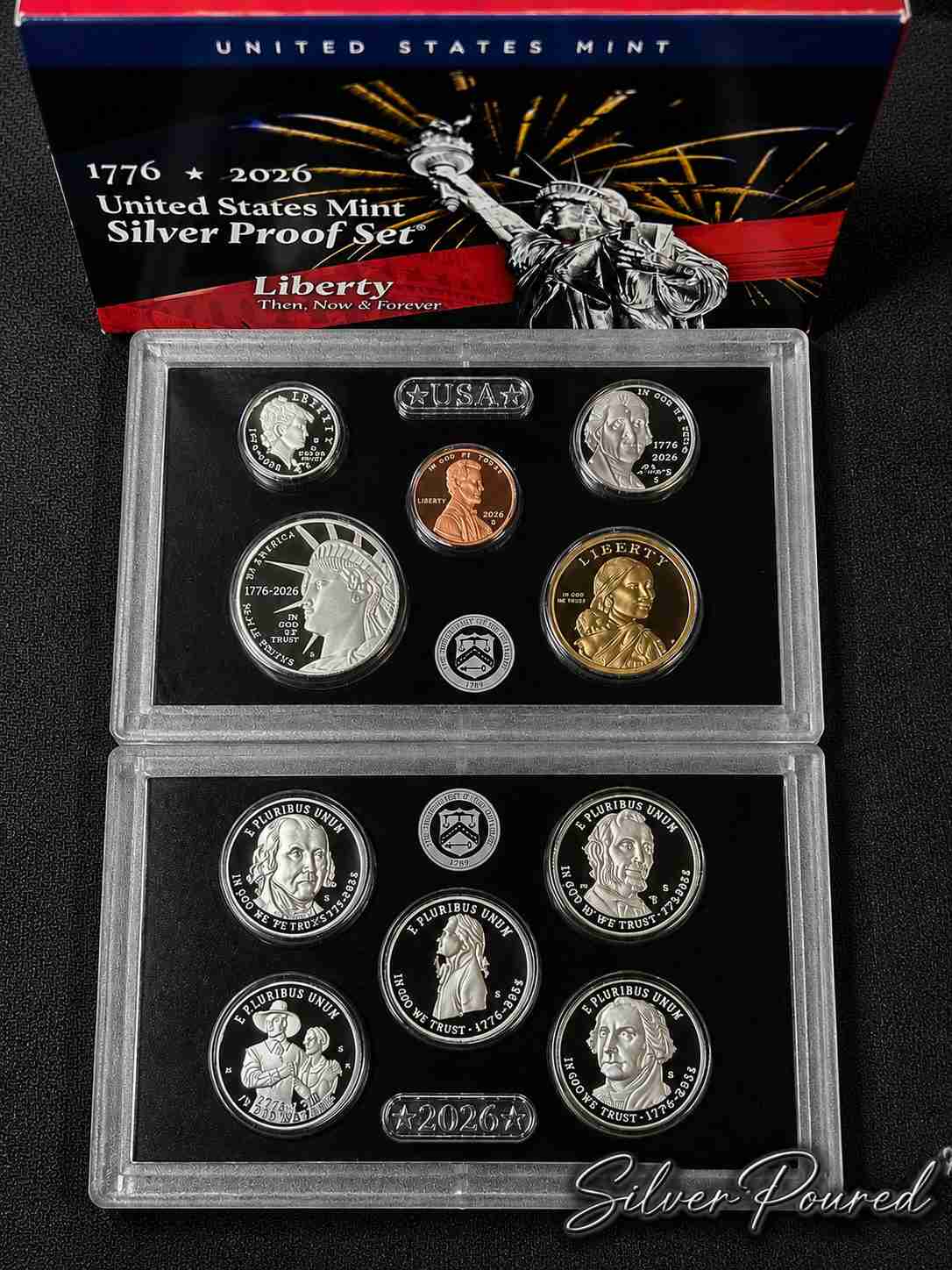
The 2026 Semiquincentennial Silver Proof Set provides a useful modern endpoint for this historical database. The one-year anniversary issue contains 10 Proof coins, each bearing the S mint mark of the United States Mint at San Francisco. The Roosevelt dime, five Semiquincentennial quarters, and Enduring Liberty half dollar are struck in 99.9% fine silver.
The United States Mint lists both the product limit and mintage limit for the 2026 Silver Proof Set at 271,520. That number is an authorized ceiling, not a declaration that 271,520 sets have already been sold. Final sales and final production history should be evaluated only after the program has matured and the appropriate Mint reporting becomes available.
| 2026 Silver Proof Set Reference | Official Information |
|---|---|
| Year | 2026 |
| Program | United States Semiquincentennial |
| Number of Proof coins | 10 |
| Mint facility | San Francisco |
| Mint mark | S |
| Silver fineness | 99.9% fine silver for the dime, five quarters, and half dollar |
| Product limit | 271,520 |
| Mintage limit | 271,520 |
The 2026 set also demonstrates why Proof Set mintages should be viewed as part of a broader historical narrative. Its appeal is not based on a single number. It combines America’s 250th anniversary, one-year circulating coin redesigns, modern .999 silver coinage, a collectible 2026 Lincoln cent after the end of cent production for general circulation, and a complete presentation of the Semiquincentennial quarter program.
Do Lower Proof Set Mintages Automatically Mean Higher Value?
No. Lower Proof Set mintages can create a smaller original supply, but value depends on both supply and demand. A low-production modern set that almost everyone preserved may remain readily available, while an older set with a larger original mintage may command stronger prices because surviving original examples are harder to locate.
Collector demand also changes. A year containing a major design change, precious-metal transition, key variety, commemorative issue, unusual Mint mark, bonus coin, or historically important anniversary can attract interest beyond the normal annual-set market. Conversely, an otherwise low-mintage set may remain inexpensive if demand is modest.
Original Government Packaging Matters
Original government packaging preserves more than presentation. It documents how the Mint sold the coins as a collector product. For historical sets, intact packaging can help distinguish original sets from groups assembled later from individual Proof coins.
Packaging should still be evaluated for condition. Plastic haze, environmental contamination, cracked holders, damaged envelopes, missing certificates, and improper storage can affect desirability. A beautiful set with original packaging may appeal to one collector, while another may prefer certified individual coins with strong cameo contrast.
Certified Proof Coins Create a Separate Market
Third-party certification can transform coins removed from annual Proof Sets into individual registry collectibles. Grades such as PF69 or PF70, Cameo, Ultra Cameo, and Deep Cameo describe characteristics that are not represented by Proof Set mintages alone.
A high certified population can restrain premiums even when a set had relatively modest production, while a condition rarity may command substantial value despite originating in a common annual set. Proof Set mintages establish the original supply environment; certification data describes the surviving graded market.
Important No-S Proof Errors and Varieties
Modern Proof Sets are also known for several important varieties and missing-mint-mark errors. Certain Proof coins were mistakenly produced without the expected S mint mark, creating some of the most famous modern U.S. Proof rarities. Collectors should not assume that owning the correct year means they own the rare variety; authentication requires examining the exact coin and diagnostic characteristics.
Varieties also explain why two sets with the same Proof Set mintage can have radically different market values. A normal annual set represents the broad production population, while a rare die variety or error may exist in only a tiny fraction of that total.
How Collectors Should Use a Proof Set Mintage Database
Proof Set mintages are most useful as a starting point for research. Compare the year’s production with adjacent years, identify whether the issue belongs to a special program, confirm the composition of its coins, determine whether the figure represents production or sales, and then evaluate current collector demand.
For silver issues, intrinsic metal value adds another layer. Silver Proof Sets can trade above ordinary clad sets because their designated silver denominations carry precious-metal value before any collector premium is considered. Live silver prices therefore matter when evaluating damaged, incomplete, or common silver Proof material, although intact collector sets often trade on numismatic value rather than melt value alone.
The lowest number in a Proof Set mintages table is not automatically the “best investment.” The strongest collector decisions combine original production, surviving supply, composition, packaging, varieties, certified populations, current demand, and recent transactions. Mintage establishes the starting supply; the market determines what collectors are willing to pay.
Proof Set Mintages FAQ
When did modern U.S. Proof Sets begin?
The modern era generally begins in 1936, when the United States Mint resumed Proof coin production for collectors after a lengthy interruption. Production continued through 1942, paused during and after World War II, and resumed again in 1950.
Why are there no Proof Set mintages for 1965 through 1967?
Regular Proof Sets were suspended during the national coin-shortage period. The Mint issued Special Mint Sets instead. Those coins were better prepared than ordinary circulation strikes but were not produced to normal Proof standards.
When did San Francisco begin producing modern Proof Sets?
San Francisco assumed modern Proof production when the program resumed in 1968. The resulting Proof coins carried the S mint mark, establishing the San Francisco tradition associated with modern annual Proof Sets.
When did annual Silver Proof Sets begin?
The modern annual Silver Proof Set program began in 1992. Special silver Proof products existed earlier, including the three-coin 1976 Bicentennial silver Proof set, but those should not be treated as part of the uninterrupted annual Silver Proof Set series beginning in 1992.
When did Silver Proof Sets change to .999 silver?
In 2019, the designated silver denominations in the annual Silver Proof Set changed to 99.9% silver. Earlier modern annual Silver Proof Sets used 90% silver for the dime, quarters, and half dollar.
Are Proof Set sales the same as Proof Set mintages?
Not necessarily. Sales report how many packaged products were sold at a particular reporting stage. Mintage can refer to production or final Mint accounting. Product limits and mintage limits are ceilings rather than proof of actual final sales. A reliable database keeps those metrics clearly labeled.
Does a low Proof Set mintage guarantee high value?
No. Low original production can help create scarcity, but surviving supply and collector demand are equally important. Modern Proof Sets generally have high survival rates, while older sets may have suffered decades of separation, damage, or loss.
Official United States Mint Research Sources
SilverPoured uses primary United States Mint material whenever possible when interpreting Proof Set mintages and modern product specifications. The Mint’s Proof Sets reference explains the modern Proof product, while the San Francisco Mint history documents the facility’s assumption of Proof production in 1968.
Modern silver-composition research is supported by the Mint’s documentation of the 2019 Silver Proof Set, and current Semiquincentennial specifications come from the official 2026 Silver Proof Set product page. Historical figures should always be interpreted according to the metric used by the underlying source.
What Proof Set Mintages Reveal About U.S. Coin Collecting
Nearly nine decades of Proof Set history show how dramatically American coin collecting has evolved. The modern program began with only a few thousand possible complete sets, expanded into a mass-market collector product with annual production in the millions, diversified into silver and commemorative formats, and eventually entered an era in which annual sales once again measure in the hundreds of thousands rather than millions.
No single number tells the entire story. Proof Set mintages become meaningful when they are connected to the Mint facility, set format, composition, packaging, special varieties, precious-metal content, and collector demand of their era. That broader context is what turns a production table into a historical research tool.
Related SilverPoured Resources
Continue researching Proof Set mintages, United States Mint production, silver coin values, live precious-metal pricing, and the collector factors that can move a Proof coin or set above its underlying metal value.
United States Mint Research
Philadelphia Mint
Denver Mint
San Francisco Mint
West Point Mint
Silver Coin Values
Silver Prices & Value Tools
Silver Spot Price Today
Silver Melt Value Calculator
What Is Silver Melt Value?
Silver Spot vs Bid vs Ask Price
Best Silver Dealers
Collector & Premium Education
Limited Mintage Silver
Serialized Silver Bars
Why Collectible Silver Sells For More
Why Silver Premiums Change
Why Bullion Dealers Charge Premiums
Purchase Precious Metals from a Trusted Dealer
Proof Sets occupy a different part of the market from newly produced bullion, but many collectors build both numismatic and precious-metal holdings. Silver Proof coins can combine collector value with intrinsic metal value, while modern bullion products provide a more direct way to purchase silver, gold, and copper based primarily on weight, purity, and market premiums.
Before buying, compare the exact product being offered. An intact annual Silver Proof Set, a certified Proof coin, and a newly minted bullion round may all contain precious metal, but their premiums are driven by different factors. Understanding Proof Set mintages helps evaluate the collector side of the equation; live spot prices and dealer premiums help evaluate the metal side.
Collector Insight
Proof Set mintages establish the original size of a collector issue, but they do not determine value by themselves. Original packaging, coin quality, cameo contrast, varieties, precious-metal composition, certified populations, surviving supply, and current collector demand can all matter. The most useful mintage figure is therefore one that is understood in the historical context of the exact Mint product being evaluated.
Keep SilverPoured Free
SilverPoured is built to help collectors and precious-metals investors make smarter decisions through free calculators, original photography, coin research, value references, collector education, and independent market resources. Every page is created to make valuable precious-metals information available without requiring a paid subscription.
Building and maintaining a historical Proof Set mintages database requires ongoing research as United States Mint reporting changes and new annual sets are released. Every contribution helps support the research, original photography, historical data maintenance, and collector resources that keep this archive available and current.
Your support allows SilverPoured to remain independent while building one of the web’s most comprehensive free libraries for coin collectors, bullion buyers, precious-metals researchers, and long-term investors.