
The New Orleans Mint occupies a unique place in United States coinage history. Opened for coin production in 1838, interrupted by the Civil War, restored to coinage operations in 1879 and finally retired from coin production in 1909, the Louisiana branch produced an extraordinary range of American gold and silver coins identified by the historic letter O.
For collectors, the New Orleans Mint represents far more than a building or mint mark. Its coins connect antebellum commerce, Southern precious-metal flows, the Civil War, Seated Liberty coinage, Liberty Head gold, Morgan Silver Dollars, Barber coinage and some of the most challenging condition rarities in American numismatics.
The O mint mark is easy to recognize, but identifying an O-mint coin is only the beginning. Date, denomination, grade, strike quality, surviving population, originality, rarity and collector demand can produce enormous differences in value.
This SilverPoured guide examines New Orleans Mint history, explains what the O mint mark means, documents the gold and silver coins produced there, explores important collector issues and uses original SilverPoured photography of genuine O-mint coins.
What Was the New Orleans Mint?
The New Orleans Mint was a federal branch facility created as the United States expanded beyond the practical reach of a single mint in Philadelphia. Congress authorized new branch mints at New Orleans, Charlotte and Dahlonega in 1835, and all three began coinage operations in 1838.
Charlotte and Dahlonega were strongly associated with Southern gold deposits. New Orleans had a broader role. Located in one of the nation’s major ports and commercial centers, the Louisiana facility produced both gold and silver coins for a growing economy.
The branch used the letter O as its mint mark. That small letter now provides collectors with an immediate link to where a coin was made and often plays a major role in determining rarity and value.
New Orleans Mint Key Facts
| Fact | New Orleans |
|---|---|
| Congressional authorization | 1835 |
| Coin production began | 1838 |
| Historic mint mark | O |
| First production period | 1838–1861 |
| Second production period | 1879–1909 |
| Metals coined | Gold and silver |
| Civil War interruption | 1861 |
| Morgan Dollar production | 1879–1904 |
| Final year of coin production | 1909 |
The two production periods make the New Orleans Mint especially interesting. The same branch that struck federal coins before the Civil War later returned to service during the great nineteenth-century silver-dollar era and remained active into the twentieth century.
Why Was the New Orleans Mint Created?
The early United States Mint system was centered in Philadelphia. As the nation expanded, transporting precious metal long distances for conversion into federal coinage became increasingly inefficient.
Southern gold discoveries helped create demand for branch facilities closer to the sources of precious metal. Congress responded by creating the Charlotte, Dahlonega and New Orleans branches.
New Orleans served a different economic environment from the two gold-region branches. The city was a major port connected to domestic and international commerce. Bullion, foreign coins and other forms of money moved through the region, giving a local federal coinage facility significant practical value.
The new branch could receive precious metal and return standardized federal coins without requiring every transaction to pass through Philadelphia. This regional role helps explain why New Orleans Mint production eventually included such a wide range of silver and gold denominations.
What Does the O Mint Mark Mean?
The letter O on a historic United States coin identifies production at the New Orleans Mint. Mint marks first appeared on American coins when the first branch facilities opened in 1838.
New Orleans used O, Charlotte used C and Dahlonega used D. Philadelphia generally continued producing nineteenth-century coins without a mint mark.
For collectors, the O can be enormously important. Two coins with the same date and denomination may have very different mintages, survival rates and market values when one was struck at Philadelphia and the other in New Orleans.
Identification should therefore come before valuation. Determine the date, denomination and mint mark first, and only then compare the coin with appropriate pricing and auction references.

Where Is the O Mint Mark Located?
The location of the O mint mark depends on the denomination and design. On Morgan Silver Dollars, it appears on the reverse beneath the wreath and above the letters DO in DOLLAR.
On Barber Half Dollars, the mint mark appears beneath the eagle on the reverse. Classic gold coins also generally place the O on the reverse, although its exact position varies by denomination and design.
Wear, toning, debris or a weak strike can make a small mint mark difficult to see. A collector should not automatically assume a coin is a Philadelphia issue simply because an O is not immediately obvious.
When the claimed issue carries a substantial premium, compare mint-mark position and shape with established references and consider professional authentication.
The O mint mark can change the entire identity of a coin. Two pieces with the same date and denomination can contain the same amount of precious metal yet occupy completely different collector markets because one was produced in Philadelphia and the other at the New Orleans Mint. Mint identification should happen before price research, not after it.

What Coins Did the New Orleans Mint Produce?
The New Orleans Mint produced a remarkably broad range of nineteenth- and early-twentieth-century federal coinage. Its output included small silver denominations used in everyday commerce, large silver dollars and multiple gold denominations.
| Coin Family | New Orleans Connection |
|---|---|
| Seated Liberty Half Dimes | Produced during the first operating era |
| Seated Liberty Dimes | Multiple collectible O-mint issues |
| Seated Liberty Quarters | Classic Southern branch production |
| Seated Liberty Half Dollars | Major New Orleans silver series |
| Seated Liberty Dollars | Important early O-mint dollars |
| Barber Dimes | Produced during the later era |
| Barber Quarters | Produced through the final years |
| Barber Half Dollars | Important collector issues |
| Morgan Silver Dollars | Major production from 1879–1904 |
| Gold Dollars | Antebellum gold production |
| Quarter Eagles | Liberty Head O-mint issues |
| Half Eagles | Important classic gold issues |
| Eagles | Major New Orleans gold denomination |
| Double Eagles | Highly collectible O-mint issues |
This breadth allows collectors to approach the facility in many ways. A collection can focus on one denomination, one metal, Morgan Dollars, classic gold or a broad type set spanning the entire history of the branch.
Gold Coins from the New Orleans Mint
Gold is essential to understanding New Orleans Mint history. The branch was never merely a silver-dollar facility.
Before the Civil War, it converted precious metal into several federal gold denominations. These coins served commerce in a region closely connected to national and international trade.
New Orleans gold is now a specialized field within American numismatics. Many issues had relatively modest original mintages, while circulation, export, melting and other forms of attrition reduced surviving populations.
As a result, high-quality examples can become difficult even when the original mintage does not initially appear extraordinary. Date, grade, strike and surface originality often matter far more than bullion value.
The 1856-O Liberty Head Quarter Eagle
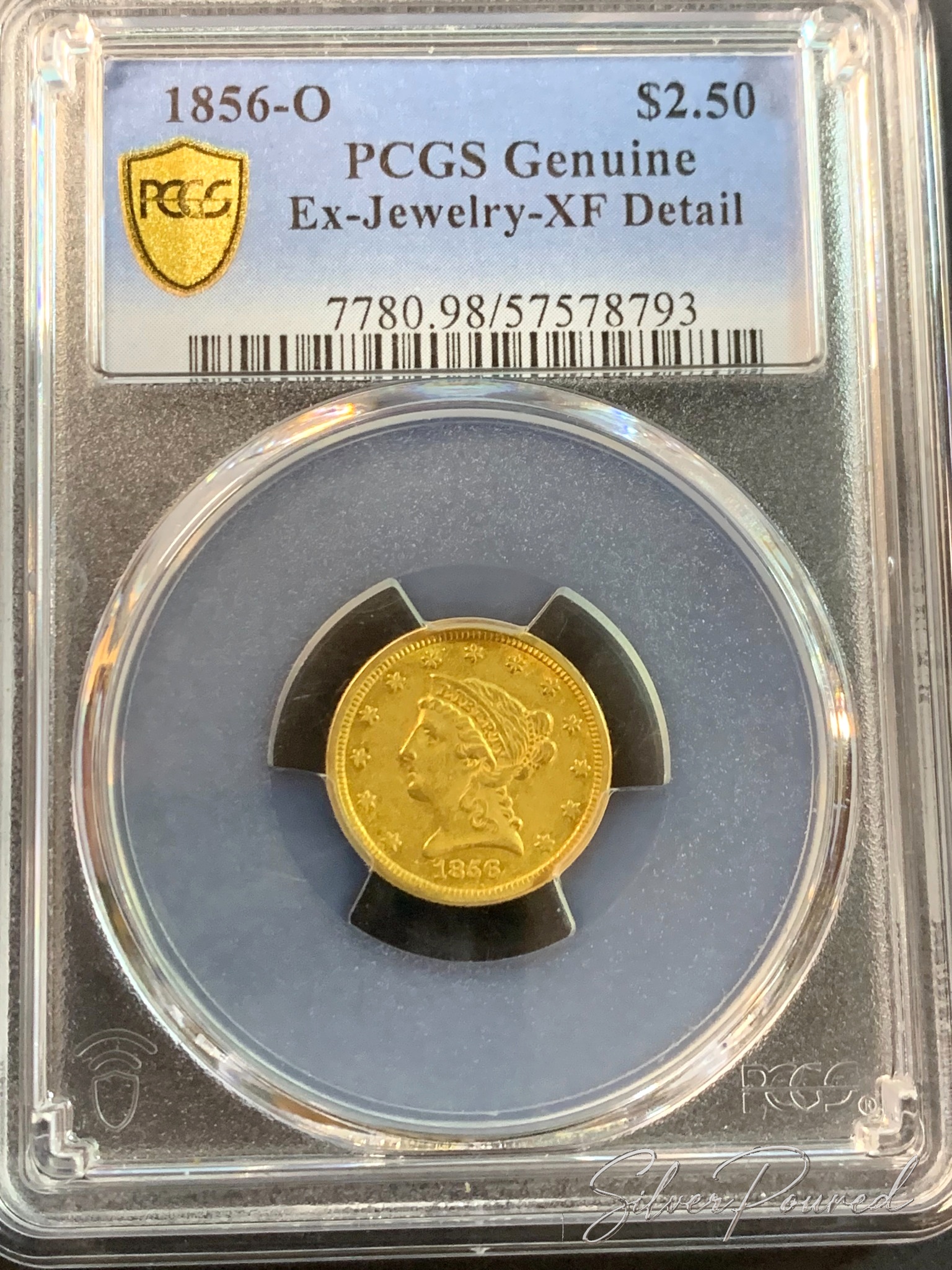
The 1856-O Liberty Head Quarter Eagle provides a tangible example of antebellum gold production. A quarter eagle carried a face value of $2.50 and represented considerably more purchasing power in the nineteenth century than that denomination suggests today.
Collectors evaluating an 1856-O should look beyond its underlying gold content. Scarcity, grade, strike characteristics, surviving population, originality and market demand can dominate value.
The SilverPoured specimen photographed here is especially useful because its reverse provides a direct visual example of the O mint mark on classic United States gold.

The New Orleans Mint and the Civil War
Few United States coinage facilities have a Civil War history as complicated as the New Orleans Mint. Louisiana seceded from the Union in January 1861, and control of the branch changed during the developing national crisis.
Coinage continued for a period using United States designs, dies and equipment. Coins dated 1861 therefore occupy an unusual position in American numismatics because production crossed changes in political authority.
For some 1861-O coins, identifying which authority controlled the facility at the precise time of striking can depend on production records, die research and specialist study rather than the date and mint mark alone.
The period also produced the famous Confederate half dollar. Four original examples are traditionally recognized. They paired a United States Seated Liberty obverse die with a specially prepared Confederate reverse.
Those extraordinary pieces should not be confused with ordinary federal-design 1861-O half dollars struck during the same turbulent period.
Collectors who want to explore this history further can consult the United States Mint historical timeline and the American Numismatic Association’s history of Confederate coinage.
An 1861-O coin cannot always tell you which government controlled the New Orleans Mint at the precise moment it was struck. Federal dies and designs remained in use as political authority changed. Attribution of 1861 production can therefore require historical records, die research and specialist scholarship rather than simply reading the date and mint mark.
Why Did Coin Production Stop in 1861?
The Civil War ended normal federal branch-mint operations across the South. Coin production at New Orleans ceased in 1861 and would not resume for many years.
Charlotte and Dahlonega never returned to United States coin production after the war. New Orleans eventually did, making its later reopening one of the most important differences among the original Southern branch mints.
The Long Closure and Reopening in 1879
The facility remained outside normal coin production for nearly two decades. Its return was closely connected to renewed federal demand for silver dollars following the Bland-Allison Act of 1878.
Philadelphia, Carson City and San Francisco began Morgan Dollar production in 1878. The New Orleans Mint returned to coinage the following year and joined the silver-dollar program in 1879.
A surviving federal report from 1878 documents the preparations necessary to reopen the facility, including issues involving the land on which the mint stood.
The reopening created a second identity for the branch. A facility historically associated with antebellum silver and gold became one of the great production centers of the Morgan Silver Dollar era.
Morgan Silver Dollars and the New Orleans Mint
Morgan Dollars are probably the coins most collectors immediately associate with the New Orleans Mint today. Designed by George T. Morgan, the silver dollar series began in 1878, and New Orleans joined production in 1879.
The Louisiana facility continued striking Morgan Dollars through 1904. Millions of O-mint dollars were produced during those years, but total mintage does not tell collectors how difficult every date will be in every grade.
Some New Orleans Morgan Dollars are readily available in circulated and lower Mint State grades. Others become significantly harder when collectors demand high numerical grades, exceptional surfaces or unusually strong strikes.
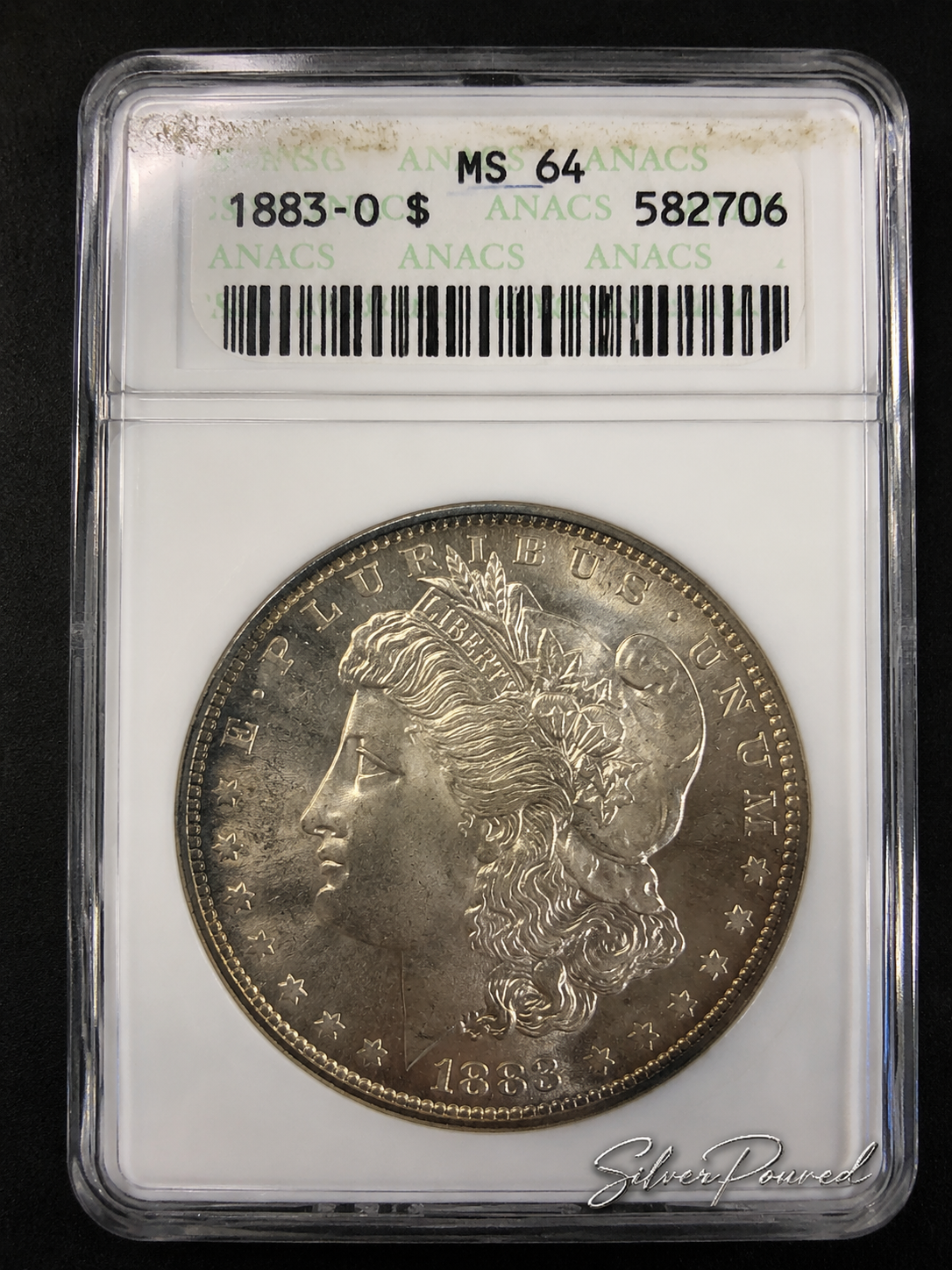
The original SilverPoured 1883-O Morgan is graded ANACS MS64. Its certified preservation makes it a useful real-world example of postwar New Orleans silver-dollar production.
Collectors researching the complete series can continue through the SilverPoured Morgan Silver Dollar Value Guide.
Why Are Some O-Mint Morgan Dollars Weakly Struck?
Strike quality is not the same thing as circulation wear. A coin can leave the press with incomplete detail and still retain full Mint State surfaces and luster.
On Morgan Dollars, collectors often pay attention to Liberty’s hair above the ear and the feathers on the eagle’s breast. Those areas can appear soft when the strike was incomplete.
New Orleans issues are particularly well known for variation in strike quality. That means a collector should avoid assuming that every soft-looking central detail represents circulation wear.
Conversely, a sharply struck example can be especially attractive when unusually strong detail is difficult for a particular date.
Important New Orleans Morgan Dollars
O-mint Morgan Dollars do not form one uniform rarity group. Some dates are abundant enough to support large collector markets, while others become considerably more difficult as quality increases.
Condition rarity is particularly important. A coin can be common enough in circulated grades yet become difficult at MS65 or above, especially when strong strike and attractive surfaces are required.
Reliable comparisons should match date, mint, grade, strike quality and surface condition. Auction records and third-party population reports become more useful as the potential value rises.
Barber Coinage at New Orleans
The Barber era documents the later chapters of silver production at New Orleans. Charles E. Barber’s dime, quarter and half-dollar designs circulated extensively during the late nineteenth and early twentieth centuries.
The branch struck all three Barber silver denominations during portions of their production runs. O-mint Barber coins therefore provide collectors with a direct connection between the Morgan Dollar era and the facility’s final years.
Some dates remain attainable in circulated grades, while others become difficult when collectors demand higher preservation or original problem-free surfaces.
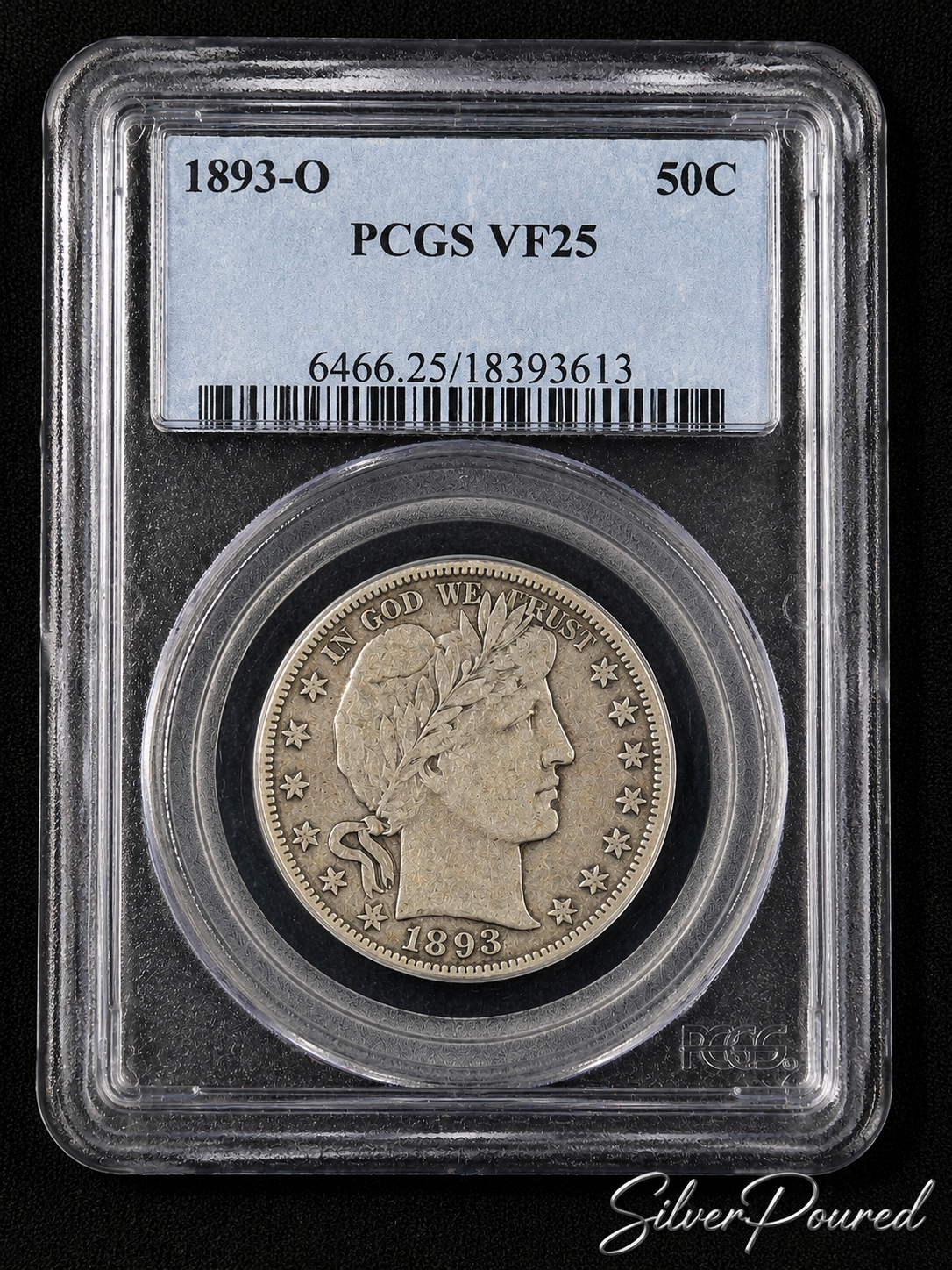
The SilverPoured 1893-O Barber Half Dollar is graded PCGS VF25 and documents genuine circulating silver from this period. Unlike a generic illustration, the photographed specimen shows the appearance of an actual certified O-mint coin after decades of historic circulation.

For denomination-specific research, see the Barber Half Dollar Silver Value Guide.
New Orleans Mint Silver Coins
Silver formed an enormous part of the branch’s history. Long before Morgan Dollars became synonymous with the O mint mark, New Orleans produced Seated Liberty half dimes, dimes, quarters, half dollars and dollars for commerce.
Many of those coins now trade primarily as numismatic objects. Their intrinsic silver content establishes a baseline, but date, mint, grade and scarcity can produce premiums far above melt value.
The same principle applies to later Barber silver and Morgan Dollars. A common circulated piece and a scarce high-grade example may contain essentially the same amount of silver while belonging to completely different collector markets.
Collectors who need the metal baseline can use the SilverPoured Silver Melt Value Calculator without confusing melt value with numismatic value.
New Orleans Mint Gold Coins
Gold collectors encounter a different market. The New Orleans Mint produced several gold denominations during its history, including quarter eagles, half eagles, eagles and double eagles.
Some specialists build a date set within one denomination. Others pursue a New Orleans gold type set containing representative examples of several denominations.
High-grade survivors can be challenging because nineteenth-century gold coins were money first and collectibles later. Coins were spent, exported, melted, damaged and otherwise removed from the surviving population.
That history is one reason an O-mint gold coin should not be priced by gold content alone.
Rare New Orleans Mint Coins
Rarity among New Orleans Mint coins takes several forms. Some issues began with low original mintages. Others suffered high attrition and now have low surviving populations.
A third category is condition rarity. These coins may be obtainable in circulated grades but become surprisingly difficult with high Mint State preservation.
Originality adds another dimension. A coin can survive physically yet have cleaned, damaged or otherwise impaired surfaces that reduce collector demand.
That is why a simple mintage ranking should never be treated as a complete value ranking.
Mintage vs Survival
Mintage records tell collectors how many coins were officially produced. They do not tell us how many survive today or how those survivors are distributed across grades.
Coins can disappear through wear, loss, melting, export, damage or destruction. Gold in particular could move internationally or return to the melting pot when economic conditions changed.
Morgan Dollars experienced a different survival pattern because large quantities remained in government storage for extended periods. Even there, however, survival and preservation vary greatly by date and grade.
For a meaningful New Orleans Mint rarity assessment, collectors should consider mintage, estimated survival and grade distribution together.
A large New Orleans Mint mintage does not guarantee an easy coin in every grade. Some O-mint issues become genuinely difficult when collectors demand strong strikes, original surfaces and high Mint State preservation. Mintage and rarity should therefore be treated as related evidence rather than interchangeable measurements.
How Much Are New Orleans Mint Coins Worth?
There is no single value for coins from the New Orleans Mint. A common circulated O-mint coin can be relatively affordable, while a scarce date or exceptional certified example may command a substantial numismatic premium.
Value generally depends on the exact date, denomination, mint mark, grade, strike, originality, rarity and current collector demand. Precious-metal content adds another component for gold and silver coins.
| Value Factor | Why It Matters |
|---|---|
| Date | Some years are substantially scarcer than others |
| Mint mark | Identifies the production facility |
| Denomination | Collector markets differ by series |
| Grade | Preservation can create major premiums |
| Strike | Especially important for some Morgan Dollars |
| Originality | Problem-free surfaces usually attract stronger demand |
| Survival | Remaining population may differ greatly from mintage |
| Certification | Can increase confidence in valuable issues |
| Metal content | Provides an intrinsic value component |
| Demand | Popular series can support stronger premiums |
Melt Value vs Collector Value
Melt value measures the theoretical precious-metal value contained in a coin. Collector value measures what buyers may pay for the complete historical object.
For an ordinary circulated silver issue, metal value may represent a meaningful portion of the total price. For a scarce New Orleans Mint date, numismatic value can overwhelm the melt component.
The same applies to classic gold. A scarce O-mint quarter eagle, half eagle or double eagle should never be evaluated only by multiplying its gold content by spot price.
Cleaned and Problem O-Mint Coins
Cleaning is common among classic nineteenth-century coins. Abrasive polishing can leave hairlines and unnatural brightness, while chemical treatments can produce altered color or texture.
A cleaned coin remains genuine when otherwise authentic, and its gold or silver content remains intact. Its collector market can nevertheless change significantly.
A rare date may still be valuable after cleaning, but an original problem-free example will generally attract stronger demand when all other factors are comparable.
Do not clean an O-mint coin simply because it looks dark or tarnished. Abrasive cleaning can permanently alter original surfaces, leave hairlines, and reduce collector appeal. Preserve the coin as found and seek an experienced numismatist’s assessment before attempting any treatment.
Counterfeits, Altered Mint Marks and Authentication
The more valuable an O-mint issue becomes, the more important authentication becomes. Counterfeit coins and altered mint marks can create costly mistakes.
A collector should inspect the shape and position of the mint mark, surrounding surfaces, lettering, edge, weight, diameter and known die characteristics.
Those checks are useful but do not replace specialist authentication on expensive coins. Third-party certification can provide an independent opinion of authenticity and grade.
Numerical grade describes a coin’s condition, while surface preservation, evidence of cleaning or damage, and certification also influence collector demand. When comparing O-mint coins, consider authenticity and surface quality alongside the assigned grade rather than relying on the number alone.
How to Collect New Orleans Mint Coins
One of the strengths of New Orleans Mint collecting is that there is no single required path. A collector can begin with one representative O-mint coin or pursue a specialized collection spanning decades.
Silver specialists can focus on Seated Liberty, Morgan and Barber issues. Gold collectors can pursue representative quarter eagles, half eagles, eagles and double eagles.
Advanced collectors can build broader date-and-denomination sets that turn the history of the branch into a chronological coin collection.
New Orleans Mint Type Set
A type set uses representative designs and denominations instead of requiring every date. It is one of the most approachable ways to document the branch.
A practical set might include Seated Liberty silver, Liberty Head gold, a Morgan Dollar and a Barber silver coin.
O-Mint Morgan Dollar Set
Morgan Dollars provide the best-known specialized collecting route. A collector can pursue the New Orleans issues from 1879 through 1904.
The challenge rises substantially when the goal changes from filling date holes to locating attractive, sharply struck Mint State examples.
New Orleans Gold Type Set
A gold type set can represent several denominations without requiring complete date runs. This approach highlights the facility’s importance as a gold producer while keeping the collection achievable.
The SilverPoured 1856-O Quarter Eagle photographed on this page is an example of the type of coin that can anchor such a collection.
New Orleans vs Philadelphia, Carson City and San Francisco
Mint marks allow collectors to reconstruct the geographic history of United States coinage. Philadelphia was the original federal mint and generally did not identify its nineteenth-century production with a mint mark.
New Orleans used O, Carson City used CC and San Francisco used S. These facilities sometimes produced the same denominations during overlapping years, but their coins can have dramatically different mintages, strike characteristics and surviving populations.
| Mint | Historic Mark | Collector Association |
|---|---|---|
| Philadelphia | None / later P | Original federal mint |
| New Orleans | O | Southern gold, silver and Morgan Dollars |
| Carson City | CC | Comstock silver and Morgan Dollars |
| San Francisco | S | Western gold and silver coinage |
This geographic distinction matters because a mint mark can change a seemingly ordinary coin into an entirely different collector issue.
The Final Years of the New Orleans Mint
The economic justification for maintaining the branch weakened in the early twentieth century. Morgan Dollar production ended in 1904, removing one of the facility’s largest programs.
Denver began coin production in 1906, further changing the national network of United States Mint facilities. New Orleans entered its final years and struck its last coins in 1909.
One of the most famous final-year pieces is the 1909-O Indian Head Half Eagle. It was the only Indian Head Half Eagle produced at New Orleans and had an official mintage of 34,200 pieces.
That issue provides an appropriate closing point for a remarkable gold-coin history extending back into the antebellum United States.
What Happened After Coin Production Ended?
The end of coinage did not erase the former mint from American history. The building continued through other governmental and institutional uses after production stopped.
Its survival gives collectors something unusual: a physical architectural connection to the branch-mint era. An O-mint coin can still be connected with the historic institution in which it was made.
That connection helps explain why New Orleans Mint collecting appeals to people interested in both numismatics and broader American history.
Why New Orleans Mint Coins Matter
Coins are compact historical documents. Their dates identify periods of production, their designs reflect federal symbolism, their metal connects them to the monetary system and their wear can document real economic use.
The O mint mark adds geography to that historical record. An antebellum gold coin, an 1861-O silver coin, an early postwar Morgan Dollar and a final-year 1909-O issue each represent a different chapter.
Together, New Orleans Mint coins form a monetary timeline stretching from the expansion of the federal branch-mint system through the Civil War and into the modernizing economy of the early twentieth century.
Few historic mint marks carry as much chronological range as O. The same letter appears on coins associated with antebellum commerce, the Civil War era, the Morgan Dollar boom, Barber coinage and the final New Orleans production of 1909. An O-mint collection can therefore become a study of American monetary history rather than simply a hunt for matching mint marks.
Original SilverPoured New Orleans Mint Photography
Original owner photography throughout this guide documents genuine coins produced at New Orleans across different decades, metals and denominations.
The 1856-O Liberty Head Quarter Eagle represents antebellum gold production. The 1883-O Morgan Silver Dollar represents the postwar reopening and silver-dollar era. The 1893-O Barber Half Dollar represents circulating silver from the later operating period.
Using actual coins rather than generic stock images allows collectors to examine genuine mint-mark locations, design details, surfaces, circulation wear and certified preservation.
| SilverPoured Specimen | Historical Role |
|---|---|
| 1856-O Liberty Head Quarter Eagle | Antebellum New Orleans gold |
| 1883-O Morgan Dollar ANACS MS64 | Postwar silver-dollar production |
| 1893-O Barber Half Dollar PCGS VF25 | Later circulating silver coinage |
Historic O Mint Mark vs Modern O Privy Mark
Collectors should distinguish genuine historic New Orleans Mint marks from modern commemorative O privy marks.
Historic O-mint coins were physically produced at New Orleans. Modern Morgan commemoratives have used an O privy mark to honor the former facility even though those coins were produced elsewhere.
This distinction matters because a privy mark is commemorative symbolism, while an original O mint mark identifies the actual nineteenth- or early-twentieth-century production facility.
Frequently Asked Questions About the New Orleans Mint
What does the O mint mark mean?
The O mint mark identifies a historic United States coin produced at the New Orleans Mint in Louisiana. The branch began coinage operations in 1838.
When did the New Orleans Mint produce coins?
Coin production occurred during two primary periods: 1838 through 1861 and 1879 through 1909.
Why did New Orleans coin production stop during the Civil War?
Louisiana’s secession and the Civil War disrupted federal mint operations across the South. New Orleans ceased coin production in 1861 and did not resume until 1879.
Did the Confederacy use the New Orleans Mint?
Control of the facility changed during 1861, and federal-design coins continued to be produced for a period as political authority shifted. Four original Confederate half dollars with a special Confederate reverse are traditionally recognized.
What coins were made at the New Orleans Mint?
The branch produced numerous United States silver and gold denominations, including Seated Liberty coinage, Morgan Silver Dollars, Barber silver and several classic gold denominations.
Did New Orleans make Morgan Dollars?
Yes. Morgan Silver Dollars were produced there from 1879 through 1904 and carry the historic O mint mark.
Where is the O mint mark on a Morgan Dollar?
The O appears on the reverse beneath the wreath and above the DO in DOLLAR.
Are all O-mint coins rare?
No. Some issues are relatively available, while others are scarce by date, surviving population or grade. Exact identification is necessary before estimating rarity.
Are New Orleans Mint coins valuable?
They can be. Values range from modest premiums on relatively common circulated pieces to substantial prices for rare dates, scarce gold and exceptional certified coins.
Why are some O-mint Morgan Dollars weakly struck?
Strike quality varied because of dies, planchets, press pressure and production conditions. A soft central strike does not automatically mean a Morgan Dollar circulated.
What was the final year of New Orleans Mint coinage?
The final year of coin production was 1909.
What was the final New Orleans gold issue?
The 1909-O Indian Head Half Eagle was the final New Orleans gold issue and the only Indian Head Half Eagle produced there.
Should I clean an old O-mint coin?
No. Cleaning can permanently alter original surfaces and reduce collector demand. Valuable classic coins should generally be preserved as found.
How can I tell whether an O mint mark is genuine?
Compare its shape and position with established references and inspect surrounding surfaces for evidence of alteration. Expensive suspected rarities should be professionally authenticated.
Is an O mint mark the same as a modern O privy mark?
No. Historic O-mint coins were actually struck in New Orleans. Modern O privy marks commemorate the former facility but appear on coins produced elsewhere.
Final Thoughts on the New Orleans Mint
The New Orleans Mint is one of the most historically layered institutions in United States numismatics. Its coins connect the development of federal branch mints, Southern commerce, gold and silver production, the Civil War, the return of silver-dollar coinage, Morgan Dollars, Barber coinage and the modernization of the national mint system.
For collectors, the O mint mark provides an immediate connection to that history. But the letter alone does not determine value. Date, denomination, grade, strike, originality, rarity and surviving population must still be evaluated.
The original SilverPoured specimens on this page demonstrate the range directly: an 1856-O Quarter Eagle from the antebellum era, an 1883-O Morgan Silver Dollar from the postwar reopening and an 1893-O Barber Half Dollar from the later decades of production.
Together, they show why the New Orleans Mint deserves to be studied not merely as another former branch facility, but as an entire collecting field of its own.
Related SilverPoured Resources
Continue exploring the New Orleans Mint through related SilverPoured guides covering historic U.S. mints, mint marks, Morgan Dollars, classic silver coinage and precious-metal values.
U.S. Mints & Mint Marks
What Do Coin Mint Marks Mean?
Philadelphia Mint
Denver Mint
San Francisco Mint
Carson City Mint
Morgan Dollars & Historic U.S. Coins
Morgan Silver Dollar Value
Morgan Dollar Value Guide & Collector Hub
Carson City Morgan Dollar Guide
Seated Liberty Coins
Peace Silver Dollar Value
Silver Value & Collector Education
Silver Coin Values
Silver Melt Value Calculator
What Is Silver Melt Value?
Why Collectible Silver Sells For More
Limited Mintage Silver
Purchase Precious Metals from a Trusted Dealer
Historic New Orleans Mint coins demonstrate how precious-metal content and numismatic value can exist in the same object. An O-mint Morgan Dollar, Barber coin or classic gold piece may contain valuable silver or gold, but its collector premium can depend far more on date, grade, rarity, strike and originality.
Collectors seeking physical precious metals primarily for metal ownership can also consider modern bullion with standardized weights and clearly identified purity. Golden State Mint provides physical silver, gold and copper products for precious-metals buyers without implying that specific rare New Orleans Mint collectibles are currently available.
Collector Insight
The New Orleans Mint shows why identifying a coin’s production facility is fundamental to numismatic research. The O mint mark can connect an otherwise familiar design to antebellum gold production, Civil War history, Morgan Dollar coinage or the final years of the branch. Metal content matters, but date, mint, preservation and surviving population determine whether an O-mint coin trades primarily as bullion, an affordable collectible or a significant rarity.
Keep SilverPoured Free
SilverPoured is built to help collectors and precious-metals investors make smarter decisions through free calculators, original photography, coin research, value references, collector education, and independent market resources. Every page is created to make valuable precious-metals information available without requiring a paid subscription.
This New Orleans Mint guide combines original SilverPoured coin photography with mint-mark identification, Civil War history, gold and silver coinage research, Morgan Dollar education and collector-value context. Every contribution helps support continued original photography, independent coin research, calculator development and expansion of free collector resources.
Your support allows SilverPoured to remain independent while building one of the web’s most comprehensive free libraries for coin collectors, bullion buyers, precious-metals researchers, and long-term investors.