
Hand poured copper is one of the most visually distinctive forms of copper bullion and metal art because the finished piece records part of the pouring process itself. Ripples, cooling lines, small pits, rounded edges, mold texture, oxidation, and other surface characteristics can make two bars poured from the same copper look completely different.
That individuality is a major part of the appeal. A machined copper bar is designed to look consistent. A hand poured copper bar often tells you something about how molten metal moved, cooled, contracted, reacted with the mold, and was finished after the pour.
SilverPoured approaches this subject from both sides. Copper is an industrial metal with measurable physical properties, but hand poured copper is also something we have actually made. During the early Poured In USA years, more than 1,000 ounces of copper were melted and poured into bars and other pieces. That experience does not replace metallurgy, but it does make certain lessons about molds, heat, cooling, finishing, weight, and unpredictability very real.
This guide explains what hand poured copper is, how poured copper bars are made, what .999 copper means, why surfaces vary, how molds affect the final piece, why copper changes color, what collectors look for, how premiums work, and what buyers should know before paying more than raw copper value.
Hand Poured Copper Quick Facts
| Characteristic | What It Means |
|---|---|
| Element | Copper, chemical symbol Cu, atomic number 29 |
| Melting Point | Approximately 1,084.62°C / 1,984.32°F |
| Density | Approximately 8.96 g/cm³ at room temperature |
| Common Bullion Purity | .999 fine copper is frequently used for collectible bars and rounds |
| Appearance | Fresh copper can show a reddish-orange metallic surface that darkens or develops patina over time |
| Typical Forms | Bars, ingots, rounds, cast shapes, art pieces, medallions, and custom pours |
| Primary Value Drivers | Copper content, weight, workmanship, maker, design, scarcity, condition, and collector demand |
| Investment Character | Physical copper exposure plus fabrication or collector premium; not interchangeable with exchange-priced copper |
The physical values above are consistent with published data from the Royal Society of Chemistry. The important practical point for a pourer is the melting temperature: copper requires substantially more heat than metals such as tin, lead, or aluminum, and the entire workflow has to respect that temperature.
What Is Hand Poured Copper?
Hand poured copper is copper that has been melted and manually transferred into a mold rather than being produced entirely through high-volume rolling, stamping, extrusion, or automated industrial casting. The phrase usually refers to relatively small-batch bars, ingots, rounds, or artistic shapes made by an individual pourer or specialty producer.
The word “hand” does not mean that every step is literally performed without equipment. A furnace is normally required to reach copper’s melting temperature. Crucibles, tongs, molds, protective equipment, scales, stamps, grinders, polishing equipment, and other tools may all be involved. What makes hand poured copper different is the small-batch, manually controlled character of the pour.
A finished bar may be left rough, wire-brushed, polished, stamped, antiqued, toned, engraved, or otherwise finished. Some pieces emphasize the raw casting surface. Others are cleaned until the copper becomes bright and reflective. Both can be legitimate hand poured copper; they simply represent different finishing choices.
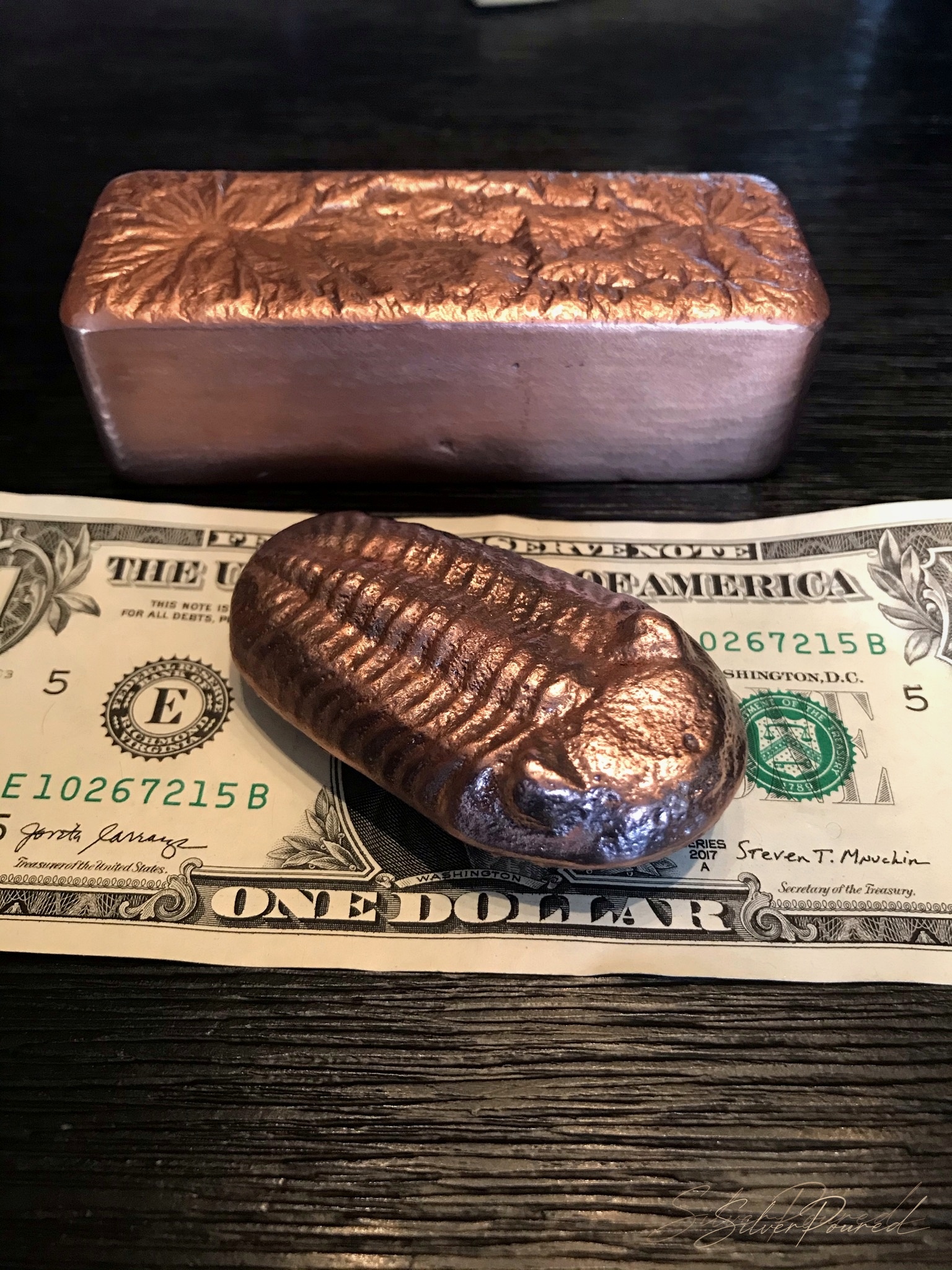
The result should not be confused with an official coin. A poured copper bar can carry a design, weight, purity mark, serial number, maker stamp, or decorative impression, but none of those features turns it into legal-tender coinage unless it was issued by a government with monetary authority.
Why Copper Behaves Differently During a Pour
One reason hand poured copper develops so much character is that copper is demanding to pour. Its melting point is just under 2,000°F, which means the crucible, furnace, mold, surrounding work area, and protective equipment are operating around extreme heat.
Temperature affects fluidity. If molten copper loses too much heat before or during the transfer, it may not flow through a detailed mold as expected. If the mold has thin channels, sharp corners, deep relief, or large changes in cross section, metal flow becomes even more important. A simple rectangular ingot mold is generally more forgiving than an intricate artistic mold.
Copper also conducts heat extremely well. That is one reason it is used throughout electrical and thermal applications, but during hand pouring it means heat moves rapidly through both the metal and anything touching it. A newly cast piece may look solid long before it is remotely safe to handle.
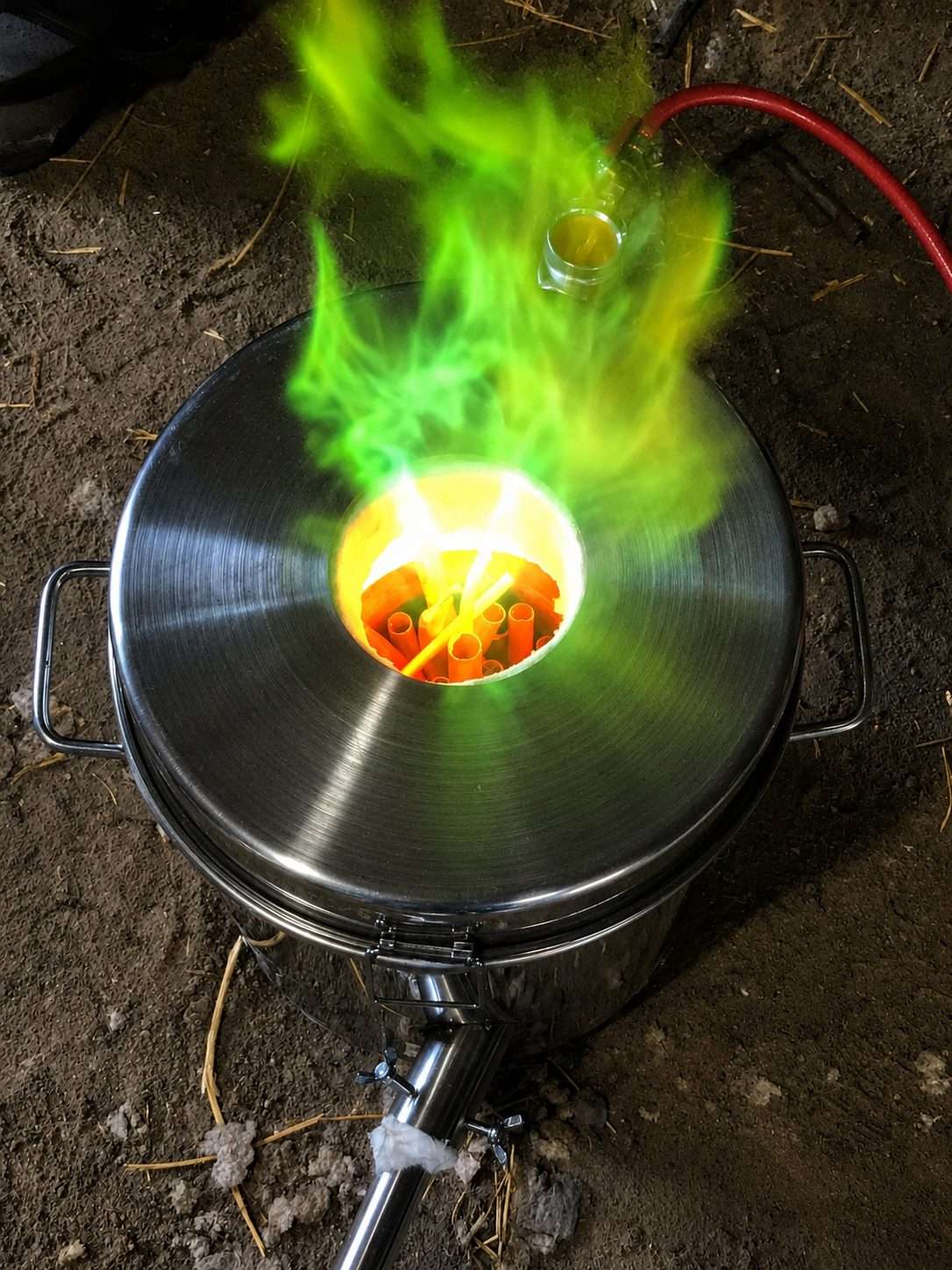
The photograph above comes from the furnace used during Poured In USA copper production. It is a useful reminder that the polished bar at the end of the process begins as material exposed to temperatures approaching 2,000°F. The attractive surface comes later. Heat control comes first.
A heavy copper bar can remain dangerously hot long after the visible glow is gone. Copper’s high thermal conductivity moves heat efficiently through the entire casting, while a thick pour stores far more heat than a thin decorative piece. Visual appearance is therefore a poor test of temperature. In practical hand poured copper work, cooling time is part of the production process—not dead time between the pour and finishing.

From Copper Feedstock to a Finished Bar
The basic idea behind hand poured copper sounds simple: obtain copper, melt it, pour it into a mold, let it cool, and finish the piece. The actual quality of the result depends on nearly every decision inside that sentence.
Copper Selection and Purity
The starting material matters. Copper tubing, wire, bus bar, sheet, shot, grain, or other known copper stock may all be usable depending on the equipment and intended product. What should never be assumed is purity. Material that looks like copper may be plated, alloyed, coated, soldered, painted, contaminated, or attached to other metals.
This becomes especially important when a finished hand poured copper bar is stamped “.999.” A purity mark is a representation about composition. The appearance of the bar cannot prove that representation by itself. Buyers should distinguish between known-source fine copper and miscellaneous scrap whose exact composition has not been verified.
Preparing the Charge
Pieces have to fit safely into the crucible and melt efficiently. Large, awkward scraps may create voids that reduce the amount of material that can initially be loaded. Additional metal can be introduced only through a process appropriate for the furnace and operator. Contaminants should not simply be accepted because they may burn away; unknown coatings and residues can create serious hazards when heated.
Melting the Copper
Once the furnace has brought the charge above copper’s melting point, the solid pieces become a molten pool. Successful melting is not merely about reaching a number on a thermometer. The metal needs enough usable heat to survive removal from the furnace, movement to the mold, and the pour itself.
This is where hand poured copper becomes highly dependent on equipment, batch size, weather, mold material, mold temperature, distance between furnace and mold, and operator technique. A process that works perfectly for a small bar may need adjustment for a much heavier casting.
The Pour
The pour is quick compared with the preparation. Molten copper leaves the crucible and enters the mold under gravity. The pourer is managing flow rate, crucible position, mold opening, metal volume, and the shrinking window before the metal begins freezing.
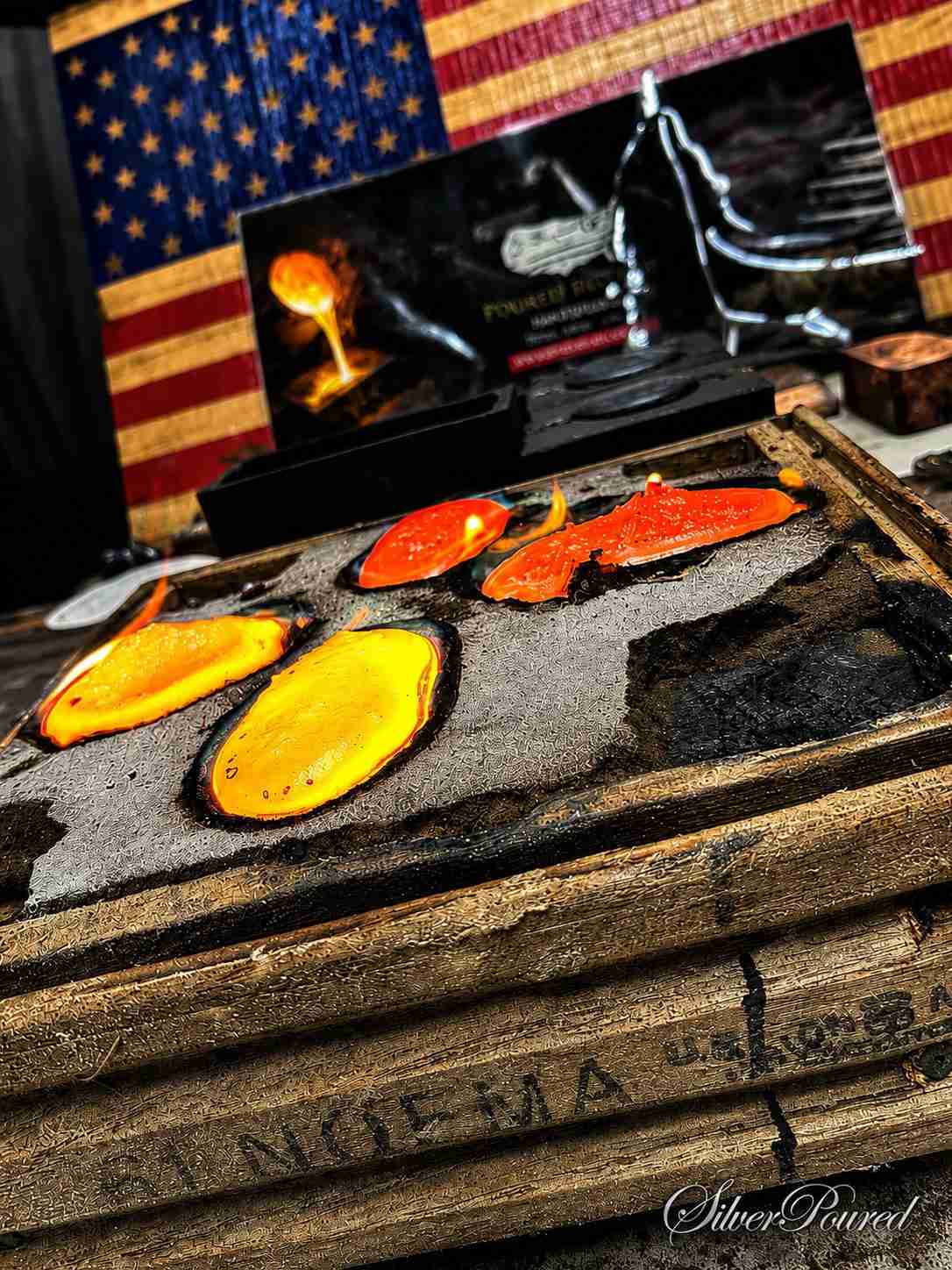
Sand casting can capture forms that a simple open ingot mold cannot, but it adds another variable: the mold itself becomes part of the surface. Grain size, compaction, pattern design, channels, vents, and the path the copper takes through the mold can influence the finished casting.
Molds Shape More Than the Outline
When people first look at hand poured copper, they tend to focus on the design cut into the mold. The mold influences much more than the outline. It can affect texture, edge shape, relief, cooling rate, and how molten copper fills the piece.
An open graphite ingot mold may create a relatively clean-sided bar with a characteristic exposed top surface. A cast-iron mold can produce a different texture and heat-transfer behavior. Sand molds allow shapes and relief that would be difficult to create in a basic ingot mold, but the sand surface itself may transfer texture to the copper.
The more complicated the design, the more the metal has to do before it freezes. Thin extensions, lettering, deep recesses, narrow channels, and abrupt changes in thickness may not fill exactly the same way on every pour. That is part of why complex hand poured copper pieces can vary even when the same pattern is used repeatedly.
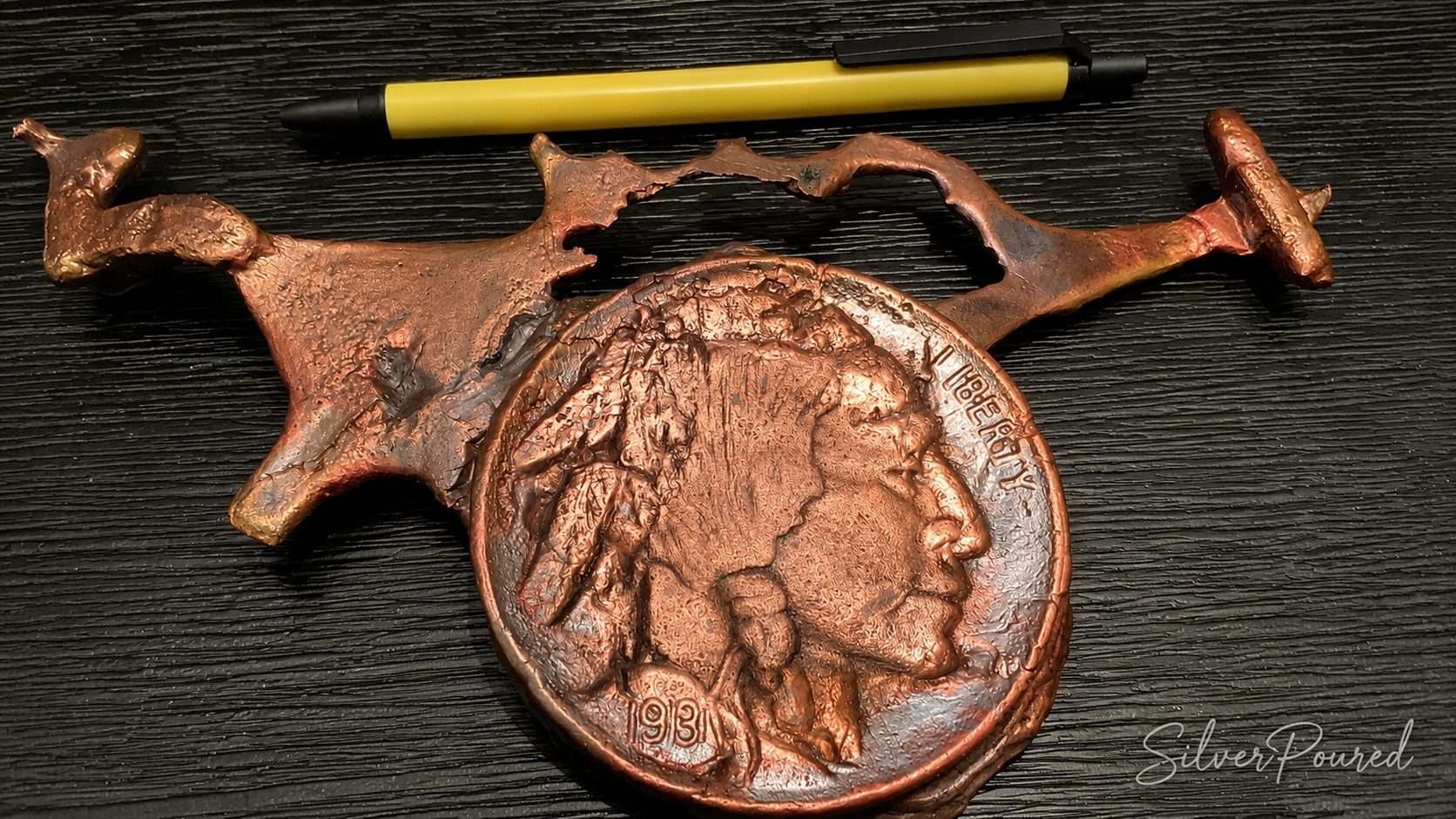
This Buffalo Nickel-inspired casting shows a useful example. The excess copper around the intended shape records where metal traveled beyond the final display area. Those runs can later be cut, ground, or otherwise finished away, or in some artistic pieces partially preserved to emphasize the casting process.
The mold does not merely give hand poured copper its shape. It helps write the surface history of the piece. Sand can leave grain, open molds can produce dramatic exposed cooling surfaces, and complex cavities can create runs or incomplete fills. Collectors who understand the mold can often understand why a poured piece looks the way it does—and why an unusual surface feature is not automatically damage.
Why Every Hand Poured Copper Bar Looks Different
The word “imperfection” can be misleading when discussing poured metal. Some defects truly are undesirable. A structurally incomplete casting, severe contamination, incorrect weight, false purity marking, or damage after manufacture should not be romanticized. But many irregularities in hand poured copper are simply evidence of casting.
Cooling contraction can create depressions. Gas can contribute to pits or voids. Flow can leave lines or ridges. The top of an open-poured bar can freeze from the edges inward and develop textures quite different from the sides that touched the mold. Small changes in temperature or pour speed may change the pattern again on the next bar.
That is why two nominally identical 10-ounce hand poured copper bars may have noticeably different tops, edge profiles, or coloration. Their copper content may be the same while their surfaces remain individually recognizable.
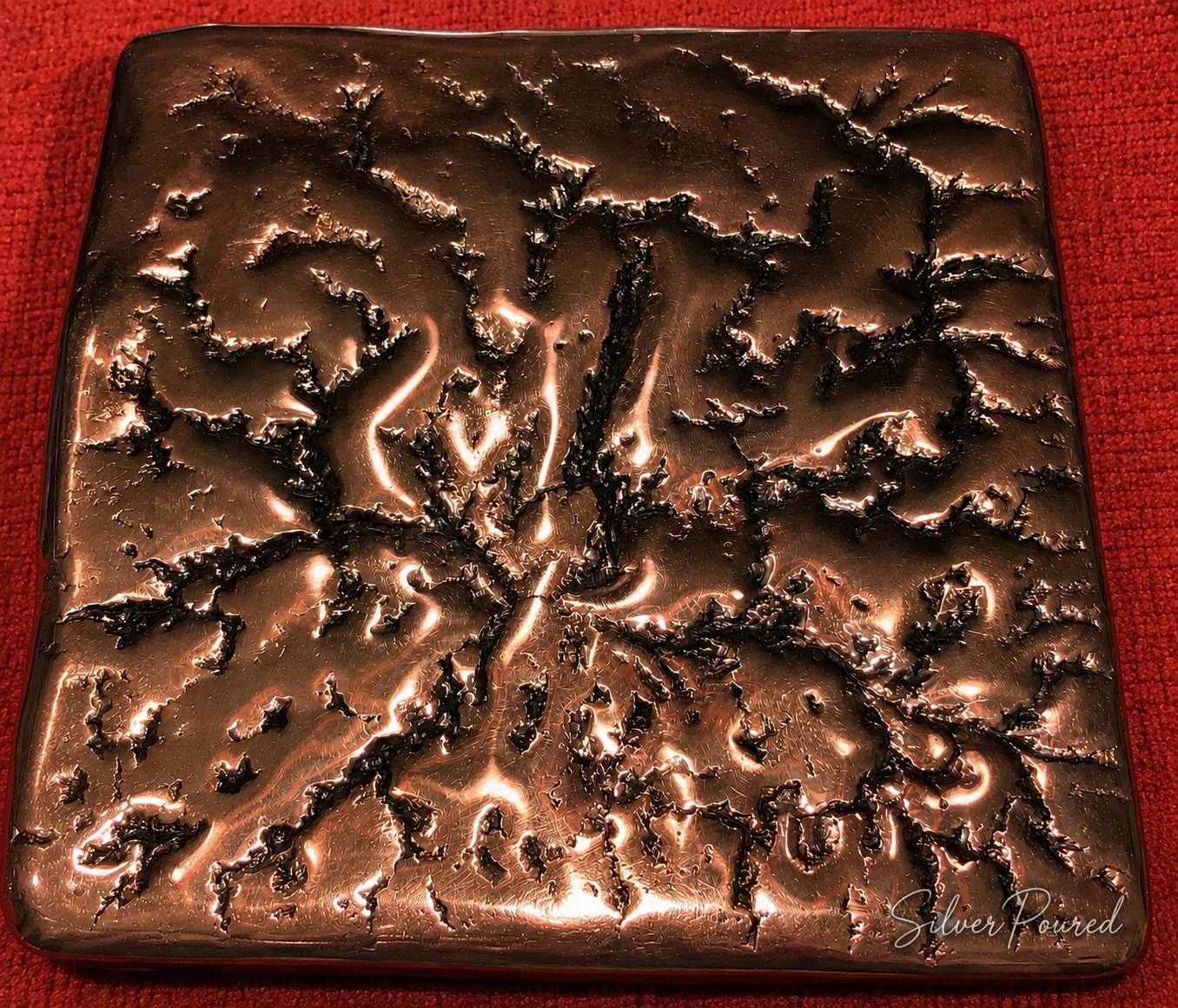
The 5.2-pound bar above is one of our favorite examples because nobody designed a heart into its mold. The heart-like depression appeared naturally in the cooling surface. It is not proof of anything mystical, and it does not change the amount of copper in the bar. It simply shows how memorable a naturally formed surface feature can become when the object is hand poured rather than manufactured to eliminate variation.
Cooling, Shrinkage, Pits, Ripples and Pour Lines
Molten copper occupies a different physical state from solid copper. As the casting freezes and cools, the metal contracts. The geometry of the mold determines where metal remains hottest longest and where the solidification front progresses first.
On a thick open-poured bar, the exterior can solidify while the center remains much hotter. Continued contraction can pull the upper surface inward and contribute to a depression. On another pour, the surface may show waves or rings where the liquid metal moved while freezing.
Small pits can have several causes and should not all be interpreted identically. Mold conditions, gas, contamination, turbulence, and finishing can influence the final surface. A collector evaluating hand poured copper should look at the entire piece rather than assuming every pit is a manufacturing error or every rough surface is desirable.
Consistency matters most where the seller makes an objective claim. If a bar is sold as 10 troy ounces, the weight needs to support that representation. If it is marked .999, the stated purity matters. Surface character is subjective; weight and composition are not.
Weight: Ounces, Troy Ounces and Pounds
Copper bars can create confusion because sellers may use ordinary ounces, avoirdupois pounds, or troy ounces depending on the product. Precious metals such as silver and gold are commonly quoted in troy ounces. Copper, however, is also an industrial commodity and is frequently discussed in pounds.
| Unit | Equivalent | Why It Matters |
|---|---|---|
| 1 avoirdupois ounce | 28.3495 grams | Standard everyday U.S. ounce |
| 1 troy ounce | 31.1035 grams | Traditional precious-metals unit |
| 1 avoirdupois pound | 16 avoirdupois ounces / 453.592 grams | Common way industrial copper is quoted |
| 1 troy pound | 12 troy ounces / 373.242 grams | Less commonly encountered by retail copper buyers |
A bar labeled simply “1 oz” should therefore be understood in context. Reputable hand poured copper listings should make the unit clear, especially when the bar is marketed alongside silver or gold products where buyers may instinctively assume troy weight.
Heavy copper pieces can also surprise people physically. Copper’s density is close to 9 grams per cubic centimeter, so a thick bar carries considerable weight in a relatively compact footprint. That substantial feel is one reason large poured copper bars can be satisfying display pieces.
A one-ounce label does not always mean the same ounce. Troy ounces are heavier than standard avoirdupois ounces, while an avoirdupois pound contains 16 standard ounces. With hand poured copper, always read the stated unit rather than assuming it. The difference may look small on one piece, but it becomes substantial when comparing larger bars or calculating price per unit of copper.
What Does .999 Fine Copper Mean?
When a hand poured copper bar is represented as .999 fine copper, the mark means the producer is claiming copper purity of at least 99.9 percent. The mark does not mean the bar is 99.9 percent of some theoretical investment grade; it is a compositional statement.
For buyers, the important question is what supports the claim. Established manufacturers may have controlled feedstock and documented production. Small pourers may use known commercial copper stock. A bar produced from random mixed scrap is a different situation unless its composition has been verified.
Copper alloys can still look strongly copper-colored. Brass contains copper and zinc. Bronze traditionally combines copper with tin, although modern bronze families vary. Other copper alloys incorporate nickel, aluminum, silicon, or additional elements. Visual appearance alone is not a reliable purity test.
This distinction matters because collector premiums are often much larger than the underlying copper value. When someone pays a premium for hand poured copper, the weight, purity representation, maker, design, and craftsmanship all become part of the transaction.
Finishing a Poured Copper Bar
The moment copper leaves the mold is not necessarily the end of production. Many hand poured copper pieces go through cleaning and finishing steps before they are ready for sale or display.
Excess metal may need to be removed from a casting. Sharp edges can be dressed. Sand residue may need to be cleaned from detailed pieces. A bar can be wire-brushed to brighten its surface, mechanically polished to a stronger shine, stamped with weight and purity information, or intentionally left largely untouched.
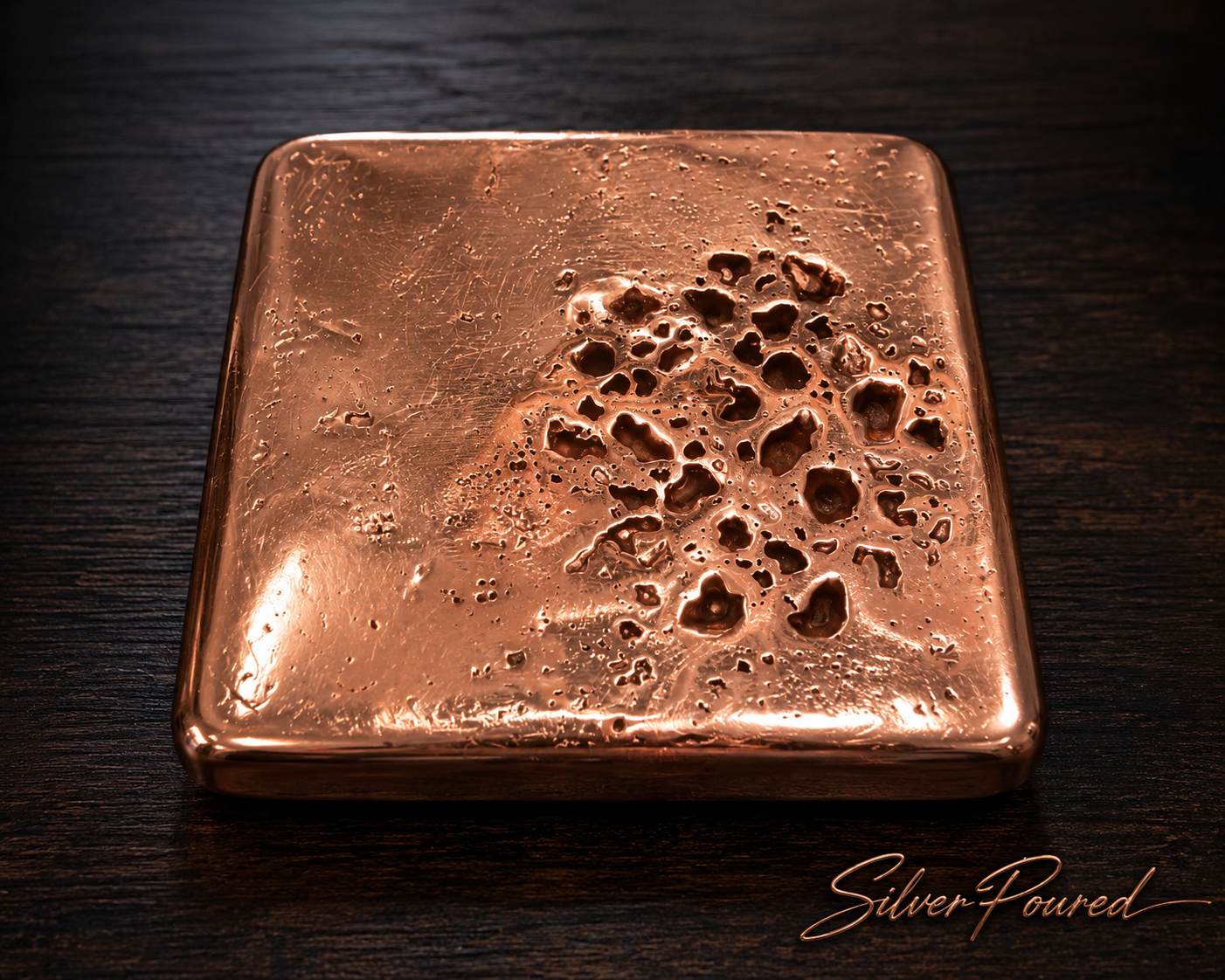
Polishing changes the visual presentation dramatically. Freshly polished copper can become bright and mirror-like, revealing red, orange, and golden tones that may not be obvious on an oxidized casting. It also creates a surface that will show fingerprints and environmental change more readily.
Some collectors prefer a bright finish. Others specifically want the natural as-poured skin, furnace coloration, or developing patina. There is no universal “best” finish for hand poured copper because the correct choice depends on what the piece is meant to be.
Why Copper Changes Color
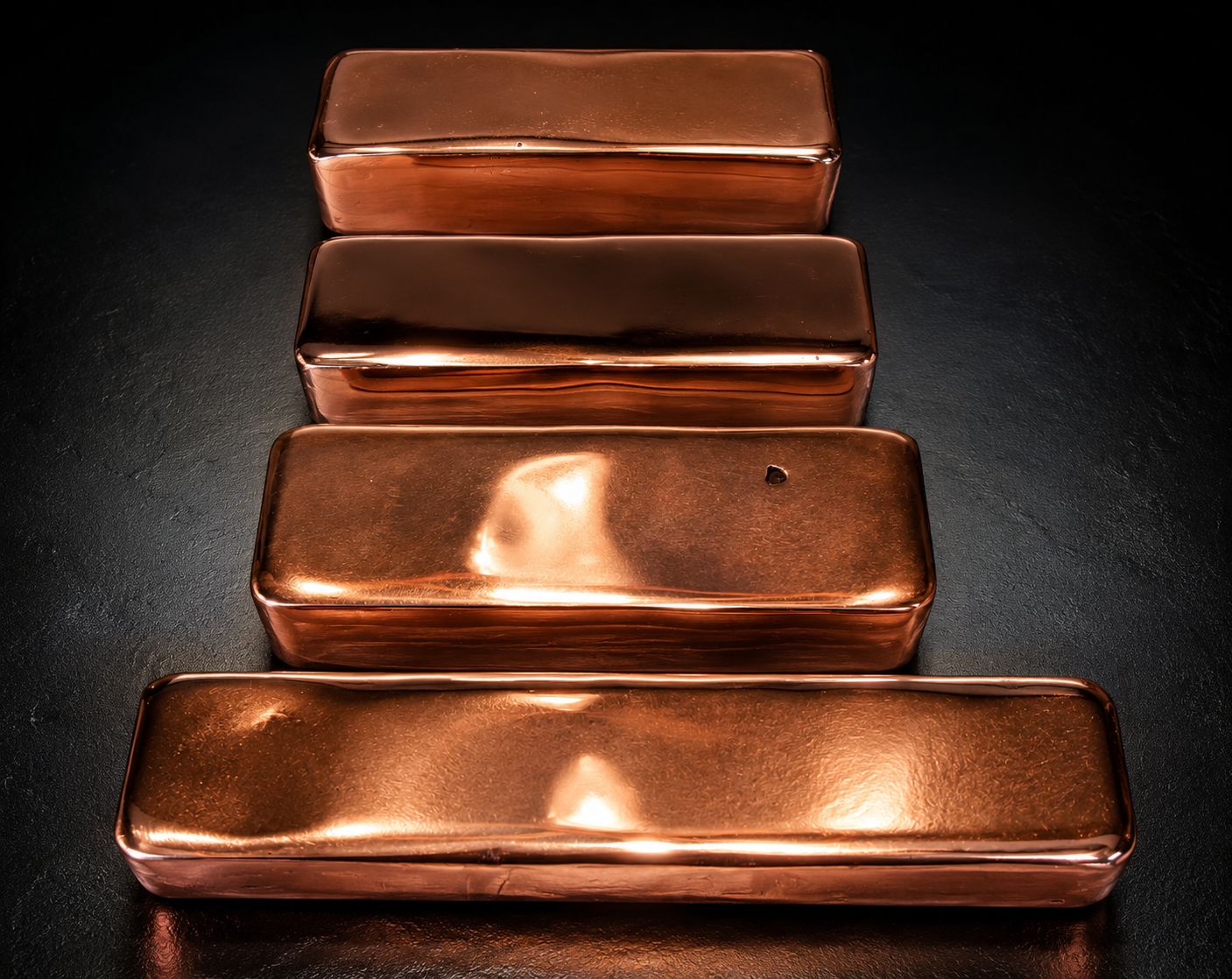
Copper is famous for changing appearance. A newly polished surface can begin bright and reddish, then gradually darken as it reacts with its environment. Depending on exposure conditions, copper may progress through brown tones and eventually develop green or blue-green corrosion products associated with long-term patina.
That change is not unique to hand poured copper. It is part of copper chemistry. The difference is that the irregular texture of a poured surface can make toning look especially dramatic because raised areas, recesses, pits, polish marks, and untouched cast skin may age differently.
Fingerprints can also matter. Skin oils and salts remain on the surface and may create uneven coloration. A collector who wants a bright copper bar to remain as uniform as possible should handle it carefully, preferably by the edges or with clean gloves. A collector who enjoys natural patina may be far less concerned.
Cleaning is a personal decision, but aggressive polishing can permanently alter a collectible surface. That matters more when the value of the piece depends on original finish, maker characteristics, or provenance rather than simply the copper weight.
Is Toning or Patina Damage?
Not automatically. Natural oxidation is expected on exposed copper. Whether a particular collector likes the appearance is subjective.
A uniformly darkened vintage bar may be more desirable to one collector than the same piece polished bright. Another buyer may strongly prefer new-looking copper. Neither preference changes the underlying metal, but it can affect collector demand.
True physical damage is a different question. Deep scratches, dents from dropping, destructive cleaning, corrosion caused by inappropriate storage, altered stamps, or removed material can affect a collectible hand poured copper piece in ways that ordinary toning does not.
Bright copper is only one stage in the life of the surface. Natural oxidation can create brown, red, violet, blue, and eventually greenish tones depending on conditions. With collectible hand poured copper, an older original surface can be part of the piece’s history. Before polishing a scarce or maker-identified bar, consider whether removing that history might reduce the very character a collector values.
What Gives Hand Poured Copper Value?
The first layer of value is the copper itself. A known-weight bar contains measurable copper, and the commodity price provides a raw-metal reference. That is only the beginning for most retail hand poured copper pieces.
Unlike an industrial copper contract or bulk scrap transaction, a small-batch bar has fabrication costs. Someone sourced the material, melted it, supplied fuel, maintained equipment, prepared a mold, performed the pour, cleaned or finished the piece, stamped or marked it, photographed it, packaged it, and brought it to market.
That means the retail price of hand poured copper can sit far above the calculated metal value. The premium may be modest for a simple mass-produced copper bar and substantial for a low-production artistic casting from a recognized maker.
| Value Factor | Potential Effect |
|---|---|
| Copper Weight | Establishes the underlying physical metal content |
| Purity | Known .999 fine copper generally gives buyers greater confidence than unidentified material |
| Maker | Established or collectible makers can command stronger secondary-market demand |
| Mintage / Production | Low production can increase scarcity but does not guarantee demand |
| Design | Distinctive themes and successful artistic work can create collector interest |
| Surface Character | Exceptional pour lines, cooling patterns, mold texture, or toning may distinguish a piece |
| Serial Number | Can improve identification and appeal when part of an established series |
| Provenance | Original packaging, maker records, documented history, or known ownership may strengthen collector interest |
| Condition | Damage or destructive alteration can reduce collector value |
Copper Spot Price vs. the Price of a Poured Bar
One of the biggest mistakes a new buyer can make is comparing the retail price of a hand poured copper bar directly with a commodity copper quote and assuming the difference is automatically unreasonable.
Commodity pricing usually describes copper in a completely different market context: large quantities, standardized forms, wholesale participants, futures contracts, industrial supply, or scrap channels. A one-pound artistic bar shipped to a retail collector is not that market.
At the same time, a premium should not become invisible simply because a product is collectible. Buyers can calculate the approximate raw copper value, compare similar products, understand the premium they are paying, and decide whether the craftsmanship or collectibility justifies it.
That is the healthiest way to evaluate hand poured copper: separate the metal component from the collector component. If copper rises, the underlying metal value rises. If collector demand for a particular maker rises, the premium may increase independently. The two value components can move together—or not.
Hand Poured Copper as Bullion vs. Collectible Copper
The word “bullion” can make people think every copper bar should trade like a silver round. Copper occupies a different retail market. Because the metal value per ounce is much lower than silver or gold, manufacturing and shipping represent a much larger percentage of the final retail price.
A simple copper bar may be purchased mainly because someone wants physical copper. Another hand poured copper piece may be bought because of its design, rarity, maker, finish, or connection to a collection. In the second case, copper content is only one reason the buyer wants it.
This is also why the term “stacking” means something slightly different with copper. Stacking copper purely for metal exposure requires a buyer to pay close attention to acquisition premium and storage weight. Collecting hand poured copper allows the premium itself to be part of the objective because the buyer values the object, not just the commodity inside it.
What Makes a Poured Copper Bar Collectible?
Collectibility is ultimately created by people. A scarce bar nobody wants is merely scarce. A bar becomes collectible when enough people value its characteristics to seek it out.
Recognizable makers matter because collectors can build sets around a body of work. Serial-numbered series create another collecting structure. Limited designs can generate demand from people who want a complete run. Retired makers or discontinued molds can turn ordinary past production into material that becomes difficult to replace.
Unusual pour characteristics can matter too. A dramatic cooling swirl, a naturally shaped depression, exceptionally deep mold texture, or striking toning can make one bar stand out from otherwise similar pieces. This is where hand poured copper behaves more like art than standardized bullion.
Provenance becomes increasingly useful as pieces age. Who made the bar? When? Was it part of a numbered series? Does the original certificate, packaging, listing, photograph, or maker documentation survive? Those details help future collectors distinguish an identifiable piece from an anonymous chunk of copper.
How to Evaluate a Hand Poured Copper Bar Before Buying
Start with the objective claims. Identify the stated weight, unit of weight, purity, maker, and dimensions if available. If the piece is serialized or advertised as limited production, understand whether the number refers to an individual serial number, a production maximum, or simply a mold designation.
Then evaluate the premium. Compare the selling price with approximate copper content and with comparable poured products. A high premium is not necessarily wrong, but buyers should know they are paying it.
Next look at the surface. Decide whether the roughness, pits, toning, polishing, or cast texture are attractive to you. With hand poured copper there is no reason to buy a surface you dislike simply because someone describes every irregularity as “unique.” Unique does not automatically mean desirable.
Finally, consider liquidity. Generic copper bars may have broad but price-sensitive resale demand. Niche art pours may sell exceptionally well to the right collector and slowly to everyone else. A recognized maker can help, but no premium is guaranteed to survive resale.
Storing and Handling Hand Poured Copper
Copper is physically durable, but the surface is chemically active enough that storage conditions affect appearance. Moisture, salts, fingerprints, sulfur-containing materials, chemicals, and prolonged exposure to uncontrolled environments can change color or encourage corrosion.
If the goal is to preserve a bright finish, keep the piece dry, minimize bare-hand contact, and use storage materials intended for long-term collectible use. Avoid improvised materials that may release chemicals as they age.
If natural patina is welcome, the storage approach can be less appearance-sensitive, but the bar should still be protected from damaging moisture and corrosive contamination. “Let it tone” is not the same thing as “store it carelessly.”
Heavy hand poured copper also deserves practical handling respect. A five-pound bar can damage another collectible—or a foot—if it falls. Large pieces should be displayed on stable surfaces capable of supporting the weight.
Can You Pour Copper at Home?
People do melt and pour copper in home and small-shop environments, but this is not a beginner craft simply because small furnaces are commercially available. Copper’s melting temperature creates severe burn, fire, equipment, and material-handling hazards.
Moisture is especially dangerous around molten metal because water can rapidly convert to steam. Unknown scrap can contain coatings, solder, oils, plastics, zinc-bearing alloys, or other contaminants that behave badly under high heat. Appropriate crucibles, tools, protective equipment, workspace design, fire controls, and ventilation are not optional details.
Airborne exposure also deserves attention. OSHA lists occupational exposure limits for copper dusts and mists, while NIOSH separately addresses copper fume exposure. NIOSH notes that copper fume can cause respiratory irritation, metallic taste, nausea, and metal fume fever. Anyone doing metalwork should understand the hazards created by the exact materials and processes being used rather than assuming “it is only copper.”
For authoritative workplace information, review the OSHA copper chemical data and applicable local fire, ventilation, and occupational requirements. This page explains hand poured copper; it is not a substitute for hands-on foundry training or a site-specific safety plan.
The video above shows real Poured In USA copper work rather than a staged demonstration. That distinction matters. Molten copper moves quickly, tools become hot, and a process that looks straightforward in a finished photograph involves far more control than the photograph can show.
Recycled Copper and Hand Pouring
Copper can be recycled repeatedly, which makes scrap an obvious source of interest for small pourers. Recycling generally reduces demand for newly extracted raw materials, and the U.S. Environmental Protection Agency identifies conservation of natural resources and energy among the broad benefits of recycling.
But “recycled” and “.999 fine” are not synonyms. Clean known copper can remain high purity, while mixed scrap can contain alloys, solder, coatings, fasteners, or other metals. A hand poured copper producer using recycled feedstock should know what is going into the crucible before making a purity claim about what comes out.
That is another reason provenance begins before the pour. Knowing the source material can matter just as much as knowing which mold made the bar.
Why Hand Poured Copper Fits the Poured In USA Story
Poured In USA did not begin with an elaborate precious-metals business plan. It began with copper tubing, a furnace, safety equipment, and the simple question of what we could make.
We poured more than 1,000 ounces. Some pours came out beautifully. Some taught lessons. Some pieces were polished. Others retained obvious casting texture. One heavy bar made for Mom cooled with a heart-shaped impression that nobody planned.
That experience is why this page does not describe hand poured copper as if every irregular surface is automatically a masterpiece. Pouring teaches you quickly that some variation is character, some variation requires finishing, and sometimes a pour simply does not come out the way you wanted.
That is also what makes the successful pieces satisfying. The maker controls the metal, temperature, mold, pour, and finish—but never every microscopic detail of solidification. There is still a point where the copper gets a vote.
Frequently Asked Questions About Hand Poured Copper
Is hand poured copper real bullion?
It can be described as copper bullion when the primary product is a known-weight, known-purity physical copper bar or round, but the term does not make it equivalent to exchange-traded industrial copper. Many hand poured copper pieces combine bullion content with craftsmanship and collector value.
Is .999 copper pure copper?
.999 fine copper represents 99.9 percent copper purity. That is very high purity, although it is not mathematically 100 percent. Buyers should rely on credible sourcing or testing rather than color alone when purity matters.
Why does hand poured copper have pits?
Pits can form from several parts of the casting process, including gas, mold conditions, turbulence, contaminants, and solidification behavior. Some small pits are normal surface character. Severe porosity or an incomplete casting may indicate a less successful pour.
Why is there a dip in the top of my copper bar?
A depression can develop as the copper solidifies and contracts, particularly in a thick open-poured bar. The outer metal may freeze before the hottest central region finishes cooling, producing visible shrinkage at the exposed surface.
Why does copper turn brown?
Exposed copper reacts with oxygen and other substances in its environment. A bright freshly polished surface therefore tends to darken with time. Moisture, handling, contaminants, and storage conditions influence the rate and appearance of that change.
Should I polish a hand poured copper bar?
That depends on the piece. Polishing a common personal bar may create the appearance you want. Polishing a scarce vintage or maker-collectible bar can remove original surface character and potentially reduce collector appeal. Know what you own before changing it permanently.
Is hand poured copper worth more than copper spot price?
Retail poured copper commonly sells above its underlying metal value because fabrication, equipment, labor, design, finishing, packaging, distribution, and collector demand add cost. The amount of premium varies enormously from basic bars to scarce art pours.
Does a low mintage guarantee a copper bar will increase in value?
No. Scarcity alone does not create collector demand. A low-production hand poured copper bar may become sought after if collectors value the maker or design, but an obscure piece can remain difficult to sell even if very few were made.
Are serialized copper bars more valuable?
A serial number can strengthen identification and set-building appeal, particularly when the maker documents production. It does not automatically create additional value. Demand for the series still matters.
Can recycled copper be .999 fine?
Yes, depending on the purity of the source material and processing, but “recycled” does not prove purity. Known clean copper and mixed unknown scrap are very different feedstocks. A .999 claim should be supported by the material or testing rather than assumed from appearance.
What is the best hand poured copper bar to collect?
There is no universal best bar. Some collectors prefer large heavy ingots, others pursue particular makers, limited series, serial numbers, unusual molds, dramatic pour lines, or naturally toned pieces. The best choice is one whose weight and purity you understand and whose collector premium makes sense to you.
The Bottom Line on Hand Poured Copper
Hand poured copper sits at an interesting intersection of metallurgy, bullion, craftsmanship, and collecting. At its simplest, it is copper melted and manually poured into a mold. At its best, the finished piece preserves enough of that process to become individually recognizable.
The copper itself remains measurable. Weight matters. Purity matters. The commodity value of the metal matters. But those measurements do not completely explain why one poured bar may sell for much more than another containing the same amount of copper.
Molds, makers, production size, finish, provenance, surface character, design, serial numbers, and collector demand can all contribute additional value. Understanding those layers helps buyers separate raw copper value from the premium they are choosing to pay.
For us, hand poured copper also represents where the larger Poured In USA story began: copper tubing, a furnace, a lot of heat, plenty of trial and error, and eventually more than 1,000 ounces poured into bars and other pieces.
Years later, the same idea still holds. Know the material. Respect the process. Understand what you are paying for. And when a pour develops a characteristic nobody planned—whether it is a ripple, a deep cooling line, an unusual mold texture, or a heart in the middle of a bar—sometimes the copper makes the piece its own.
Related SilverPoured Resources
Continue exploring how poured metals, bullion premiums, craftsmanship, scarcity, and collector demand affect physical-metal value. These SilverPoured resources expand on many of the same principles that apply to hand poured copper.
Hand-Poured & Collectible Metals
Best Hand Poured Silver Bars
Why Hand Poured Silver Costs More
Why Hand Poured Silver Is Collectible
What Makes Silver Bars Collectible
Vintage Silver Bars
Scarcity, Serialization & Collector Value
Serialized Silver Bars
Limited Mintage Silver
Why Rare Silver Bars Cost More
Why Limited Mintage Bullion Costs More
Why Serialized Bullion Costs More
Premiums, Pricing & Buying
Premium Over Spot Explained
Why Silver Premiums Change
Why Bullion Dealers Charge Premiums
Best Silver Dealers
Shop Copper
Purchase Precious Metals from a Trusted Dealer
Understanding hand poured copper makes it easier to separate raw metal value from fabrication cost, craftsmanship, scarcity, and collector premium. The same principle matters when comparing silver, gold, copper bullion, rounds, bars, and other physical precious-metal products.
When buying physical metals, compare stated weight and purity, product type, dealer reputation, current market pricing, and the premium above the underlying metal value. Traditional bullion can provide a useful baseline when deciding how much additional value you personally place on hand pouring, limited production, unusual designs, or collectible craftsmanship.
Collector Insight
The copper inside two bars may have essentially the same raw-metal value while the bars themselves sell for very different prices. With hand poured copper, the maker, mold, surface character, craftsmanship, production quantity, serial number, provenance, and collector demand can create value beyond copper content. That premium is not guaranteed to survive resale, which is why collectors should understand both the metal they are buying and the reason they are paying above its underlying copper value.
Keep SilverPoured Free
SilverPoured is built to help collectors and precious-metals investors make smarter decisions through free calculators, original photography, coin research, value references, collector education, and independent market resources. Every page is created to make valuable precious-metals information available without requiring a paid subscription.
This hand poured copper guide combines metallurgy, real-world pouring experience, original photography, collector education, and practical information about copper bars, purity, premiums, molds, finishing, value, and preservation. Every contribution helps support the continued expansion and maintenance of free SilverPoured research and educational resources.
Your support allows SilverPoured to remain independent while building one of the web’s most comprehensive free libraries for coin collectors, bullion buyers, precious-metals researchers, and long-term investors.